
7-minute read · By the Step Balance Research Team
Acupressure mats, also called spike mats or beds of nails, are covered in small plastic spikes that press into the skin when you lie or stand on them. Many people use them to unwind at the end of the day. But what does the research actually show? This guide looks at every trial we could find on spike mats, explains why the evidence is limited, and gives practical, safety-first advice on how to use one.
In 30 seconds
- The research is thin. Only a handful of small trials have studied spike mats, and none has tested our mats [1][2][3][4][5].
- The prickling fades. In a lab study, the sensation peaked within about 30 seconds and then eased [1].
- Relaxing is what helps. In a three-week study, students who relaxed on a mat improved just as much as students who relaxed without one [5].
- Mat studies are not acupressure studies. Research on pressing specific points is a different technique and has its own quality problems [6][7].
- Ask first if you are pregnant, take blood thinners, have a skin condition, diabetes, reduced sensation or a pacemaker [2][3][4], or a circulatory disorder.
What a spike mat is
A spike mat is a foam or fiber pad with a cover carrying thousands of small plastic spikes, usually arranged in rosettes. Your body weight spreads across all of them, so the pressure on each one is low. The idea comes from the traditional bed of nails, but a mat presses broadly on the skin rather than on specific acupressure points.
What the research shows
The first minutes
In a study of 32 healthy adults, the prickling sensation peaked within 30 seconds of lying down and then gradually faded. Self-rated relaxation rose in every condition, with or without the mat. On the mat, blood pressure was slightly higher, heart rate slower, and one measure of heart rate variability linked to rest was higher; saliva cortisol, a stress hormone, did not change [1].
Relaxation with or without a mat
The most useful study for everyday users compared healthy students who practiced relaxation for three weeks on a mat with students who practiced relaxation without any tools. Both groups reported less stress and better wellbeing, sleep quality and concentration, and there was no difference between the groups. Blood pressure and heart rate did not change [5]. The honest reading: taking time to lie down and relax is what helped.
Small pilot trials
Three small trials have tested mats in people with long-standing neck or back complaints. Two pilot studies reported lower pain ratings after two to three weeks of regular use compared with no treatment, but neither was blinded or compared the mat with a placebo [2][3]. A third trial added a mat to an exercise program for six months; the difference in pain between groups was not statistically significant, while one quality-of-life measure improved slightly more with the mat [4]. These are early, small studies, and we do not make health claims for our mats on the basis of them.
Why acupressure research is a different question
You may read that acupressure improves sleep or eases anxiety. Those findings come from studies of firm pressure applied by a person to specific points, not from mats. A meta-analysis of such studies found better sleep-quality scores than sham treatment [6], and another found lower anxiety before medical procedures [7], but both reviews noted a high risk of bias because most trials were not blinded. The results cannot simply be transferred to lying on a spike mat.

How to use a mat
- Start with a layer. Lie down wearing a thin T-shirt for the first sessions, then try bare skin if you wish.
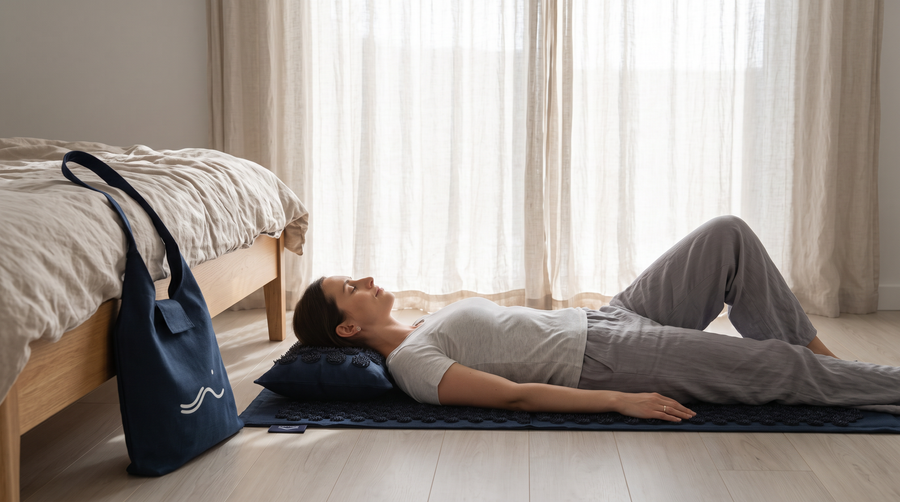
- Lower yourself slowly so your weight spreads evenly, and use the neck rest or a pillow for your head.
- Expect the first minute to prickle. The sensation usually eases within a few minutes [1][3].
- Keep it short at first: 5 to 10 minutes. The trials used sessions of 15 to 30 minutes on most days [2][3].
- Get up by rolling onto your side rather than sliding off, which can scratch the skin.
- Try your feet. Sitting or standing with your feet on the mat is a gentler way in.
Faint red marks after a session are normal and fade. Stop if the skin is broken, if you feel sharp pain, or if you feel unwell.
Who should ask a professional first
There is no independent clinical guideline on spike mats, so we follow the conditions that the trials excluded [2][3][4]. Ask a healthcare professional before using a mat if you are pregnant or breastfeeding, take blood-thinning medication or have a bleeding disorder, have a skin condition, wound or irritation where the mat would touch, have diabetes or reduced sensation, or have a pacemaker. Our own product instructions add one more: ask first if you have a circulatory disorder.
Our mats
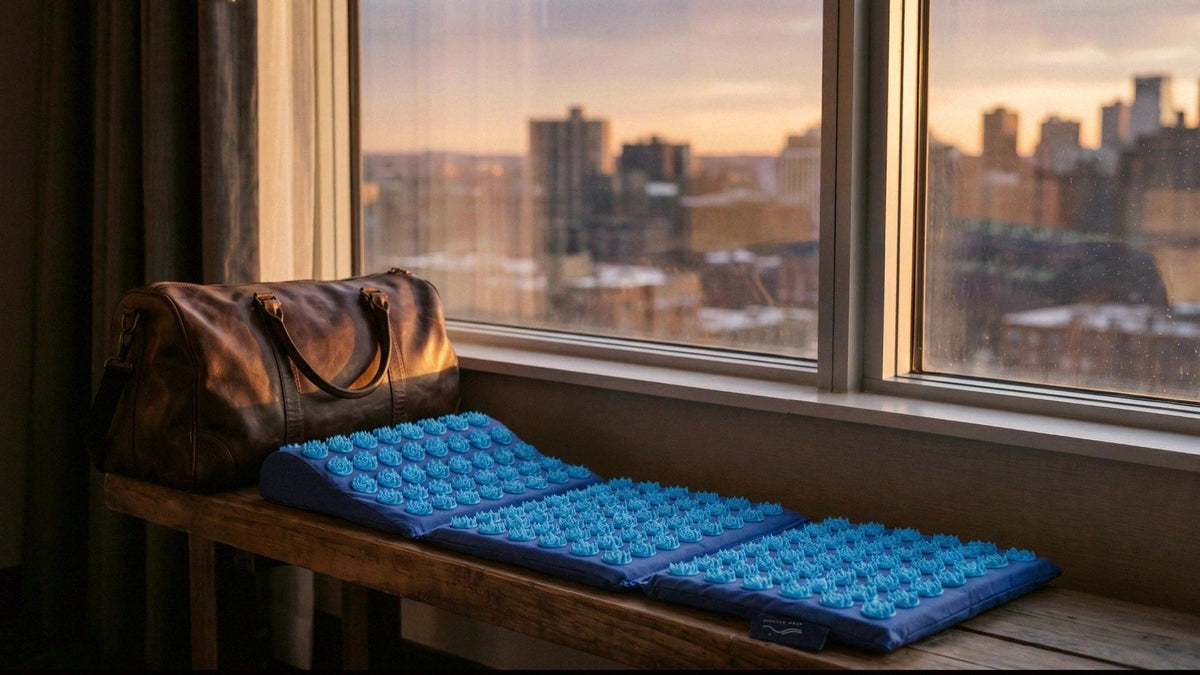
The AcuNomad has 5,400 ABS spikes in swirl-pattern rosettes, opens to 73 × 46 cm with a 5 cm contour for the neck, and folds into three zip-connected sections of 25 × 46 cm. It has a cotton cover over a high-density foam core and weighs about 700 g, so it travels well. The AcuEarth set pairs a 75 × 44 cm mat (5,250 spikes) with a 40 × 30 cm pillow (1,475 spikes) and a tote bag. Its covers are a linen and cotton blend, with coconut fiber in the mat and buckwheat hulls in the pillow, which shape themselves to you. Neither is a medical device, and we offer them as tools for a few quiet minutes, not as a treatment.

Frequently asked questions
Does it hurt?
The first seconds feel prickly, and most people find the sensation eases within a few minutes [1]. It should never be sharply painful.
How long should I lie on it?
Start with 5 to 10 minutes. If you enjoy it, build up gradually; the studies used 15 to 30 minutes [2][3].
Can I fall asleep on it?
We suggest not. Use the mat for a set time, then get up by rolling onto your side.
Is it the same as acupuncture or acupressure?
No. A mat presses broadly on the skin; acupressure applies firm pressure to specific points, and acupuncture uses needles. The research on those techniques does not transfer to mats [6][7].
Sources
- Olsson EMG, von Schéele B. Relaxing on a bed of nails: an exploratory study of the effects on the autonomic, cardiovascular, and respiratory systems, and saliva cortisol. Journal of Alternative and Complementary Medicine. 2011;17(1):5-12. doi:10.1089/acm.2010.0135
- Kjellgren A, Erdefelt K, Werngren L, Norlander T. Does relaxation on a bed of nails (spike mat) induce beneficial effects? A randomized controlled pilot study. Alternative Medicine Studies. 2011;1(1):e5. doi:10.4081/ams.2011.e5
- Hohmann C, Ullrich I, Lauche R, et al. The benefit of a mechanical needle stimulation pad in patients with chronic neck and lower back pain: two randomized controlled pilot studies. Evidence-Based Complementary and Alternative Medicine. 2012;2012:753583. doi:10.1155/2012/753583
- Frizziero A, Finotti P, La Scala C, Morone G, Piran G, Masiero S. Efficacy of an acupressure mat in association with therapeutic exercise in the management of chronic low back pain: a prospective randomized controlled study. Applied Sciences. 2021;11(11):5211. doi:10.3390/app11115211
- Kisker J, Schöne B. Regular use of acupressure mats reduces perceived stress at subjective but not psychophysiological levels: insights from a three-week relaxation training. Applied Psychology: Health and Well-Being. 2024;16(1):338-355. doi:10.1111/aphw.12490
- Waits A, Tang YR, Cheng HM, Tai CJ, Chien LY. Acupressure effect on sleep quality: a systematic review and meta-analysis. Sleep Medicine Reviews. 2018;37:24-34. doi:10.1016/j.smrv.2016.12.004
- Au DWH, Tsang HWH, Ling PPM, Leung CHT, Ip PK, Cheung WM. Effects of acupressure on anxiety: a systematic review and meta-analysis. Acupuncture in Medicine. 2015;33(5):353-359. doi:10.1136/acupmed-2014-010720
About this guide. Prepared by the Step Balance Research Team, the in-house product and research group behind our insoles, compression supports and recovery tools, designed in Spain. Product details come from our own specifications; statements about acupressure mats and relaxation come from the studies and health-service sources listed above. This guide is for information only and does not replace advice from a healthcare professional.
 MuscleGlide™ Wooden Recovery Stick
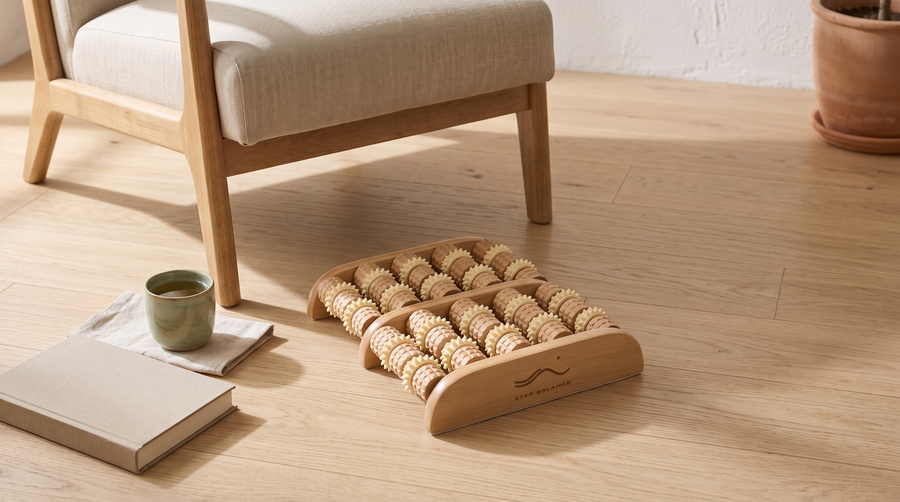
 ReflexRoll™ Wooden Foot Massager
 AcuNomad™ Foldable Acupressure Mat
 AcuEarth™ Acupressure Set