
9-minute read · By the Step Balance Research Team
Most people choose insoles by a single word: “cushioning”. But the right insole depends mostly on three things: the shoe it will live in, what your day looks like, and how it feels when you walk. This guide sums up what the research says, without miracle promises, and ends with a simple way to decide.
In 30 seconds
- Start with the shoe. Interior space decides: a dress shoe or a soccer cleat needs a thin insole; a sneaker or a work shoe can take more thickness and cushioning.
- Think about your day. Long hours standing, lots of walking or impact sport each call for something different.
- Trust your comfort. Research suggests that perceived comfort is a good filter for choosing footwear and inserts [1, 2].
- Give it time. Build up wear gradually, roughly one extra hour per day [9].
- See a professional if you have pain that is not improving, tingling, or diabetes [8].

Why comfort matters more than you think
For decades, choosing footwear was about controlling impact or pronation. A review in the British Journal of Sports Medicine concluded that neither variable has been shown to conclusively predict injury, and proposed another approach: people intuitively choose what feels comfortable, and that comfort keeps them in their natural movement pattern [1].
It is not only a subjective feeling. In a study of runners, differences in comfort between inserts were linked to measurable changes in how they moved and in muscle activity [2]. The practical takeaway: test an insole by walking in it, not by pressing it with your thumb.
Step 1. Start with the shoe, not the foot
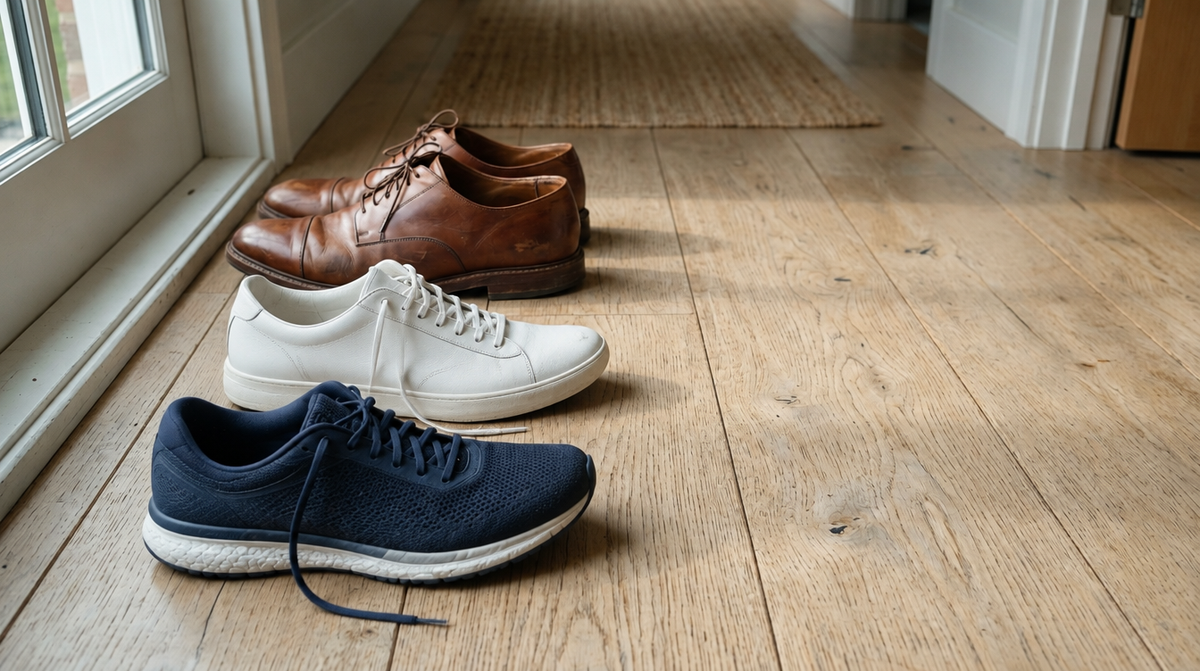
The most common mistake is buying a thick insole for a shoe that has no room for it. If the inside is already snug, the insole lifts your heel, squeezes your toes and the shoe stops holding your foot properly. Think of your footwear in three groups:
- Low volume: dress shoes, loafers, ankle boots, soccer cleats and cycling shoes. They need a slim profile, around 3 mm.
- Medium volume: everyday sneakers and closed work shoes. They take 4 to 6 mm and more generous cushioning.
- Sports shoes with a removable insole: running, padel, gym or team sports. Here you normally replace the factory insole.
One simple rule: replace, don't stack. If your shoe has a removable insole, take it out and put the new one in its place. Lay the new insole on top of the old one to check that the size matches before you fit it. Sandals, mules and slip-on shoes are usually poor candidates for any insole, because they don't hold the foot [9].

Check the fit: the insole should lie flat with no wrinkles at the toe, your heel should sit in the heel cup and your toes should be able to move. The American Academy of Orthopaedic Surgeons advises trying shoes on at the end of the day, when feet are slightly swollen, and with the same type of sock you will wear [10].
Step 2. Think about your day
A 2025 systematic review of workers who stand for long hours describes the balance well: soft soles reduce impact and fatigue but offer limited support; firmer soles add stability but can create localized pressure. Most insoles improve pressure distribution by loading the arch, although a semi-rigid arch support can feel uncomfortable for some people [3].
| Your day | What usually matters | What to avoid |
|---|---|---|
| Long hours standing (retail, healthcare, hospitality) | Cushioning across the whole insole and a well-seated heel | Very thin insoles in roomy shoes |
| Lots of walking, city, travel | Cushioning, flexibility and a breathable top | Structures too rigid for the shoe |
| Impact sport and changes of direction | A stable base and cushioning at heel and forefoot | Soft insoles that deform when you turn |
| Formal shoes for hours | A slim profile with some heel cushioning | Any insole that forces you to change shoe size |
An honest note on cushioning. A meta-analysis of clinical trials found that shock-absorbing insoles on their own did not reduce injuries; foot orthoses were linked to fewer injuries overall and fewer stress fractures, although trial quality varied widely [4]. And in a trial of 848 runners, harder shoes were linked to more injuries, but the protective effect of cushioning only showed up in lighter runners [5]. Bottom line: cushioning is mainly about comfort. Be wary of any insole that promises to prevent injuries.
Step 3. Get to know your foot (without obsessing)
The wet footprint test gives you a first idea of your arch: wet your foot, step onto kraft paper or cardboard, and look at the middle of the print.

- Almost full print: low arch. You will notice an arch support more at first.
- Curved middle band: neutral arch. Usually adapts well to most insoles.
- Only a thin outer strip: high arch. An arch support may feel firmer; heel and forefoot cushioning matter more.
Treat it as a guide, not a diagnosis. Arch shape alone does not predict what you will find comfortable, and the AAOS recommends having a professional assess your foot if you want to know your arch type precisely [10].
Step 4. What each feature means (and what the research says)
- Arch support. Increases the contact area and spreads the load [3]. Its firmness is what you notice most in the first days.
- Metatarsal pad. A small dome just behind the ball of the foot. In older adults with forefoot discomfort, these domes reduced pressure under the forefoot, especially when placed about 5 mm behind the metatarsal heads [6]. In runners without symptoms, however, one study found that forefoot cushioning reduced pressure more than a metatarsal pad [7]. It helps some people, position matters, and you will feel it at first.
- Heel and forefoot cushioning. These are the two areas that take the most load when you walk and run, so this is where cushioning is most noticeable.
- Stable base. A firm base stops the insole from bending or deforming inside the shoe. Too much stiffness, though, can feel hard.
- Top layer. Leather gives a fine, discreet feel in dress shoes; perforated technical tops help ventilation in sports shoes.
- Off-the-shelf or custom? In a meta-analysis on heel pain, custom insoles were no better than prefabricated ones at any point of follow-up [11]. For everyday comfort, an off-the-shelf insole is a reasonable first step. If you have a diagnosed condition, follow your podiatrist's or physical therapist's advice.
Step 5. The first two weeks
Any insole with arch support needs an adaptation period. NHS orthotics services recommend increasing wear by about an hour each day and not using new insoles for sport until they are comfortable to walk in all day. They also advise watching for redness that does not fade within about 10 minutes, rubbing or blisters [9].
We see this in our own customer reviews: the most common comment about our insoles is that the arch feels firm in the first days. That is why we would rather say it plainly. If, after two weeks of gradual use, an insole still isn't comfortable, it is probably not the right one for you.
Step 6. When to replace them

There is no universal number; it depends on your weight, how many hours you wear them and your activity. Look for these signs:
- the heel is compressed or shiny;
- the area under the ball of the foot has flattened;
- the top layer is torn or peeling at the edges;
- the comfort you felt at the start has gone.
To look after them: wipe with a damp cloth, dry away from radiators and other direct heat, and do not soak or machine wash them [9]. Taking them out of the shoe to air between wears also helps.
When to see a professional
An insole is not a substitute for a medical assessment. See your doctor, podiatrist or physical therapist if pain under your foot is severe or stops you doing normal activities, if it gets worse or keeps coming back, if it has not improved after two weeks of self-care, if you have tingling or loss of feeling, or if you have diabetes [8].
Where our insoles fit
We are Step Balance and we design insoles, so this part is about ours. We have tried to describe them with the same yardstick as the rest of this guide: what they are for and what they are not for. All three share an anatomic TPU shell with a molded arch and metatarsal support, on a carbon-fiber-look PU base, and come in EU sizes 36 to 45. The difference is in the layers on top.
| Slim Fit | Comfort Every Day | Sports Performance | |
|---|---|---|---|
| Footwear | Low volume: dress shoes, loafers, ankle boots, soccer cleats, cycling shoes | Medium volume: everyday sneakers, work shoes | Sports shoes with a removable insole |
| Approx. thickness | 3 mm | 5.5 to 6 mm, 6 layers | 4.5 to 5 mm, 5 layers |
| Cushioning | Thin super-rebound foam plus a deep-absorption heel pad | 3 mm full-length deep-absorption core between two super-rebound foams, plus an extra heel pad | 3 mm high-rebound EVA with deep-absorption heel and forefoot pads |
| Top layer | Perforated real leather | Perforated microfiber | Microfiber |
| Best for | Long days in formal shoes; sport in snug footwear | Long hours standing and walking | Running, padel, gym, team sports |
| Not the best choice if | You want maximum cushioning | Your shoe is snug or formal | You prefer a very soft feel underfoot |


A practical tip: if you are torn between two, choose for the shoe you spend the most hours in. And pick the same size you wear in that shoe.
Frequently asked questions
Can I use the same insole in several shoes?
Yes, if they have a similar interior volume. Moving an insole from a sneaker to a dress shoe rarely works well.
Do I need to remove the original insole?
Yes, whenever it is removable. Two stacked insoles take up space and your foot loses hold.
Can an off-the-shelf insole replace a custom one?
For everyday comfort, an off-the-shelf insole is a good starting point, and for heel pain studies found no difference between the two [11]. If you have a diagnosed condition, decide with your healthcare professional.
Do insoles prevent injuries?
The evidence is mixed. Shock-absorbing insoles did not reduce injuries in the trials analyzed, and foot orthoses showed an effect in studies of widely varying quality [4]. Choose insoles for comfort and fit, not for promises.
How long do they last?
It depends on use. Check the heel and forefoot: when they compress or the comfort is gone, it's time to replace them.
Sources
- Nigg BM, Baltich J, Hoerzer S, Enders H. Running shoes and running injuries: mythbusting and a proposal for two new paradigms: “preferred movement path” and “comfort filter”. Br J Sports Med. 2015. doi:10.1136/bjsports-2015-095054
- Mündermann A, Nigg BM, Humble RN, Stefanyshyn DJ. Orthotic comfort is related to kinematics, kinetics, and EMG in recreational runners. Med Sci Sports Exerc. 2003. doi:10.1249/01.MSS.0000089352.47259.CA
- Kang LP, Gong TS, Quan XH, Zhang C. Influence of footwear on foot comfort of workers engaged in prolonged standing occupations: a systematic review. Saf Health Work. 2025. doi:10.1016/j.shaw.2025.10.003
- Bonanno DR, Landorf KB, Munteanu SE, Murley GS, Menz HB. Effectiveness of foot orthoses and shock-absorbing insoles for the prevention of injury: a systematic review and meta-analysis. Br J Sports Med. 2017. doi:10.1136/bjsports-2016-096671
- Malisoux L, Delattre N, Urhausen A, Theisen D. Shoe cushioning influences the running injury risk according to body mass: a randomized controlled trial involving 848 recreational runners. Am J Sports Med. 2020. doi:10.1177/0363546519892578
- Landorf KB, Ackland CA, Bonanno DR, Menz HB, Forghany S. Effects of metatarsal domes on plantar pressures in older people with a history of forefoot pain. J Foot Ankle Res. 2020. doi:10.1186/s13047-020-00388-x
- Hähni M, Hirschmüller A, Baur H. The effect of foot orthoses with forefoot cushioning or metatarsal pad on forefoot peak plantar pressure in running. J Foot Ankle Res. 2016. doi:10.1186/s13047-016-0176-z
- NHS. Plantar fasciitis. Reviewed 14 February 2025. nhs.uk/conditions/plantar-fasciitis
- NHS Borders, Orthotics Department. Foot orthoses (insoles): patient information. Right Decision Service, NHS Scotland. rightdecisions.scot.nhs.uk
- American Academy of Orthopaedic Surgeons. Avoid injuries this spring with the right athletic shoe. 2021. aaos.org
- Whittaker GA, Munteanu SE, Menz HB, Tan JM, Rabusin CL, Landorf KB. Foot orthoses for plantar heel pain: a systematic review and meta-analysis. Br J Sports Med. 2018. doi:10.1136/bjsports-2016-097355
About this guide. Prepared by the Step Balance Research Team, the in-house product and research group behind our insoles, compression supports and recovery tools, designed in Spain. Product data comes from our own technical specifications; statements about health and biomechanics come from the peer-reviewed studies and clinical guidance listed above. This guide is for information only and does not replace advice from a healthcare professional.


 Sports Performance Insoles
 Comfort Every Day Insoles
 Slim Fit Insoles