
7-minute read · By the Step Balance Research Team
Reflexology is one of the best-known complementary therapies in Europe, and almost every wooden foot roller sold online comes with a chart that links points on the sole to the heart, the liver or the kidneys. We make a foot roller, so we wanted a clear answer to a simple question: what does the research actually show? We read the systematic reviews, from the first major ones to the largest evaluation published so far. Here is what we found, without the hype and without the cynicism.
In 30 seconds
- The foot maps have not passed a blinded test. When experienced reflexologists examined the feet of patients without knowing their conditions, their findings did not match the diagnoses and did not agree with each other [1].
- Systematic reviews do not show that reflexology treats any medical condition. Two reviews covering 18 and 23 randomised trials reached the same conclusion [2][3].
- The largest evaluation to date, published by the Australian Government in 2025, rated the evidence low or very low certainty for all 38 outcomes it examined and drew no confident conclusion for any condition [4].
- A foot massage is still pleasant and relaxing, and a few minutes of rolling the soles can loosen the back of the legs for a short time [7]. You do not need a map for that.
Where reflexology comes from
Modern reflexology grew out of “zone therapy”, described by the American physician William Fitzgerald in the 1910s, who divided the body into ten vertical zones. In the 1930s the physiotherapist Eunice Ingham focused the idea on the feet and drew detailed foot maps; her 1938 book Stories the Feet Can Tell is still the basis of most charts today [8]. The central claim is that every organ has a matching “reflex point” on the foot, and that pressing that point can detect and influence problems in the organ. No known anatomical pathway links a point on the sole to a specific internal organ, so the claim stands or falls on testing.
Test 1: do the foot maps hold up?
The cleanest way to test a map is to see whether it finds anything. In a blinded study published in 2000, two experienced reflexologists examined the feet of 18 adults whose conditions were known from their medical records, without being told what those conditions were [1]. Their ratings did not distinguish between people who had a condition and people who did not, and the two practitioners did not agree with each other. The researchers concluded that the results do not suggest reflexology is a valid method of diagnosis. Charts also differ from one school to another, another sign that they describe a tradition rather than measured anatomy.
Test 2: does it treat conditions?
In 2009 Edzard Ernst, then professor of complementary medicine at the University of Exeter, reviewed every randomised controlled trial of reflexology for a medical condition [2]. He found 18. Five reported positive results, but most trials were small and methodologically weak, and most of the higher-quality trials found no effect. His conclusion: the best evidence available does not demonstrate convincingly that reflexology is an effective treatment for any medical condition. An update in 2011 with 23 trials showed the same pattern: nine high-quality trials were negative, and the overall conclusion did not change [3].
Governments have looked at the same question. A 2015 Australian review found insufficient evidence to draw definite conclusions about the clinical effectiveness of reflexology and 15 other natural therapies, and since April 2019 they have not been eligible for the private health insurance rebate in Australia. A new, much larger review followed and was published in 2025. Its independent evaluation of reflexology examined 38 outcomes: the certainty of the evidence was low for 4 of them and very low for the other 34, and the reviewers concluded that it is not possible to draw conclusions about the effects of reflexology with confidence for any condition or outcome [4]. The most positive result was low-certainty evidence that sessions may improve sleep quality compared with no treatment or usual care. “Low certainty” means the true effect may be substantially different. That finding is about sessions with a practitioner, and we make no such claim for our products.
What about the newer trials?
Since 2020, dozens of small trials have been published, mostly by nursing teams in hospitals, and several meta-analyses pool them. Some report less anxiety, pain or fatigue in specific groups of patients. Read closely, the reviews explain why this is not yet proof:
- Certainty is low. A 2022 review of reflexology for stress and anxiety in people with cancer rated the evidence low to very low and found the results mixed and conflicting [5].
- The comparison is usually “nothing”. A 2024 review in cancer care found reflexology did better than passive control groups and called for trials against active controls [6]. We know that a calm half hour of foot massage with an attentive person beats lying alone in a hospital bed. The real question is whether pressing the “right” points adds anything to a plain foot massage, and the earlier sham-controlled trials suggest it does not: in six of the nine trials that compared reflexology with a gentle foot massage avoiding the reflex points, there was no difference [2].
- Trials are small and rarely blinded. People usually know which treatment they received, which tends to inflate self-reported results.
Why it still feels good
None of this means reflexology sessions are worthless to the people who enjoy them. Ernst himself wrote that there is little doubt a foot massage is pleasantly relaxing [2]. Pressure and touch on the soles, a quiet room and time set aside for yourself are real, and they are enough to explain why people leave feeling better. More broadly, massage is among the better-supported ways to feel less sore and less tired after exercise [9]. What the evidence does not support is the specific map, and the medical promises built on it.
| Claim | What the evidence says |
|---|---|
| “Points on the foot match organs” | Not supported. A blinded test found no diagnostic accuracy and no agreement between practitioners [1]. |
| “Reflexology treats illness” | Not demonstrated. Systematic reviews and the largest evaluation so far found no convincing or confident evidence for any condition [2][3][4]. |
| “It helps people relax and feel cared for” | Plausible and consistent with how people describe it. When trials compared it with a plain foot massage, the map usually added nothing [2]. |
| “Rolling the soles can loosen the back of the legs” | A small, short-term effect in a pilot randomised trial [7]. |
How to read a reflexology claim
Ask four questions whenever a product, a chart or a practitioner makes a promise:
- Does it name an organ or a disease? Claims about the liver, kidneys, hormones or blood pressure are not backed by good evidence. Treat them as a red flag.
- Does it promise to “detox”? There is no evidence that pressing the feet removes toxins.
- Does it claim to diagnose? No reliable test has shown that the feet reveal problems elsewhere in the body [1].
- Does it suggest delaying or replacing medical care? Never do that. A gentle foot massage is low risk for most people; the real risk is waiting too long to see a doctor.
What a foot roller can do
Take away the map and you are left with something simple and useful: regular, comfortable pressure on the soles that feels good. In a small pilot trial, two minutes of rolling each sole over a ball improved a sit-and-reach test straight away [7]. It is a short-term effect, but a pleasant one, and you can have it at your desk or on the sofa. For a comparison of balls, foam rollers and wooden rollers, see our guide to choosing a foot massager.

A 4-minute foot session, no map required
- Sit tall with both feet on the roller, barefoot or in thin socks.
- Whole sole (1 minute): roll slowly from heel to toes with light pressure.
- Arch (1 minute): lean forward slightly and roll the middle of the foot back and forth.
- Your spot (1 minute): wherever feels tight, slow down and hold a comfortable pressure for 20 to 30 seconds. Let your own feedback guide you, not a chart.
- Finish (1 minute): spread and lift your toes ten times, circle each ankle five times, then stand and walk a few steps.
Pressure: firm but comfortable, never sharp. Check first with a healthcare professional if you have reduced feeling in your feet, diabetes, a circulation disorder, a foot injury, or are pregnant, and do not roll over wounds or swelling.
Our ReflexRoll
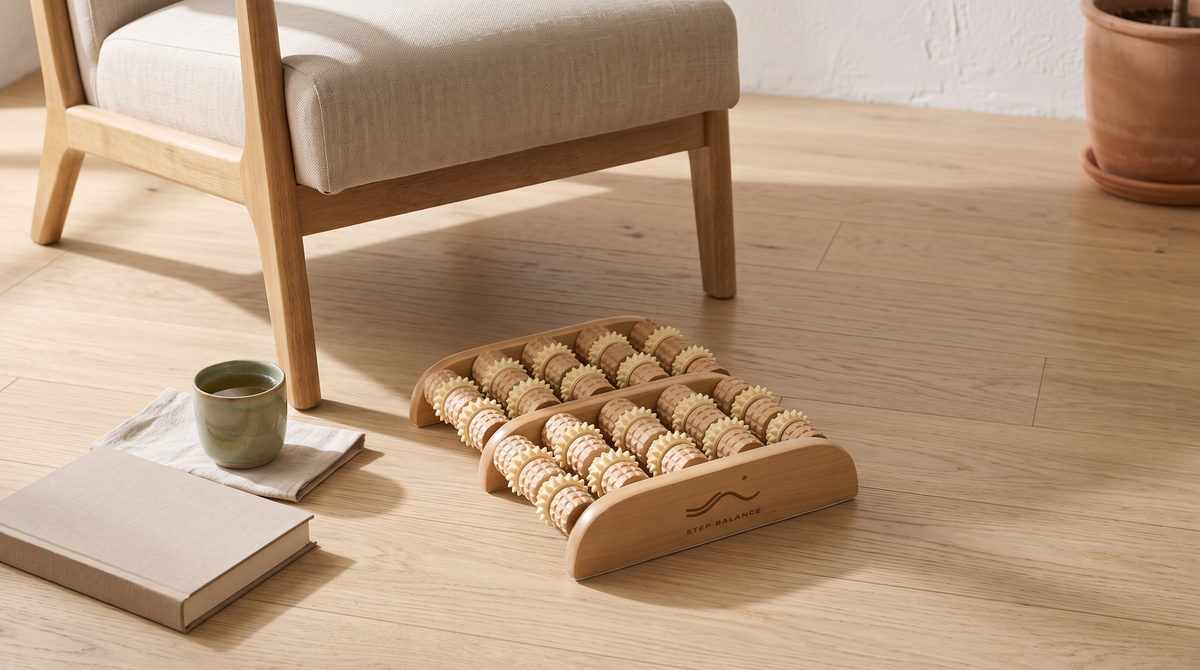
Our ReflexRoll is a wooden foot roller with 50 rollers in two textures: 25 in smooth Schima hardwood and 25 with TPR spikes for firmer pressure. Two roller channels let you use one foot or both, and a rubber base keeps it steady on the floor. It comes without an organ chart, on purpose. For calves and thighs, our MuscleGlide wooden massage stick does the same job higher up the leg.
Frequently asked questions
Is reflexology harmful?
For most people a gentle foot massage is low risk. The main risk is relying on it instead of seeing a doctor about symptoms that need attention.
Should I stop seeing my reflexologist?
If you enjoy it and find it relaxing, that is a perfectly good reason to go. Treat it as a massage, not as a diagnosis or a treatment.
Is a foot roller “reflexology at home”?
Not in the sense of maps and health claims. It is a self-massage tool for the soles, and that is how we describe it.
Why do some spots feel more tender than others?
Sensitivity varies across the sole, for example between the thick heel pad and the thinner arch, and with how much time you spend on your feet. It is not a sign of a problem elsewhere in the body. Foot pain that persists should be checked by a doctor or podiatrist.
Sources
- White AR, Williamson J, Hart A, Ernst E. A blinded investigation into the accuracy of reflexology charts. Complementary Therapies in Medicine. 2000;8(3):166-172. doi:10.1054/ctim.2000.0380
- Ernst E. Is reflexology an effective intervention? A systematic review of randomised controlled trials. Medical Journal of Australia. 2009;191(5):263-266. doi:10.5694/j.1326-5377.2009.tb02780.x
- Ernst E, Posadzki P, Lee MS. Reflexology: an update of a systematic review of randomised clinical trials. Maturitas. 2011;68(2):116-120. doi:10.1016/j.maturitas.2010.10.011
- Australian Government, Department of Health and Aged Care. Natural Therapies Review 2024: Review of the Australian Government Rebate on Natural Therapies for Private Health Insurance. Canberra; 2025. Reflexology section and Appendix M. health.gov.au
- Tian EJ, Veziari Y, Leach MJ, Kumar S. The effectiveness of reflexology on mental health in cancer patients: a systematic review and meta-analysis of randomised controlled trials. Complementary Therapies in Clinical Practice. 2022;50:101708. doi:10.1016/j.ctcp.2022.101708
- Klaus M, Kutschan S, Männle H, Hübner J, Dörfler J. Reflexology in oncological treatment: a systematic review. BMC Complementary Medicine and Therapies. 2024;24(1):32. doi:10.1186/s12906-023-04220-4
- Grieve R, Goodwin F, Alfaki M, Bourton AJ, Jeffries C, Scott H. The immediate effect of bilateral self myofascial release on the plantar surface of the feet on hamstring and lumbar spine flexibility: a pilot randomised controlled trial. Journal of Bodywork and Movement Therapies. 2015;19(3):544-552. doi:10.1016/j.jbmt.2014.12.004
- Ingham ED. Stories the Feet Can Tell. St Petersburg, Florida: Ingham Publishers; 1938.
- Dupuy O, Douzi W, Theurot D, Bosquet L, Dugué B. An evidence-based approach for choosing post-exercise recovery techniques to reduce markers of muscle damage, soreness, fatigue, and inflammation: a systematic review with meta-analysis. Frontiers in Physiology. 2018;9:403. doi:10.3389/fphys.2018.00403
About this guide. Prepared by the Step Balance Research Team, the in-house product and research group behind our insoles, compression supports and recovery tools, designed in Spain. Product details come from our own specifications; statements about reflexology and massage come from the sources listed above. This guide is for information only and does not replace advice from a healthcare professional.
 MuscleGlide™ Wooden Recovery Stick
 ReflexRoll™ Wooden Foot Massager
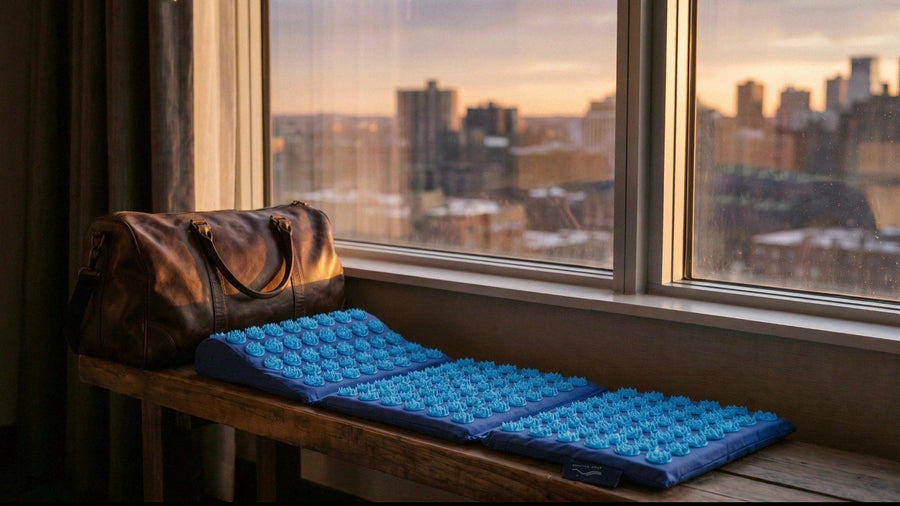
 AcuNomad™ Foldable Acupressure Mat
 AcuEarth™ Acupressure Set