

6-minute read · By the Step Balance Research Team
Standing all day at work is tiring at any time of year, and from Black Friday to the January sales it often gets harder, especially for seasonal hires facing their first long run of shifts. Here are practical tips for the holiday season: what long standing does, what helps on shift, a 60-second routine, a checklist and your right to breaks.
It is a short companion to our main guide, Insoles for standing all day: what the research says, which covers the evidence on cushioning in depth.
In 30 seconds
- Long standing is common, and it adds up. About one in five EU workers spends most of the working day standing; in Spain it is 43%. Standing more than 4 hours a day goes with two to six times as many leg, ankle and foot aches [1].
- Move about every 30 minutes. In lab studies, low back discomfort appeared after about 71 minutes of uninterrupted standing [2]. European guidance recommends a short movement break every 30 minutes [1].
- Cushioning helps, moderately. Cushioned floors and insoles reduce discomfort and fatigue, with no clear winner between a mat and insoles [4][5].
- Know your break. In the EU, a rest break is due when the working day is longer than 6 hours, plus at least 11 consecutive hours of rest in every 24 [13].
What standing all day at work does to your body
Standing is not harmful in itself; standing for a long time in roughly one spot is. European guidance calls standing prolonged when it lasts more than 1 hour without a break or more than 4 hours a day, and a shift at a register or behind a bar easily passes both [1]. In the 2021 EU-OSHA report, 20% of EU workers spent most of their working time standing (43% in Spain, 11% in Germany), and people standing more than 4 hours a day reported two to six times as many pains in the legs, ankles or feet [1]. A NIOSH review links prolonged standing with low back and leg pain and fatigue, while noting that many studies are weak [3].
Time without a break matters. Pooled lab studies found noticeable low back discomfort after about 71 minutes of uninterrupted standing, or 42 minutes in people prone to it [2]. In a small lab and field study, even 1 hour without rest had measurable effects on leg discomfort [7]. After a simulated 5-hour standing day, muscle fatigue was still measurable more than 30 minutes later, when people no longer felt tired [8]. These are small studies, but they point the same way: break up the standing.
How to stand for long hours: what helps on shift
Official guidance puts workplace measures first (a seat or perch, task rotation, breaks), then mats and cushioned insoles when standing cannot be avoided [1].
Move every 30 minutes, and shift your weight
EU-OSHA calls a microbreak to move around every 30 minutes important, and its motto fits a busy shift: sit when you need to, stand when you want to, walk or move when you can [1]. Fetch stock, straighten a shelf, swap tasks with a colleague. In between, change stance and swap the leg that carries your weight. A foot rail or low footrest makes this easier [10], although in a lab study of 20 people a footrest did not significantly reduce low back discomfort [11].
Stand on a mat where there is one
A systematic review found moderate evidence that cushioned flooring and cushioned insoles reduce discomfort and fatigue in standing workers [4]. In a small 2-hour trial, people reported less low back discomfort on a mat, although their muscle activity did not change [6]. Thicker is not better: too much cushioning can add to fatigue and tripping risk, so a firm mat with slanted edges is the safer choice [10].
Cushioned shoes and insoles
Look for a firm heel grip, room for your toes, arch support and laces, and use a cushioned insole on hard floors such as concrete [10]. In real 8-hour shifts, a mat, cushioned insoles and both together all felt more comfortable than a hard floor, with no significant difference between them [5]. Evidence that insoles beat mats is limited, and footwear research is still thin [4][9]. Cushioning may make a shift feel more comfortable; it does not replace breaks. Read more in our guide to insoles for standing all day.
Compression stockings: a personal choice
In one unblinded crossover trial, 108 hairdressers wearing medical compression stockings (15-20 mmHg) reported leg discomfort scores about 12% lower on average, a small effect [12]. These are medical products, so whether to wear them is a personal choice to discuss with a pharmacist or doctor, especially if you have a vein, heart or skin condition. We don't sell compression socks, and our knee sleeves are not a substitute.
A 60-second routine for standing all day at work
Do this about every 30 minutes, holding the counter for balance if you need to. It is a low-risk suggestion based on the advice to move regularly [1][10]; no trial has tested this exact routine.
- Calf raises (about 20 seconds). Rise slowly onto your toes, then lower. Repeat 10 times.
- Toe lifts (about 15 seconds). Keep your heels down, lift your toes and the front of your feet, then lower. Repeat 10 times.
- Ankle circles (about 15 seconds). One foot at a time, 5 slow circles each way.
- Weight shifts (about 10 seconds). Rock gently from side to side, then front to back.
When you can, add a 30-60 second walk away from your spot. Stop if anything hurts. On desk days, try our desk-day reset for feet and legs.
Before, during and after your shift: a checklist
| When | What to do | Why |
|---|---|---|
| Before the season | Wear in work shoes and new insoles on shorter shifts. Check heel grip, toe room, arch support, laces and a low heel. | Feet need time to adjust [10]. |
| Before the season | Ask about a stool at the register, mats at fixed stations, break times and task rotation. | Workplace measures come first [1]. |
| During the shift | Move for 1-2 minutes about every 30 minutes, or do the 60-second routine. | Uninterrupted standing is the main problem [1][2]. |
| During the shift | Take your full break and sit down for it. | In the EU, a break is due on days over 6 hours [13]. |
| After the shift | Put your feet up, stretch your calves gently, roll your soles. | Comfort measures; no trial has tested a specific routine. |
| Between shifts | Protect your rest time, even if you feel fine. | Muscle fatigue can outlast the feeling of tiredness [8]. |
Start new firm insoles a week or two before your busiest days; our guide to firm insoles in the first two weeks explains what to expect. After a long day, try our 5-minute routine for tired feet.
Your right to breaks on long shifts
In the EU, the Working Time Directive guarantees a rest break when the working day is longer than 6 hours, and at least 11 consecutive hours of rest in every 24 [13]. National law sets the length of the break. In Spain, for example, it is at least 15 minutes when a continuous working day exceeds 6 hours, with at least 12 hours between shifts [14]. Collective agreements often give more. We have checked only the EU and Spanish rules, so check your national rules and your contract. This is general information, not legal advice.
When to see a professional
See a doctor, a podiatrist or your occupational health service if you notice any of these:
- pain that doesn't settle with rest, keeps you awake or comes back shift after shift;
- pain or swelling in one leg only, or a calf that is red, warm or tender (seek urgent care);
- numbness, tingling, or foot pain with your first steps in the morning that lasts for weeks;
- a blister or wound that won't heal, especially if you have diabetes;
- you are pregnant and working long standing shifts (talk to your midwife or doctor).
Seek emergency help for chest pain or sudden shortness of breath. Insoles, mats and rollers are not a treatment for any of these.
Where our insoles fit in
Insoles are the one cushioning measure that goes with you from the register to the stockroom. All three of our models share a 2 mm TPU anatomic shell from heel to mid-foot with molded arch support, a metatarsal pad, and premium super-rebound and extra-absorption foams on a carbon-fiber-look PU base. They come in pairs, in EU sizes 36-45.
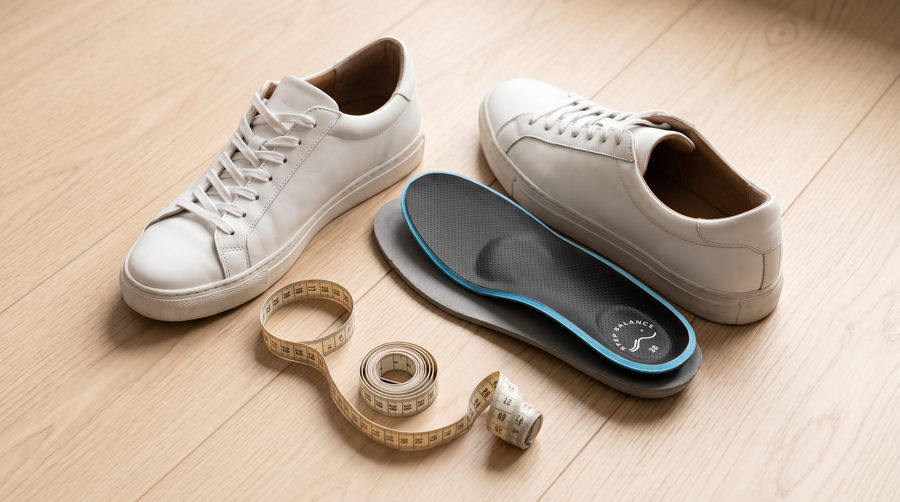
Roomy work sneakers or comfortable work shoes: our Comfort Every Day insoles, 5.5-6 mm, with six layers, a perforated microfiber top and a 3 mm deep-absorption core. They add about half a shoe size of volume, so take the factory insole out first; they may not fit snug shoes. Snug or formal shoes, such as the dress shoes many waiting staff wear: our Slim Fit insoles, 3-3.5 mm with a real perforated leather top.

Choose your usual shoe size and lay the new insole on the factory one to compare outlines before you put it in. The firm shell is intentional: it gives structure, and it takes a few days to get used to. Not sure which model suits your work shoes? Try our insole finder or read our guide to insole size and fit.
For the evening: our ReflexRoll wooden foot roller is 29 cm of Schima hardwood with textured TPR rings in two lanes, used seated. A few minutes per foot is a relaxing way to end a long day, not a treatment. Like all our products, it is a wellness accessory and does not replace breaks or professional advice.

Frequently asked questions
How long can you stand at work without a break?
European guidance calls more than 1 hour of continuous standing, or more than 4 hours a day, prolonged, and recommends a short movement break about every 30 minutes [1]. Lab studies found back discomfort building after roughly 40 to 70 minutes of standing still [2].
Are insoles or an anti-fatigue mat better for standing all day?
There is no clear winner. In real 8-hour shifts, both felt better than a hard floor, with no significant difference between them or with using both [5], and evidence that insoles beat mats is limited [4]. Insoles travel with you, which helps if you move around the store.
Do compression socks help if you stand all day?
In one trial, medical compression stockings (15-20 mmHg) lowered hairdressers' leg discomfort scores by about 12% on average, a small effect [12]. Ask a pharmacist or doctor whether they suit you.
Am I entitled to a break during a long holiday shift?
In the EU, yes, when you work more than 6 hours, plus at least 11 consecutive hours of rest in every 24 [13]. National rules set the details: in Spain the minimum break is 15 minutes for a continuous day of more than 6 hours [14].
Why are my legs still tired the next morning after a long shift?
Muscle fatigue from standing work can outlast the feeling of tiredness [8]. Keep moving during the shift [1], use your rest time, and see a professional if pain persists or one leg becomes swollen, red or painful.
Sources
- Peereboom K, de Langen N, Bortkiewicz A. Prolonged constrained standing at work: health effects and good practice advice. European Agency for Safety and Health at Work (EU-OSHA). Luxembourg: Publications Office of the European Union; 2021. osha.europa.eu
- Coenen P, Parry S, Willenberg L, Shi JW, Romero L, Blackwood DM, Healy GN, Dunstan DW, Straker LM. Associations of prolonged standing with musculoskeletal symptoms: a systematic review of laboratory studies. Gait & Posture. 2017;58:310-318. doi:10.1016/j.gaitpost.2017.08.024
- Waters TR, Dick RB. Evidence of health risks associated with prolonged standing at work and intervention effectiveness. Rehabilitation Nursing. 2015;40(3):148-165. doi:10.1002/rnj.166
- Speed G, Harris K, Keegel T. The effect of cushioning materials on musculoskeletal discomfort and fatigue during prolonged standing at work: a systematic review. Applied Ergonomics. 2018;70:300-314. doi:10.1016/j.apergo.2018.02.021
- King PM. A comparison of the effects of floor mats and shoe in-soles on standing fatigue. Applied Ergonomics. 2002;33(5):477-484. doi:10.1016/S0003-6870(02)00027-3
- Aghazadeh J, Ghaderi M, Azghani MR, Khalkhali HR, Allahyari T, Mohebbi I. Anti-fatigue mats, low back pain, and electromyography: an interventional study. International Journal of Occupational Medicine and Environmental Health. 2015;28(2):347-356. doi:10.13075/ijomeh.1896.00311
- Lin YH, Chen CY, Cho MH. Influence of shoe/floor conditions on lower leg circumference and subjective discomfort during prolonged standing. Applied Ergonomics. 2012;43(5):965-970. doi:10.1016/j.apergo.2012.01.006
- Garcia MG, Läubli T, Martin BJ. Long-term muscle fatigue after standing work. Human Factors. 2015;57(7):1162-1173. doi:10.1177/0018720815590293
- Anderson J, Williams AE, Nester CJ. A narrative review of musculoskeletal problems of the lower extremity and back associated with the interface between occupational tasks, feet, footwear and flooring. Musculoskeletal Care. 2017;15(4):304-315. doi:10.1002/msc.1174
- Canadian Centre for Occupational Health and Safety (CCOHS). Working in a standing position: basic information. OSH Answers fact sheet, revised 2022. ccohs.ca
- Lee JY, Baker R, Coenen P, Straker L. Use of a footrest to reduce low back discomfort development due to prolonged standing. Applied Ergonomics. 2018;67:218-224. doi:10.1016/j.apergo.2017.09.009
- Blazek C, Amsler F, Blaettler W, Keo HH, Baumgartner I, Willenberg T. Compression hosiery for occupational leg symptoms and leg volume: a randomized crossover trial in a cohort of hairdressers. Phlebology. 2013;28(5):239-247. doi:10.1258/phleb.2011.011108
- European Commission, Directorate-General for Employment, Social Affairs and Inclusion. Working Time Directive (Directive 2003/88/EC). ec.europa.eu
- Real Decreto Legislativo 2/2015, de 23 de octubre, Estatuto de los Trabajadores, arts. 34.3, 34.4 and 37.1. Article wording as quoted in Real Academia Española, Diccionario panhispánico del español jurídico, entry descanso laboral (dpej.rae.es). Consolidated text: BOE-A-2015-11430
About this guide. Prepared by the Step Balance Research Team, the in-house product and research group behind our insoles, compression supports and recovery tools, designed in Spain. Product details come from our own specifications; statements about standing at work, breaks and cushioning come from the sources listed above. This guide is for information only and does not replace advice from a healthcare professional.

 Sports Performance Insoles
 Comfort Every Day Insoles
 Slim Fit Insoles