
8-minute read · By the Step Balance Research Team
A gel knee sleeve and a plain knee sleeve do the same basic job: snug knit compression that makes the knee feel supported and “switched on”. The gel version adds a soft ring that frames the kneecap. No study has shown that the ring makes a knee sleeve work better for healthy athletes, so the choice comes down to your sport, your fit and the feel you prefer.
In short: choose the plain sleeve for the lowest profile, for running or under long socks. Choose the gel sleeve if you like a cushioned, defined frame around the kneecap in the gym or on court.
In 30 seconds
- Both designs share the same core: knit compression. In small lab studies a snug sleeve improved knee position sense in some tests but not others [1][2][3], and in one study 94% of athletes said the knee felt more stable [6].
- The gel ring changes the feel, not the proven effect. We found no study comparing gel and plain sleeves in healthy athletes. The only small comparison, in people with kneecap pain, found no difference in pain and more skin rubbing with the ring [7].
- Neither sleeve is injury protection. From volleyball to tennis, the measures with evidence are training programs and gradual increases in load [12][14].
- Measure, and do not size down. In a squat study, a sleeve one size smaller added nothing over the correct size [8]. Our two sleeves use different size ranges.
What every knee sleeve does, gel or plain
A snug, “aware” feel
Both of our sleeves are knit compression sleeves with no hinges or stays. They hug the knee with even pressure, and most people notice the joint more as they move. In a study of 17 CrossFit athletes, 94% said sleeves made the knee feel more stable, even though knee movement barely changed [6]. Every participant also expected sleeves to keep knee pain away, a sign of how strong expectations are. Perceived stability is real and can help confidence, but it is not the mechanical support of a hinged brace.
Position sense: small studies, mixed results
In 20 active adults, a sleeve improved accuracy on three knee-angle tests by 23% to 28% [1]. In 59 young adults, it helped only in a seated test without load [2]. In 20 male sport students, neither a sleeve nor a brace changed how well they detected passive knee movement [3]. One study suggests the effect may matter most when you are tired: after a fatigue protocol, position sense held steady on the sleeved knee [4]. A review of 20 sleeve studies counted 12 with significant improvements and 8 without [5]. Almost all used neoprene in the lab; none measured injuries.
Warmth, and the honest limits
A neoprene thigh sleeve raised skin temperature by 1.4 °C at rest and 3.1 °C during exercise, while muscle temperature during exercise did not change [9]. Knit is thinner, and we found no study comparing the two at the knee. No knee sleeve, gel or plain, has been shown to prevent sports injuries. For the full background, read our guide to knee compression sleeves.
What the gel ring adds to a knee sleeve
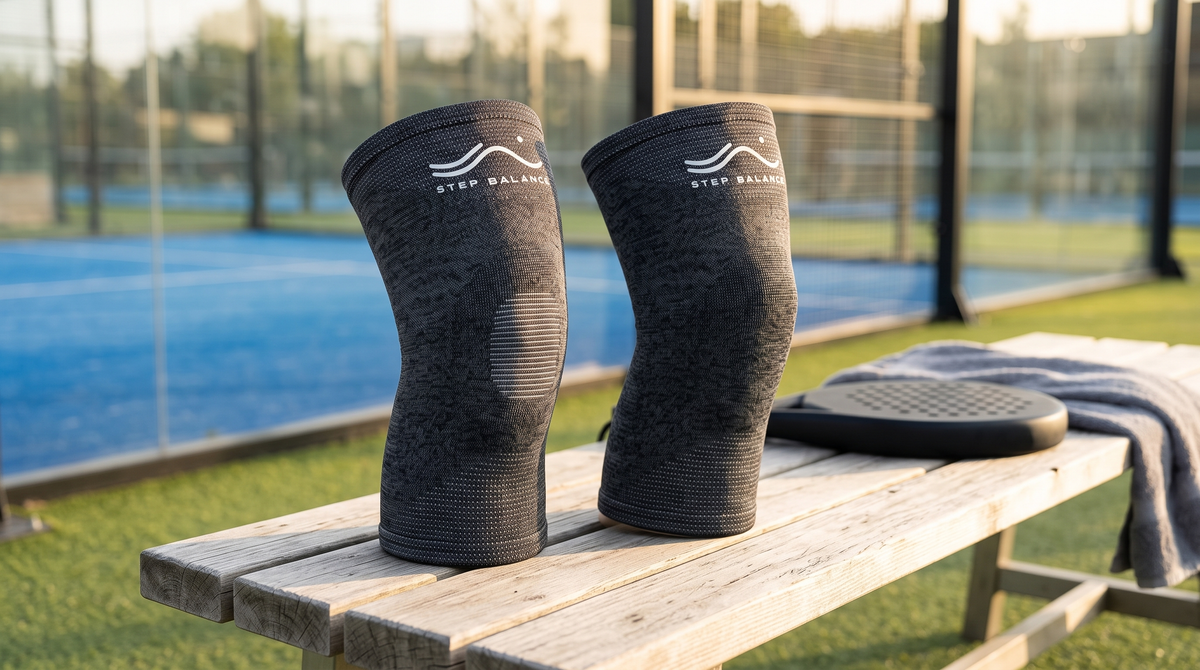
The gel version has a soft ring of TPR gel built into the knit. When the sleeve is on correctly, the kneecap sits inside the opening and the gel frames it. You get a cushioned feel at the front and a clear edge for positioning, plus a little extra bulk. Some people love that feel; others find it distracting.
What the ring has not shown is a measurable advantage. We found no study comparing a sleeve with a gel or silicone ring against the same sleeve without one in healthy athletes. The closest evidence is a Cochrane review of supports for people with pain around the kneecap, where the evidence was rated very low quality [7]. One small trial in it compared a sleeve with a kneecap ring against a plain sleeve in 44 knees: no important difference in pain, and three times as many knees with discomfort or skin abrasion in the ring group [7]. These were people with a knee problem, not athletes, but the lesson holds: a ring must sit in the right place.
You may read that a gel ring “centers”, “tracks” or “aligns” the kneecap. We do not claim that. In an MRI study, even purpose-built kneecap braces did not change kneecap tilt and barely moved it [10]. Our gel sleeve is a knit sleeve, not a brace. Nor is the ring a kneepad: it is not impact-tested.
Gel knee sleeve vs plain knee sleeve: side by side
Both are gray, sold singly, made in S, M and L, with no hinges or stays, and hand wash only.
| Knee Support Sleeve (plain) | Gel Knee Support Sleeve | |
|---|---|---|
| At the front of the knee | Smooth knit, low profile | TPR gel ring around the kneecap |
| Built-in detail | TPU grip bands that help the sleeve stay in place | The gel ring, which also helps you position the sleeve |
| Feel | Even, all-round compression | The same compression plus a soft, defined frame around the kneecap |
| Bulk at the front | Low | A little higher |
| Sizes (knee circumference) | S 30-38 cm · M 38-47 cm · L 47-55 cm | S 30-40 cm · M 40-50 cm · L 50-55 cm |
| Typical sports | Running, padel, tennis, soccer, gym | Gym, volleyball, tennis, soccer |
| Evidence against the other design | No head-to-head study | No study in athletes; one small clinical trial found more skin rubbing with a ring [7] |

Which knee sleeve for your sport
No study has compared the designs sport by sport, so this is practical guidance based on how each sport loads the knee and how each design feels.
Gym and squats
Most lifters feel more stable in a sleeve [6]. Heavier squats were shown only with thick neoprene powerlifting sleeves: trained men squatted about 3% more (166 vs 161 kg) than in a minimally supportive sleeve [8]. Our knit sleeves are thinner, so do not expect that. Either design works. Our gel sleeve was designed with the gym in mind, and many people like its defined frame at the bottom of a squat. For very deep squats or long sets with minimal material, the plain sleeve is lower profile.
Padel and tennis
In elite tennis, lower-limb injuries made up about half of all injuries, and sudden workload spikes were the strongest predictor [14]. Either sleeve suits court sports: the plain sleeve’s grip bands help it stay put, while the gel ring adds a cushioned front feel. Build up court time gradually at the start of a season, and see our guide to feet, knees and elbows in padel.

Volleyball
Ankle, knee and shoulder are hurt most often in volleyball [12], and many serious knee injuries in overhead sports happen on landing [13]. Training programs, not sleeves, reduced injuries in studies [12]. Our gel sleeve is made with volleyball in mind; the plain one is lower profile under kneepads. The gel ring is not padding: for floor contact, wear padded volleyball kneepads.
Soccer
In elite men’s soccer the most common injury was a thigh strain, not a knee injury [15]. A sleeve is optional. The plain one sits flatter under high socks; the gel one gives more feel at the front. Check that neither bunches behind the knee when you sprint.
Running
The knee is the most commonly affected area in distance runners [11]. The plain sleeve is our default: nothing extra at the front across thousands of knee bends, and a covered knee is comfortable on cold mornings [9]. Any new knee pain is a reason to reduce your load. Coming back after a break? Follow our 4-week back-to-running plan.
Knee sleeve size and fit: measure, don’t size down
How to measure
Measure around the center of the knee with a soft tape. Check the chart for the sleeve you want, because the ranges differ: a 39 cm knee is an M in the plain sleeve and an S in the gel sleeve. Between two sizes, choose the larger. Do not size down for “extra support”: in the squat study, a sleeve one size smaller gave no extra benefit [8]. Our size calculator does the math, and our measuring guide shows each step.
Fit and slipping: a 6-step check
- Put it on with the knee slightly bent. Pull it up and smooth out any folds.
- Position it. Center the gel ring so the kneecap sits in the opening, not on the gel. Center the plain sleeve over the kneecap.
- Check the pressure. Firm but comfortable: one finger should slide under the fabric. Tingling, numbness or discomfort? Take it off and try the next size up.
- Test it. Do a few squats and strides. If it keeps slipping, the size is probably wrong: grip bands only help on the right size.
- Check your skin. After the first two or three sessions, look for red marks or rubbing, especially around the gel ring [7].
- Wear it for activity, then take it off. Hand wash and air-dry fully.
When to see a professional
A sleeve is a sports accessory, not a solution for a painful knee. See your doctor or a physical therapist if knee pain has not improved within a few weeks [16]. Get urgent medical help if:
- your knee is very painful, or you cannot move it or put weight on it;
- it is badly swollen or has changed shape;
- it locks, gives way or clicks painfully (painless clicking is normal);
- you have a fever and the knee is red and hot.
If you felt a twist or a pop followed by swelling, stop playing and get assessed.
Our Knee Support Sleeve and Gel Knee Support Sleeve
Our Knee Support Sleeve is a gray knit compression sleeve with TPU grip bands that help it stay in place, in S 30-38 cm, M 38-47 cm and L 47-55 cm, measured around the center of the knee. Our Gel Knee Support Sleeve adds a TPR gel ring that sits around the kneecap, in S 30-40 cm, M 40-50 cm and L 50-55 cm. We designed it for gym, volleyball, tennis and soccer.
Both are sold singly, hand wash only, with no hinges or stays. The fabric is naturally odor-resistant, with no chemical finish. They are sports and wellness accessories and do not replace a brace or professional advice. Unsure of your size? See our size guides.

Frequently asked questions
Is a gel knee sleeve better than a regular knee sleeve?
No study shows either is better for healthy athletes. In one small trial the ring design caused more skin discomfort [7], so pick the one that feels better at the correct size.
Does the gel ring keep the kneecap in place?
We do not claim that. Even purpose-built kneecap braces barely changed kneecap position on MRI [10]. Think of the ring as a cushioned frame that helps you position the sleeve.
How tight should a knee sleeve be?
Firm but comfortable, never painful, numb or tingly, with room for one finger under the fabric. A tighter sleeve gave no extra benefit in research [8].
Do knee sleeves help with squats?
Trained lifters squatted about 3% more in thick neoprene sleeves, and a smaller size added nothing [8]. Thinner knit sleeves have not been tested that way, so choose them for feel and warmth.
Can a knee sleeve prevent knee injuries?
There is no good evidence that any sleeve prevents sports injuries. Training programs and gradual load increases have the best evidence [12][14]. If your knee swells, locks, gives way or stays painful for weeks, see a professional [16].
Sources
- Herrington L, Simmonds C, Hatcher J. The effect of a neoprene sleeve on knee joint position sense. Research in Sports Medicine. 2005;13(1):37-46. doi:10.1080/15438620590922077
- Birmingham TB, Inglis JT, Kramer JF, Vandervoort AA. Effect of a neoprene sleeve on knee joint kinesthesis: influence of different testing procedures. Medicine & Science in Sports & Exercise. 2000;32(2):304-308. doi:10.1097/00005768-200002000-00009
- Bottoni G, Herten A, Kofler P, Hasler M, Nachbauer W. The effect of knee brace and knee sleeve on the proprioception of the knee in young non-professional healthy sportsmen. The Knee. 2013;20(6):490-492. doi:10.1016/j.knee.2013.05.001
- Van Tiggelen D, Coorevits P, Witvrouw E. The use of a neoprene knee sleeve to compensate the deficit in knee joint position sense caused by muscle fatigue. Scandinavian Journal of Medicine & Science in Sports. 2008;18(1):62-66. doi:10.1111/j.1600-0838.2007.00649.x
- Mohd Sharif NA, Goh SL, Usman J, Wan Safwani WKZ. Biomechanical and functional efficacy of knee sleeves: a literature review. Physical Therapy in Sport. 2017;28:44-52. doi:10.1016/j.ptsp.2017.05.001
- Maynart FR, Mazuquin B, Costa HS, et al. Are 7 mm neoprene knee sleeves capable of modifying the knee kinematics and kinetics during box jump and front squat exercises in healthy CrossFit practitioners? An exploratory cross-sectional study. Journal of Bodywork and Movement Therapies. 2024;40:1027-1033. doi:10.1016/j.jbmt.2024.07.032
- Smith TO, Drew BT, Meek TH, Clark AB. Knee orthoses for treating patellofemoral pain syndrome. Cochrane Database of Systematic Reviews. 2015;(12):CD010513. doi:10.1002/14651858.CD010513.pub2
- Machek SB, Cardaci TD, Wilburn DT, Cholewinski MC, Latt SL, Harris DR, Willoughby DS. Neoprene knee sleeves of varying tightness augment barbell squat one repetition maximum performance without improving other indices of muscular strength, power, or endurance. Journal of Strength and Conditioning Research. 2021;35(Suppl 1):S6-S15. doi:10.1519/JSC.0000000000003869
- Miller AA, Knight KL, Feland JB, Draper DO. Neoprene thigh sleeves and muscle cooling after exercise. Journal of Athletic Training. 2005;40(4):264-270. PubMed 16404446
- Powers CM, Ward SR, Chan LD, Chen YJ, Terk MR. The effect of bracing on patella alignment and patellofemoral joint contact area. Medicine & Science in Sports & Exercise. 2004;36(7):1226-1232. doi:10.1249/01.mss.0000132376.50984.27
- van Gent RN, Siem D, van Middelkoop M, van Os AG, Bierma-Zeinstra SMA, Koes BW. Incidence and determinants of lower extremity running injuries in long distance runners: a systematic review. British Journal of Sports Medicine. 2007;41(8):469-480. doi:10.1136/bjsm.2006.033548
- Kilic O, Maas M, Verhagen E, Zwerver J, Gouttebarge V. Incidence, aetiology and prevention of musculoskeletal injuries in volleyball: a systematic review of the literature. European Journal of Sport Science. 2017;17(6):765-793. doi:10.1080/17461391.2017.1306114
- Sundberg A, Högberg J, Tosarelli F, et al. Sport-specific injury mechanisms and situational patterns of ACL injuries: a comprehensive systematic review. Sports Medicine. 2025;55(10):2489-2527. doi:10.1007/s40279-025-02271-w
- Amor-Salamanca MS, Rodríguez-González EM, Rosselló D, et al. Risk factors and prevention of musculoskeletal injuries in adolescent and adult high-performance tennis players: a systematic review. Sports (Basel). 2025;13(10):336. doi:10.3390/sports13100336
- Ekstrand J, Hägglund M, Waldén M. Injury incidence and injury patterns in professional football: the UEFA injury study. British Journal of Sports Medicine. 2011;45(7):553-558. doi:10.1136/bjsm.2009.060582
- NHS. Knee pain. nhs.uk. Page last reviewed 21 December 2023. nhs.uk/symptoms/knee-pain
About this guide. Prepared by the Step Balance Research Team, the in-house product and research group behind our insoles, compression supports and recovery tools, designed in Spain. Product details come from our own specifications; statements about knee sleeves, position sense and sport come from the sources listed above. This guide is for information only and does not replace advice from a healthcare professional.
 Ankle Support Sleeve
 Elbow Support Sleeve
 Gel Knee Support Sleeve
 Knee Support Sleeve