
7-minute read · By the Step Balance Research Team
January is when many of us start running again, and the first weeks back are when it is easiest to overdo it. This guide covers what the research says about starting to run again after a break, a 4-week run-walk plan (about 30 minutes, three times a week), strength work, shoes, cold weather and when to stop.
It works for any restart, not just in January.
In 30 seconds
- Beginners get hurt more often. Pooled studies found about 17.8 injuries per 1,000 hours of running in novices, against 7.7 in recreational runners [1].
- The 10% rule did not hold up in a trial. A plan built on it had the same injury rate as a standard plan (20.8% vs 20.3%) [2]. Avoiding big jumps seems to matter more [3].
- Strength beats stretching. In 25 trials, strength training cut sports injuries to about a third; stretching showed no protective effect [5].
- Choose shoes by comfort. In 927 new runners wearing a neutral shoe, pronated feet were not injured more often [7][8].
Why runners get hurt when they start running again
After a break, it is tempting to pick up where you left off. The data suggest caution: per hour of running, novices pick up more than twice as many injuries as recreational runners, though studies defined injury differently [1]. A previous injury is one of the most consistent risk factors, and in men, restarting running was linked with higher risk [4].
The 10% rule: what the trial found
In a randomized trial, 532 beginners followed a 13-week plan built on the 10% rule or a standard 8-week plan. Injury rates were almost identical: 20.8% and 20.3% [2]. Both plans were already gradual, and about one in five beginners got hurt even so.
What seems to matter: big jumps
In a one-year study of 874 new runners, overall injury rates did not differ by how fast weekly distance rose. For some overuse injuries, increases above 30% over two weeks were linked with a higher rate, but the result was not conclusive [3].
A 4-week run-walk plan for starting to run again
The structure follows the UK’s NHS Couch to 5K program: three sessions a week, a rest day between runs, and a 5-minute brisk walk to warm up and to cool down [9]. Running time rises by about a quarter a week at most.
| Week | Each session (after the warm-up walk) | Running per session | Running per week |
|---|---|---|---|
| 1 | 8 × (run 1 min, walk 90 s), no walk after the last run | 8 min | 24 min |
| 2 | 6 × (run 90 s, walk 2 min), no walk after the last run | 9 min | 27 min |
| 3 | Run 2, walk 1.5, run 2, walk 1.5, run 3, walk 1.5, run 2, walk 1.5, run 2 (minutes) | 11 min | 33 min |
| 4 | Run 3, walk 2, run 4, walk 2, run 3, walk 2, run 4 (minutes) | 14 min | 42 min |
How to use the plan
- Run at a pace that feels right, and repeat any week as often as you need. Walk breaks are part of the plan [9].
- Move up only if last week felt manageable and no pain lasted into the next day (our own rule).
- Had a running injury before? Repeat each week once, and consider seeing a physical therapist first [4].
Three sessions add up to about 90 minutes. The WHO recommends 150-300 minutes of moderate activity a week plus regular muscle-strengthening, so add brisk walks on other days [10].
When to stop and see a professional
- Pain that makes you limp or change your stride, or gets worse from run to run.
- Swelling, or pain at rest or at night.
Then stop and see a doctor or physical therapist. Chest pain, unusual breathlessness or dizziness need urgent medical help. If you have a heart or lung condition, talk to your doctor before you start [9][11]. Never run through pain.
Strength twice a week: feet, calves and hips
A meta-analysis of 25 randomized trials across many sports found that strength training reduced injuries to about a third, while stretching showed no protective effect [5]; the effect for returning runners is uncertain. Foot muscles may matter too: in one small trial of 118 recreational runners, those who skipped an 8-week foot-strengthening program were 2.42 times more likely to be injured over a year [6]. The routine below uses common exercises, not that trial’s protocol.
- Calf raises, 2-3 × 10-15. On a step; progress to one leg when it feels easy.
- Short foot, 3 × 10 holds of 5 seconds. Draw the ball of the foot toward the heel without curling the toes.
- Toe spreads and big-toe lifts, 2 × 10.
- Single-leg balance, 3 × 30 seconds per leg. Then on a cushion.
- Glute bridges and sit-to-stand squats, 2-3 × 10-12.
Running shoes and insoles: choose by comfort
Many stores still sell stability shoes for overpronation. In a one-year study of 927 new runners all wearing the same neutral shoe, people with pronated feet were not injured more often than people with neutral feet [7]. A review proposed choosing shoes by comfort, which may keep you in your natural movement path; that is still a hypothesis [8]. With thick winter socks, consider a half size up, and pick soles with grip [11].
Insoles are a comfort and fit choice too. One review found that runners who had used orthotics or inserts were injured more often [4]. That very likely reflects who uses them (often people who already had complaints), not harm from the inserts, but it means nobody can honestly promise that insoles prevent injuries. We do not.

Warm-up, rolling and sleep
The plan’s 5-minute walks are your warm-up and cool-down [9]. Skip long static stretches beforehand: they showed no protective effect [5]. A few minutes with a massage stick can be a calm habit, but we have no evidence that rolling lowers injury risk or speeds up recovery. Keep the pressure moderate and off bones and the kneecap.
- Before (3 minutes): calves, front of the thighs and back of the thighs, 30 seconds each per leg.
- After (6 minutes): the same three areas, 60 seconds each per leg, with slower strokes.

Finally, sleep: adults should get 7 or more hours a night [12]. That is general health advice; we found no solid research linking sleep to running injuries.
Running in cold weather: what to wear
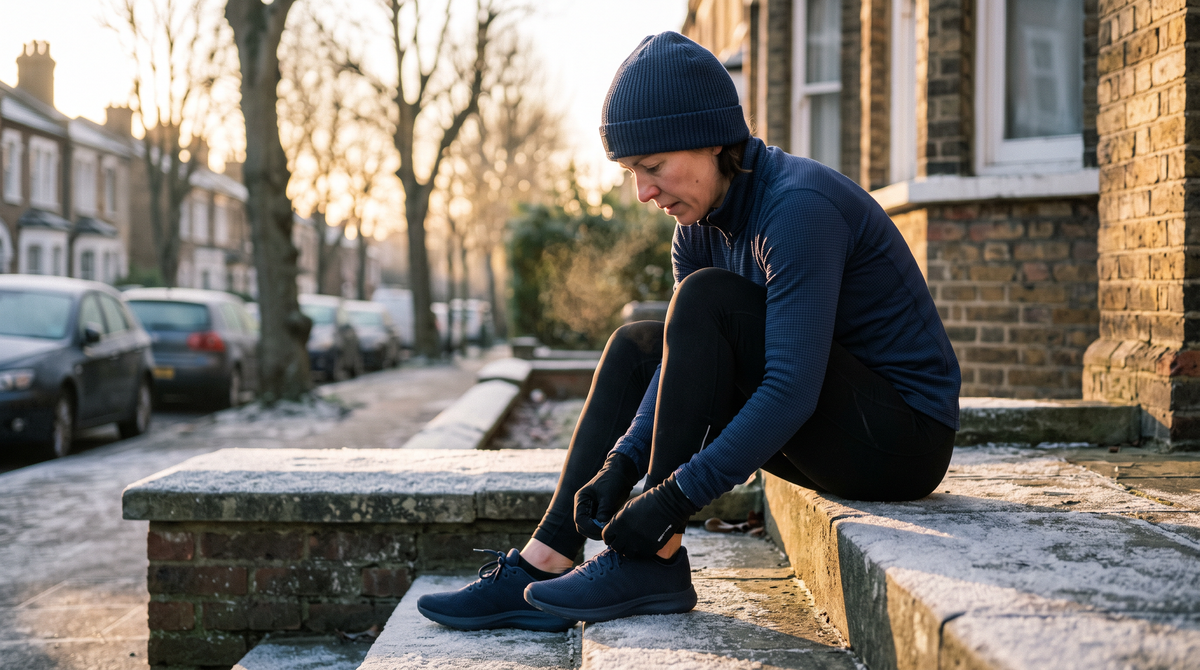
One point most winter guides miss: run-walk is stop-and-go, so you can sweat on the runs and get chilled on the walks [11]. Keep walk breaks brisk and stay close to home.
- Layers you can take off: a wicking base layer (no cotton), a fleece or wool mid-layer, a breathable windproof shell [11].
- A hat or headband and gloves; reflective or lit clothing in the dark [9][11].
- Keep drinking: you lose fluid in the cold too [11].
- Below about 0 °F (-18 °C), or in extreme wind chill, run indoors [11].
If you have asthma, heart problems or Raynaud’s, check with your doctor first. Numb or stinging skin means get out of the cold; intense shivering or slurred speech need emergency help [11].
Where our products fit in
Our products are comfort choices, not injury prevention. If you want more structure in your running shoes, our Sports Performance insoles are 4.5-5 mm thick, with a microfiber top, high-rebound EVA, a deep heel cup and a 2 mm TPU shell with molded arch support. In EU 36-45, take your usual shoe size; remove the factory insole and compare outlines first. The firm shell is intentional, so give them two weeks to settle (our guide to the first two weeks). Compare models in our guide to insoles for running and padel or use the insole finder.
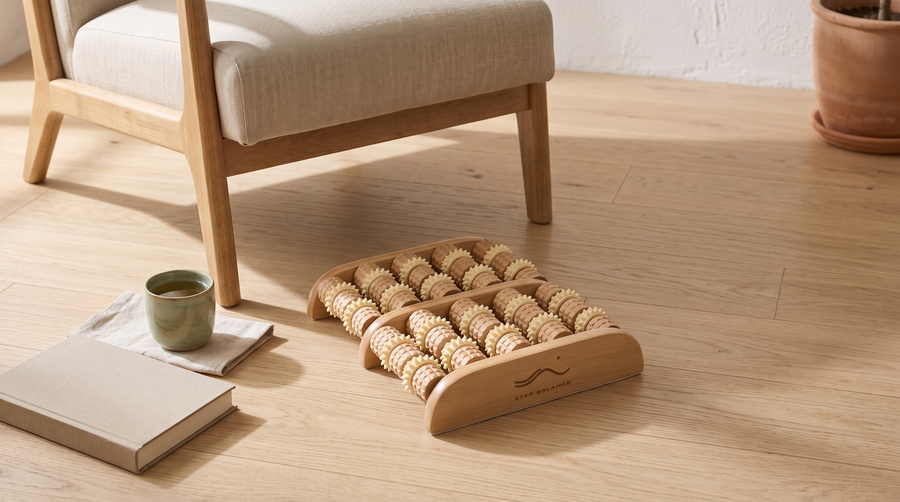
Our MuscleGlide wooden massage stick (38.4 cm, 240 g, nine Schima hardwood rings on a steel axle) suits the 3-minute and 6-minute routines above. See also our massage-stick routine for runners and our wooden roller vs foam roller comparison.
The Knee Support Sleeve is optional, for runners who like a snug layer on cold days: gray knit, S/M/L for 30-38, 38-47 and 47-55 cm around the center of the knee (size guides); between sizes, choose the larger. It is not a fix for knee pain. See our guide to knee compression sleeves.
Frequently asked questions
Is the 10% rule for running true?
Not as a proven rule. A plan built on it had the same injury rate as a standard plan [2]. Build up gradually; avoid jumps above about 30% [3].
How many times a week should I run when starting again?
Three run-walk sessions with rest days between [9], plus two short strength sessions [5].
Do I need running shoes for overpronation?
Probably not just because of your foot type [7]. Choose the most comfortable pair [8], and see a podiatrist or physical therapist if you have pain.
Is it OK to run in cold weather?
For most healthy people, yes: removable layers, gloves, a hat and visible clothing in the dark [11].
How long until I can run 30 minutes without stopping?
Couch to 5K gets complete beginners there in about 9 weeks. After this plan, you can join it at week 4 or 5 [9].
Sources
- Videbæk S, Bueno AM, Nielsen RO, et al. Incidence of running-related injuries per 1000 h of running in different types of runners: a systematic review and meta-analysis. Sports Medicine. 2015;45(7):1017-1026. doi:10.1007/s40279-015-0333-8
- Buist I, Bredeweg SW, van Mechelen W, et al. No effect of a graded training program on the number of running-related injuries in novice runners: a randomized controlled trial. American Journal of Sports Medicine. 2008;36(1):33-39. doi:10.1177/0363546507307505
- Nielsen RØ, Parner ET, Nohr EA, et al. Excessive progression in weekly running distance and risk of running-related injuries: an association which varies according to type of injury. Journal of Orthopaedic & Sports Physical Therapy. 2014;44(10):739-747. doi:10.2519/jospt.2014.5164
- van der Worp MP, ten Haaf DSM, van Cingel R, et al. Injuries in runners; a systematic review on risk factors and sex differences. PLoS One. 2015;10(2):e0114937. doi:10.1371/journal.pone.0114937
- Lauersen JB, Bertelsen DM, Andersen LB. The effectiveness of exercise interventions to prevent sports injuries: a systematic review and meta-analysis of randomised controlled trials. British Journal of Sports Medicine. 2014;48(11):871-877. doi:10.1136/bjsports-2013-092538
- Taddei UT, Matias AB, Duarte M, et al. Foot core training to prevent running-related injuries: a survival analysis of a single-blind, randomized controlled trial. American Journal of Sports Medicine. 2020;48(14):3610-3619. doi:10.1177/0363546520969205
- Nielsen RO, Buist I, Parner ET, et al. Foot pronation is not associated with increased injury risk in novice runners wearing a neutral shoe: a 1-year prospective cohort study. British Journal of Sports Medicine. 2014;48(6):440-447. doi:10.1136/bjsports-2013-092202
- Nigg BM, Baltich J, Hoerzer S, et al. Running shoes and running injuries: mythbusting and a proposal for two new paradigms: ‘preferred movement path’ and ‘comfort filter’. British Journal of Sports Medicine. 2015;49(20):1290-1294. doi:10.1136/bjsports-2015-095054
- NHS. Couch to 5K running plan. NHS Better Health. nhs.uk
- Bull FC, Al-Ansari SS, Biddle S, et al. World Health Organization 2020 guidelines on physical activity and sedentary behaviour. British Journal of Sports Medicine. 2020;54(24):1451-1462. doi:10.1136/bjsports-2020-102955
- Mayo Clinic Orthopedics & Sports Medicine. Exercising outdoors in winter. sportsmedicine.mayoclinic.org
- Watson NF, Badr MS, Belenky G, et al. Recommended amount of sleep for a healthy adult: a joint consensus statement of the American Academy of Sleep Medicine and Sleep Research Society. Sleep. 2015;38(6):843-844. doi:10.5665/sleep.4716
About this guide. Prepared by the Step Balance Research Team, the in-house product and research group behind our insoles, compression supports and recovery tools, designed in Spain. Product details come from our own specifications; statements about returning to running, training load and exercising in the cold come from the sources listed above. This guide is for information only and does not replace advice from a healthcare professional.
 Sports Performance Insoles
 Comfort Every Day Insoles
 Slim Fit Insoles