
6-minute read · By the Step Balance Research Team
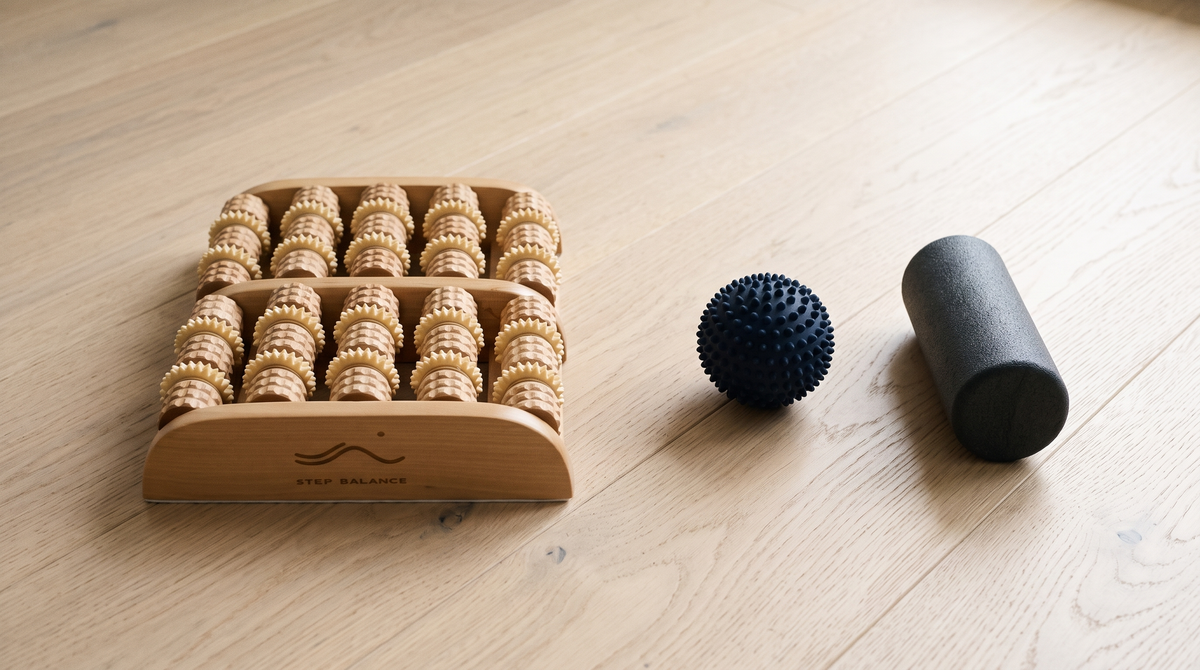
Rolling the soles of your feet is one of the simplest ways to look after them after a long day or a long run. Most people start with whatever is to hand: a tennis ball, a spiky massage ball or a foam roller. Wooden foot rollers are the other option. This guide looks at what the research says, how the three tools differ in practice, and how to choose.
In 30 seconds
- Rolling the soles feels good and can loosen the back of the legs a little for a short time. In a small trial, two minutes of rolling each sole with a ball improved a sit-and-reach test straight away [1].
- Massage in general is one of the better-supported ways to feel less sore and less tired after exercise [2].
- Reflexology charts that link points on the foot to organs are not supported by good evidence [3]. Enjoy the massage for what it is.
- Choose by how you will use it: a ball for targeted spots and travel, a foam roller for legs and back, a wooden foot roller for both feet at once, seated, at a desk or on the sofa.
What the research says
Rolling the soles: a small, short-term effect
The best-known study on this is a pilot randomised trial from the University of the West of England. Twenty-four healthy adults rolled the sole of each foot over a ball for two minutes. Compared with a group that did nothing, they reached further in a sit-and-reach test immediately afterwards [1]. The trial was small and the effect short-term, so it is a reason to try it, not proof of lasting change. Most of the effect of rolling is thought to come from how the nervous system responds to pressure and stretch, rather than from "releasing" tissue [4].
Massage and feeling recovered
A 2018 meta-analysis compared recovery methods after exercise. Massage was among the most effective for reducing muscle soreness and the feeling of fatigue [2]. These are perceived outcomes, and the studies looked at massage in general rather than foot rollers specifically. Still, they support what most people notice: a few minutes of pressure on tired feet feels good, and that matters.
What about reflexology?
Reflexology claims that points on the feet correspond to organs and that pressing them can treat illness. A systematic review of randomised trials found that the best evidence does not show convincingly that reflexology is an effective treatment for any medical condition [3]. The author also noted that there is little doubt a foot massage is pleasantly relaxing. That is the honest position, and it is ours: we do not print organ maps, and we do not make medical claims.

Spiky ball, foam roller or wooden foot roller?
All three press on the sole of the foot. The difference is how much control you have, whether you can do both feet together, and where you can use them.
| Spiky or massage ball | Foam roller | Wooden foot roller | |
|---|---|---|---|
| Pressure | Concentrated on one small spot | Spread over a wide area, soft | Spread along the whole sole, firm |
| Both feet at once | No | Awkward | Yes, on models with two channels |
| Stays in place | Rolls away easily | Rolls away | Yes, the frame stays still and only the rollers turn |
| Use at a desk | Possible, but you keep chasing it | Not practical | Designed for it |
| Best for | Targeted spots, travel | Calves, thighs, back | Regular, hands-free foot sessions |
| Portability | Pocket-sized | Bulky | Lives under the desk or sofa |
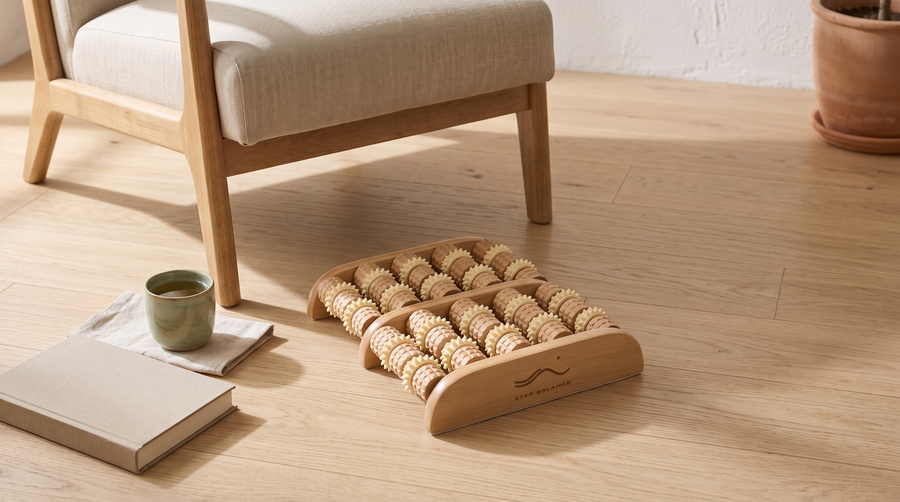
A ball is the best tool for finding one tight spot and working on it, and it fits in any bag. A foam roller is built for the legs and back; under the arch it is too wide and too soft to do much. A wooden foot roller gives you the whole sole of both feet at once, and the frame stays put, so you can use it while you read, work or watch something.
A 3-minute seated routine
- Sit tall with both feet on the roller, barefoot or in thin socks.
- Warm up (30 seconds): roll slowly from heel to toes with light pressure.
- Arch (1 minute): lean forward slightly to add pressure and roll the middle of the foot back and forth.
- Heel and forefoot (1 minute): spend 30 seconds on each area, keeping the pressure comfortable.
- Finish (30 seconds): spread your toes, lift and lower them ten times, then stand and notice the difference.
Pressure: firm but comfortable, never sharp. Check first with a healthcare professional if you have reduced feeling in your feet, diabetes, a circulation disorder, or a foot injury, and do not roll over wounds or swelling.
Our ReflexRoll
Our ReflexRoll is a wooden foot roller with 50 rollers in two textures: 25 in smooth Schima hardwood and 25 with TPR spikes for firmer pressure. Two roller channels let you use one foot or both, and a rubber base keeps it steady on the floor. It is 29 cm long, made for use while seated, and needs no cables or charging. For your calves and thighs, our MuscleGlide wooden massage stick does the same job higher up the leg.
Frequently asked questions
Can I stand on a foot roller?
We recommend using ReflexRoll seated. Standing puts your full body weight on small rollers, which is harder to control.
Barefoot or with socks?
Barefoot gives the most feedback. Thin socks soften the pressure, which is a good way to start.
How often?
A few minutes a day is plenty. Short, regular sessions are more pleasant than long, hard ones.
Will it help with heel pain?
We do not make claims about any condition. Heel or arch pain that lasts more than a couple of weeks should be checked by a doctor or physiotherapist.
Sources
- Grieve R, Goodwin F, Alfaki M, Bourton AJ, Jeffries C, Scott H. The immediate effect of bilateral self myofascial release on the plantar surface of the feet on hamstring and lumbar spine flexibility: a pilot randomised controlled trial. Journal of Bodywork and Movement Therapies. 2015;19(3):544-552. doi:10.1016/j.jbmt.2014.12.004
- Dupuy O, Douzi W, Theurot D, Bosquet L, Dugué B. An evidence-based approach for choosing post-exercise recovery techniques to reduce markers of muscle damage, soreness, fatigue, and inflammation: a systematic review with meta-analysis. Frontiers in Physiology. 2018;9:403. doi:10.3389/fphys.2018.00403
- Ernst E. Is reflexology an effective intervention? A systematic review of randomised controlled trials. Medical Journal of Australia. 2009;191(5):263-266. mja.com.au
- Behm DG, Wilke J. Do self-myofascial release devices release myofascia? Rolling mechanisms: a narrative review. Sports Medicine. 2019;49(8):1173-1181. doi:10.1007/s40279-019-01149-y
About this guide. Prepared by the Step Balance Research Team, the in-house product and research group behind our insoles, compression supports and recovery tools, designed in Spain. Product details come from our own specifications; statements about massage and recovery come from the peer-reviewed studies listed above. This guide is for information only and does not replace advice from a healthcare professional.
 MuscleGlide™ Wooden Recovery Stick
 ReflexRoll™ Wooden Foot Massager
 AcuNomad™ Foldable Acupressure Mat
 AcuEarth™ Acupressure Set