
7-minute read · By the Step Balance Research Team
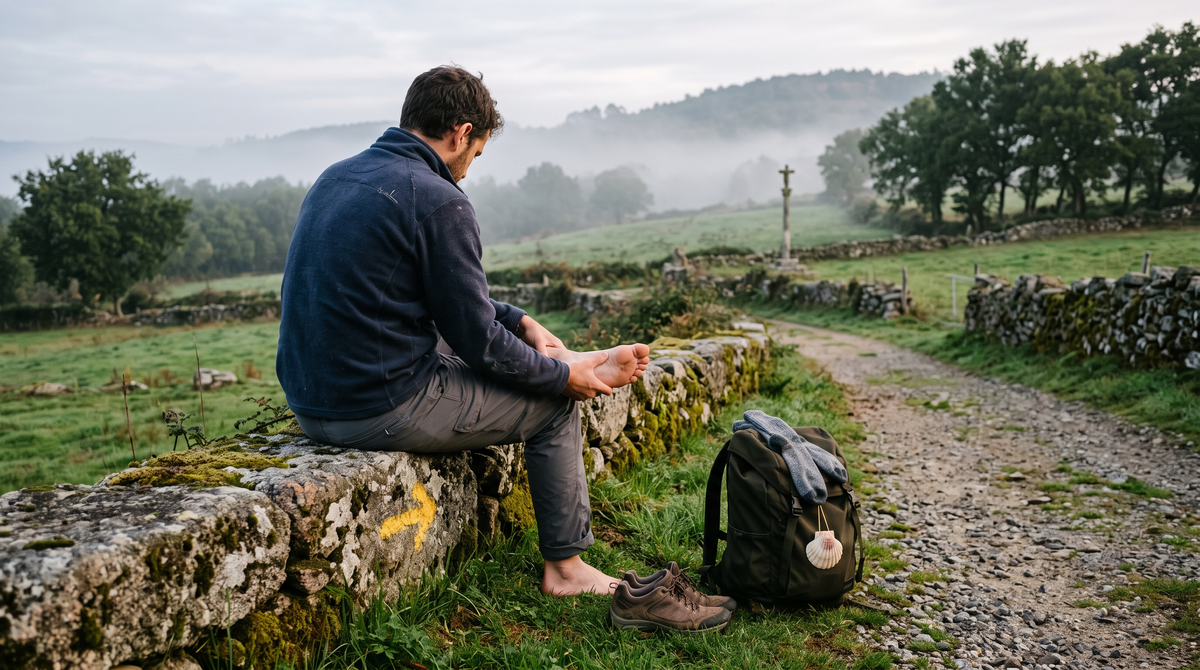
Many pilgrims finish the Camino de Santiago with the same story: the legs held up, the feet complained. Blisters are the most common foot problem on the Way. In a study of 315 walkers examined at Camino hostels, 74% had at least one after several stages [1].
Most of that trouble is predictable. Here is what research on pilgrims shows, how to prepare and a simple daily routine.
In 30 seconds
- Blisters are the main problem. 74% of 315 walkers examined at Camino hostels had at least one, most often under the ball of the foot or on the little toe [1].
- Dry feet matter more than sock fiber. Wet socks at the end of the day went with about twice the blister risk; the fiber made no difference [2].
- Prepare your skin, not just your legs. Train in your Camino shoes, socks and pack. Paper tape on hot spots cut blisters by about 40% in a trial of runners [9].
- Insoles are for comfort and fit. Shock-absorbing insoles did not prevent injuries in trials [10]. The 10% backpack rule is a convention, not an official rule [5].
The Camino de Santiago in numbers
The Pilgrim’s Office in Santiago counts every Compostela it issues. In 2025 it recorded 530,717 pilgrims, and roughly 93% arrived on foot [14].
| Pilgrim’s Office figures | 2024 | 2025 |
|---|---|---|
| Pilgrims recorded | 499,157 | 530,717 |
| On foot | 464,840 (93.2%) | 491,888 (92.7%) |
| French Way | 47.3% | 45.6% |
| Portuguese Way / Coastal Way | 19.1% / 15.0% | 19.0% / 16.9% |
| Started in Sarria | 30.3% | 30.5% |
For the Compostela on foot, you must walk at least the last 100 continuous km to Santiago on one official route, with stamps in your pilgrim credential (200 km by bicycle). That is why about three in ten pilgrims start in Sarria [14].
Why feet are the weak point
In one study, 29 healthy adults aged 40-70 walked the last 280 km to Santiago in 12 days, averaging about 23 km a day [11]. Moist skin and heavier loads both make friction blisters more likely [7]. Observational studies of Camino walkers add three practical findings:
- Wet socks. Among 203 walkers on the French Way, ending the day in wet socks went with 1.94 times the blister risk [2]. In a smaller study, walkers with blisters had more hydrated skin on their feet [4].
- Asphalt. More kilometers on asphalt went with more blisters; dirt, grass and gravel with fewer [1].
- The ball of the foot. Blisters there were linked to more pain and disability than blisters elsewhere [3].
Before you go: shoes, socks, nails and training
Break in your shoes
Do your training walks in the shoes you will wear on the Camino; the NHS advises wearing new shoes for short periods until they are comfortable [12]. Skin exposed to repeated, gentle friction gradually toughens, which may lower blister risk, and military guidance stresses well-sized footwear and regular walking [7][8].
Socks, tape and nails
There is little strong evidence that any sock prevents blisters [6], and among Camino walkers fiber made no difference [2]. Choose socks that fit without wrinkles and pack a spare pair. Tape has better support: in a randomized trial in ultramarathon runners, paper tape on blister-prone spots reduced blisters by about 40% [9]. Cut your toenails straight across a few days before you leave, not too short, so they do not press on descents.
A sample 8-week build-up
No trials tell pilgrims how to train, so this is our suggestion, not a sourced plan. The goal is two days in a row near your planned daily distance, in your Camino shoes, socks and pack [7][8].
| Weeks | Weekday walks | Weekend walk | Pack |
|---|---|---|---|
| 1-2 | 2-3 walks of 45-60 min | 8-10 km | Empty or light |
| 3-4 | 3 walks of about 60 min | 12-15 km | About half the planned weight |
| 5-6 | 3 walks of 60-75 min, some hills | 15-20 km, shorter walk the next day | Full pack |
| 7 | 2-3 walks of about 60 min | Two days in a row at your daily distance | Full pack, Camino socks and insoles |
| 8 | 2 easy walks | A relaxed 10 km | Final kit check, nothing new |

Shoes and insoles for the Camino: getting the fit right
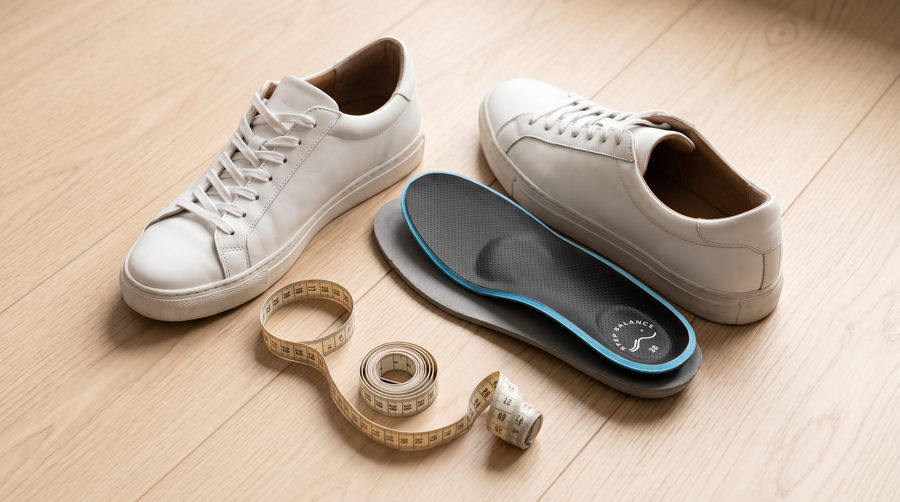
Try shoes on late in the day, with your walking socks and the insole you plan to use. Feet often feel fuller after hours on the move, so leave room to wiggle your toes. The heel should stay put uphill, and the toes should not touch the front on descents. Our guide to insole size and fit shows how to check.
Be wary of strong insole claims. A meta-analysis of randomized trials found that shock-absorbing insoles did not reduce injuries [10]. In the Camino blister study, custom-made foot orthoses were linked to fewer blisters [1], but those are prescribed by a podiatrist, and the finding does not transfer to off-the-shelf insoles. With foot pain, diabetes or reduced feeling in your feet, see a podiatrist or doctor before you go [13]. For a more comfortable fit on long days, an insole can help, once tested at home. See also how to choose insoles.
Camino backpack weight: what the 10% rule really is
Many Camino guides say your pack should weigh no more than 10% of your body weight. It is a sensible rule of thumb, but a convention: we found no official Pilgrim’s Office or Galician government rule behind it. The authors of a 2026 study note that the effect of this commonly cited limit on the feet is not yet fully understood [5].
Their data add some support. In 39 Camino walkers measured barefoot, 10% of body weight raised forefoot pressure by about 5% and 20% by about 9%; 38.5% were already carrying more than 10% [5]. The sample was small and injuries were not tracked. Weigh your full pack at home, water included.
A daily foot care routine on the Camino
A few minutes, three times a day: evidence where there is some, common practice where there is not.
- Morning check. Look at both feet, including between the toes and under the forefoot. Put paper tape on known hot spots [9]. Pull on dry socks with no wrinkles and lace so your heel does not lift.
- The hot-spot rule. Stop at the first warm or rubbing spot, not at the next café. Remove grit, smooth the sock, adjust the lacing, cover the spot.
- Midday: shoes off. On long or hot stages, air your feet at lunch and change into dry socks; wet socks went with almost twice the blister risk [2]. Where possible, walk on the dirt verge rather than asphalt [1].
- Evening care. Wash and fully dry your feet. Lift the insoles out so shoes and insoles air overnight, away from direct heat. Check for blisters, redness, swelling or broken skin [12][13]. Our 5-minute routine for tired feet works on a hostel bunk.
Blisters on the Camino: what to do
Most blisters heal on their own within about a week. The NHS advises against bursting a blister yourself or peeling off the skin. Keep it clean and covered with a soft bandage or a hydrocolloid dressing, which can protect it and reduce pain. If it bursts, wash your hands, let it drain, then cover it [12]. Fix the cause (wet sock, seam, loose lacing) before walking on.
When to stop and get care
Shorter stages and rest days are part of walking the Camino well. See a pharmacist, a health center or a doctor if you notice:
- Signs of infection: heat, yellow or green pus, spreading redness (harder to see on brown or black skin), fever or feeling unwell [12][13].
- A blister that is very painful or keeps coming back [12].
- Pain that makes you limp, worsens day by day, or sits on one spot of bone.
- Swelling that has not settled after a night’s rest.
- With diabetes or reduced feeling in your feet: any break in the skin, or a hot, red, swollen or painful foot. Take weight off it and contact a health professional straight away [13].
Where our insoles fit in
We design our insoles in Madrid. Two of our three models suit the Camino, for comfort and fit only, not injury prevention [10].
Sports Performance insoles (4.5-5 mm) have a technical microfiber top and a deep heel cup, for trail runners and walking shoes. Comfort Every Day insoles (5.5-6 mm) have six layers and a 3 mm deep-absorption core; they add about half a shoe size, so they need roomy shoes. Both have a 2 mm TPU shell with molded arch support and a metatarsal pad, in EU 36-45.
Choose your usual shoe size or use our insole finder. Take the factory insole out, lay the new one on it to compare outlines, then put it in. Never start the Camino on new insoles: the firm shell takes a few days to get used to, so test them on training walks (see the first two weeks with firm insoles). Hand-wash and air-dry away from heat.

For evenings at home, before and after the Camino, our ReflexRoll wooden foot roller is a pleasant way to wind down. At 29 cm of solid Schima hardwood, it stays home, not in your pack.

Frequently asked questions
How common are blisters on the Camino de Santiago?
Very common. In 315 walkers examined at Camino hostels, 74% had at least one blister after several stages [1].
How do I prevent blisters on the Camino?
No single method is proven. The best-supported steps: broken-in shoes that fit, dry feet, a midday sock change and paper tape on hot spots [2][9][12].
How heavy should my backpack be for the Camino?
About 10% of body weight is a rule of thumb, not an official requirement. In a small Camino study, foot pressure rose measurably from 10% upwards [5].
Should I use insoles on the Camino?
If they make your shoes more comfortable and you have tested them on training walks, yes. Do not expect injury prevention: trials found no effect [10].
How far do I have to walk to get the Compostela?
At least the last 100 continuous km to Santiago on foot, on one official route, with stamps in your credential [14].
Sources
- Chicharro-Luna E, Martínez-Nova A, Ortega-Ávila AB, et al. Prevalence and risk factors associated with the formation of dermal lesions on the foot during hiking. Journal of Tissue Viability. 2020;29(3):218-223. doi:10.1016/j.jtv.2020.04.002
- Chicharro-Luna E, et al. The influence of sock composition on the appearance of foot blisters in hikers. Journal of Tissue Viability. 2022;31(2):315-318. doi:10.1016/j.jtv.2022.02.002
- Zúnica-García S, Moya-Cuenca C, Gracia-Sánchez A, et al. Influence of blistering lesions on foot functionality in hikers. Journal of Tissue Viability. 2023;32(3):395-400. doi:10.1016/j.jtv.2023.05.004
- Gracia-Sánchez A, Martínez-Nova A, Moya-Cuenca C, et al. Influence of skin hydration level on the occurrence of blisters on the foot during hiking. International Wound Journal. 2024;21(12):e70024. doi:10.1111/iwj.70024
- Moya-Cuenca C, Zúnica-García S, Gracia-Sánchez A, et al. Plantar pressure responses to backpack load in long-distance hikers: a cross-sectional observational study. Journal of Functional Morphology and Kinesiology. 2026;11(1):36. doi:10.3390/jfmk11010036
- Worthing RM, Percy RL, Joslin JD. Prevention of friction blisters in outdoor pursuits: a systematic review. Wilderness & Environmental Medicine. 2017;28(2):139-149. doi:10.1016/j.wem.2017.03.007
- Knapik JJ, Reynolds KL, Duplantis KL, et al. Friction blisters: pathophysiology, prevention and treatment. Sports Medicine. 1995;20(3):136-147. doi:10.2165/00007256-199520030-00002
- Knapik JJ. Prevention of foot blisters. Journal of Special Operations Medicine. 2014;14(2):95-97. PubMed 24952049
- Lipman GS, Sharp LJ, Christensen M, et al. Paper tape prevents foot blisters: a randomized prevention trial assessing paper tape in endurance distances II (Pre-TAPED II). Clinical Journal of Sport Medicine. 2016;26(5):362-368. doi:10.1097/JSM.0000000000000319
- Bonanno DR, Landorf KB, Munteanu SE, et al. Effectiveness of foot orthoses and shock-absorbing insoles for the prevention of injury: a systematic review and meta-analysis. British Journal of Sports Medicine. 2017;51(2):86-96. doi:10.1136/bjsports-2016-096671
- Bemelmans RHH, Coll B, Faber DR, et al. Vascular and metabolic effects of 12 days intensive walking to Santiago de Compostela. Atherosclerosis. 2010;212(2):621-627. doi:10.1016/j.atherosclerosis.2010.06.012
- NHS (UK). Blisters. Health A to Z. nhs.uk/conditions/blisters
- NHS Lanarkshire, Department of Podiatry. Diabetes: what it means to your feet. nhslanarkshire.scot.nhs.uk
- Oficina de Acogida al Peregrino, Santiago de Compostela. La Compostela (requirements) and official pilgrim statistics (statistics), consulted October 2026. oficinadelperegrino.com
About this guide. Prepared by the Step Balance Research Team, the in-house product and research group behind our insoles, compression supports and recovery tools, designed in Spain. Product details come from our own specifications; statements about walking the Camino de Santiago and foot care come from the sources listed above. This guide is for information only and does not replace advice from a healthcare professional.
 Sports Performance Insoles
 Comfort Every Day Insoles
 Slim Fit Insoles