
8-minute read · By the Step Balance Research Team
A compression sleeve can only do its job if it fits. Too loose and it slides down and barely compresses; too tight and it pinches, leaves deep marks or makes your fingers or toes tingle. Getting the size right takes a soft tape measure and two minutes. This guide shows where to measure each joint, why the measuring point matters, and how a good fit should feel.
In 30 seconds
- Measure bare skin with a soft tape measure, snug but not pulling.
- Knee: around the center of the knee. Elbow: around the elbow, arm relaxed. Wrist: at its narrowest point. Ankle: by shoe size.
- Measure both sides. If they differ, the larger number decides.
- Between two sizes, choose the larger one.
- A good fit is firm but comfortable: one finger should slide under the edge.
- Take it off if you feel tingling or numbness, or see color changes or marks that do not fade [7].
Why the size matters more than you think
An elastic sleeve presses on the limb because the fabric is stretched around it. Physics sets the rule: the pressure under an elastic band rises with the tension in the fabric and falls as the circumference it wraps gets larger (Laplace's law) [3]. In practice, the same sleeve presses noticeably harder on a slimmer limb than on a larger one. That is why supports come in size bands based on circumference.
Fit makes a real difference. Reviews of sports compression garments point out that the pressure they apply depends on the fabric and on how the garment fits the individual [2]. When researchers measured commercially available compression garments on 50 active adults, each fitted using the manufacturer's own size chart, the pressures varied widely between people, and many were below the levels the garments were designed to reach [1].
Tighter is not better, either. A review of compression garment studies found no clear link between the pressure applied and the effects reported: benefits appeared with both low and high pressures [4]. The aim is a sleeve that stays in place and feels firm, not one that is as tight as you can tolerate.
Before you measure
- Use a soft tape measure. No tape? Wrap a piece of string around the joint, mark it and measure the string against a ruler.
- Measure bare skin, not over pants or a long sleeve.
- Keep the tape level and snug, touching the skin all the way round without digging in.
- Measure both sides. Limbs are rarely identical, especially after an injury. If the two differ, size for the larger one.
- Think about the time of day. Leg volume changes during the day and with standing [5]. If you will mostly wear the sleeve in the afternoon or after long hours on your feet, measure then.
Joint by joint
Knee

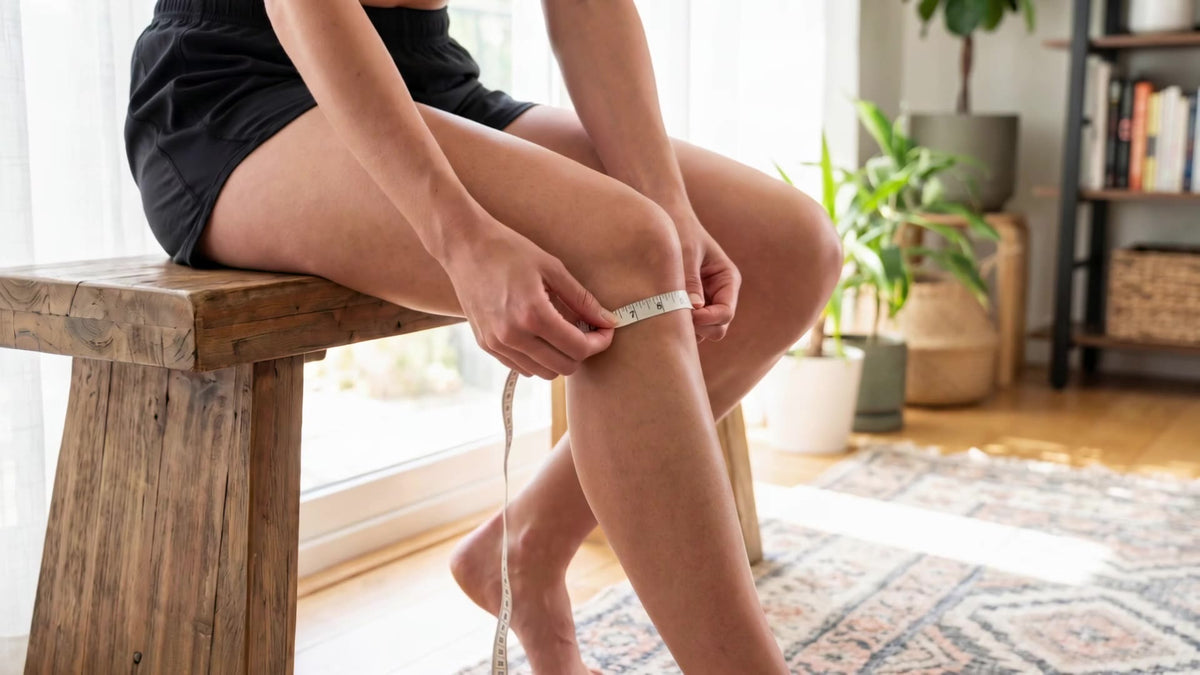
Sit with your knee slightly bent and measure around the center of the knee, across the middle of the kneecap. This is where the main compression zone of a knee sleeve sits, so it is the measurement that decides how the sleeve feels when you move.
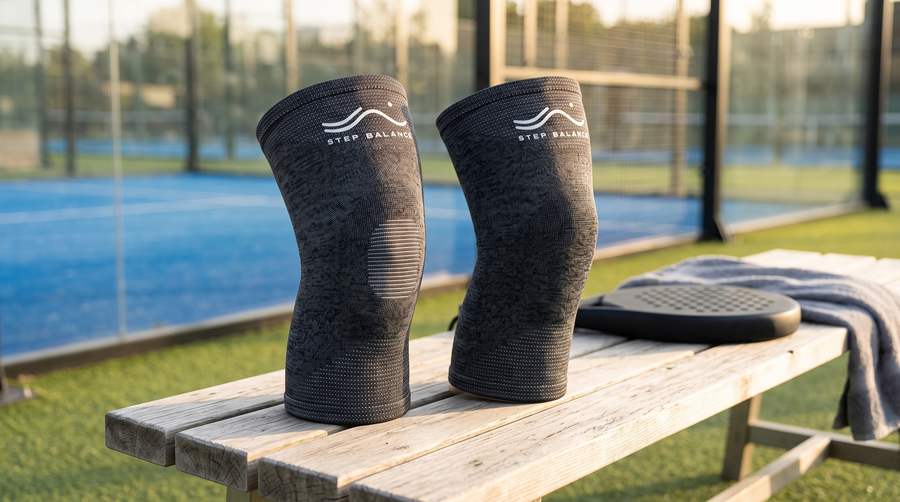
Our Knee Support Sleeve: S 30–38 cm, M 38–47 cm, L 47–55 cm. Our Gel Knee Support Sleeve is measured at the same point: S 30–40 cm, M 40–50 cm, L 50–55 cm. Once it is on, the gel ring should surround the kneecap.
Elbow

Rest your forearm on a table with the arm relaxed and measure around the elbow joint. A tensed arm measures larger and gives a misleading number. Our Elbow Support Sleeve: S 18–23 cm, M 23–27 cm, L 27–34 cm. It fits the left or the right arm.
Wrist

Measure around the wrist at its narrowest point. Our Wrist Support Sleeve: S 13–15 cm, M 15–20 cm, L 20–25 cm. Its thumb opening keeps it from riding up the forearm.
Ankle

An ankle sleeve has to pass over the heel and the instep before it reaches the ankle, so ours is sized by EU shoe size rather than by a single tape measurement. Our Ankle Support Sleeve: S 36–38, M 39–41, L 42–45. It has no straps or closures and is thin enough to wear inside a sneaker.
Between two sizes
Choose the larger one. The smaller size would sit at the top of its stretch range and press harder on the joint, for the reason explained above [3]. Most of the fit questions we receive about our supports are about a sleeve feeling snug rather than loose, which is why this is our standing advice. If the larger size slides down when you move, the smaller one is the better fit for you.
Put it on and check the fit
- Start with clean, dry skin and slide the support over your hand or foot and up to the joint.
- Center the compression zone on the joint. For the gel knee sleeve, place the gel ring around the kneecap.
- Smooth out any wrinkles. Folds and rolled edges concentrate the pressure into a narrow band; clinical guidance for medical compression stockings warns against letting them roll down for the same reason [7].
- Do the finger test: you should be able to slide one finger under the edge of the fabric.
- Move: bend and straighten the joint, walk a few steps or do a couple of squats. The sleeve should stay where you put it.
Signs it does not fit
| What you notice | What it usually means | What to do |
|---|---|---|
| It slides down or bunches up when you move | Too big, or placed too low | Reposition it; if it keeps happening, try the smaller size |
| The edges dig in or leave deep marks | Too small | Try the larger size |
| Tingling, numbness, pins and needles, a change in skin color or increasing pain | Too tight, or not suitable for you | Take it off straight away. If the symptoms do not settle, get medical advice [7] |
| An itchy rash under the fabric | Skin irritation | Stop wearing it and ask a pharmacist or doctor if it does not clear |
Even with a perfect fit, wear a support for up to 8 hours at a time and not while you sleep.
What a sleeve can and cannot do
A compression sleeve gives a feeling of support and warmth around the joint. In a small study of 20 healthy, active adults, wearing a knee sleeve (neoprene, in that study) made them more accurate at sensing and reproducing knee angles [6]. That is a sense of support, not mechanical stabilization: a sleeve does not hold a joint in place the way a hinged brace does, and it is not a treatment for an injury.
When to see a professional
A support is not a substitute for a medical assessment. For the knee, the NHS advises getting urgent advice if the knee is very painful, if you cannot move it or put weight on it, if it is badly swollen or has changed shape, if it locks or gives way, or if it is hot and red and you have a fever; and seeing a doctor if knee pain does not improve within a few weeks [8]. The same common sense applies to the ankle, elbow and wrist. If you have a circulation problem, diabetes or reduced feeling in your hands or feet, ask your doctor before wearing any compression product.
Our supports at a glance
| Support | How to size | Sizes | Worth knowing |
|---|---|---|---|
| Knee | Around the center of the knee | S 30–38 · M 38–47 · L 47–55 cm | TPU anti-slip bands inside |
| Gel knee | Around the center of the knee | S 30–40 · M 40–50 · L 50–55 cm | TPR gel ring around the kneecap; not designed for kneeling work |
| Elbow | Around the elbow, arm relaxed | S 18–23 · M 23–27 · L 27–34 cm | Fits the left or right arm |
| Wrist | At the narrowest point | S 13–15 · M 15–20 · L 20–25 cm | Thumb opening keeps it in place |
| Ankle | EU shoe size | S 36–38 · M 39–41 · L 42–45 | Thin enough to wear inside a sneaker |
All five are seamless circular knits with four-way stretch, sold as single sleeves. Each product page has a short video showing how to measure and put the support on, and the Fit & Size Guide has every chart in one place.
Frequently asked questions
Do I need one for each side?
Our supports are sold as single sleeves, so order two if you want both sides covered, and measure each side separately.
My measurement is exactly on the line between two sizes. Which one?
The larger one.
Will the sleeve loosen over time?
Knitted elastic fabric relaxes gradually with wear and washing. Hand wash it in cool water and skip fabric softener, which reduces compression. Replace a sleeve once it no longer stays in place.
Can I wear it over clothing?
No. A sleeve is designed to sit on the skin, where it grips and compresses evenly.
Can I sleep in it?
Our supports are not intended for wearing while you sleep.
Sources
- Hill J, Howatson G, van Someren K, Davidson S, Pedlar C. The variation in pressures exerted by commercially available compression garments. Sports Engineering. 2015;18:115-121. doi:10.1007/s12283-015-0170-x
- MacRae BA, Cotter JD, Laing RM. Compression garments and exercise: garment considerations, physiology and performance. Sports Medicine. 2011;41(10):815-843. doi:10.2165/11591420-000000000-00000
- Thomas S. The use of the Laplace equation in the calculation of sub-bandage pressure. EWMA Journal. 2003;3(1):21-23.
- Beliard S, Chauveau M, Moscatiello T, Cros F, Ecarnot F, Becker F. Compression garments and exercise: no influence of pressure applied. Journal of Sports Science and Medicine. 2015;14(1):75-83. PubMed 25729293
- Engelberger RP, Blazek C, Amsler F, et al. Reproducibility and day time bias correction of optoelectronic leg volumetry: a prospective cohort study. BMC Medical Research Methodology. 2011;11:138. doi:10.1186/1471-2288-11-138
- Herrington L, Simmonds C, Hatcher J. The effect of a neoprene sleeve on knee joint position sense. Research in Sports Medicine. 2005;13(1):37-46. PubMed 16389885
- The Royal Wolverhampton NHS Trust. How do I use my graduated compression stockings? Patient information leaflet. royalwolverhampton.nhs.uk
- NHS. Knee pain. nhs.uk/symptoms/knee-pain
About this guide. Prepared by the Step Balance Research Team, the in-house product and research group behind our insoles, compression supports and recovery tools, designed in Spain. Size bands and fitting instructions come from our own product specifications and how-to videos; statements about compression and health come from the peer-reviewed studies and clinical guidance listed above. This guide is for information only and does not replace advice from a healthcare professional.
 Ankle Support Sleeve
 Elbow Support Sleeve
 Gel Knee Support Sleeve
 Knee Support Sleeve