
7-minute read · By the Step Balance Research Team
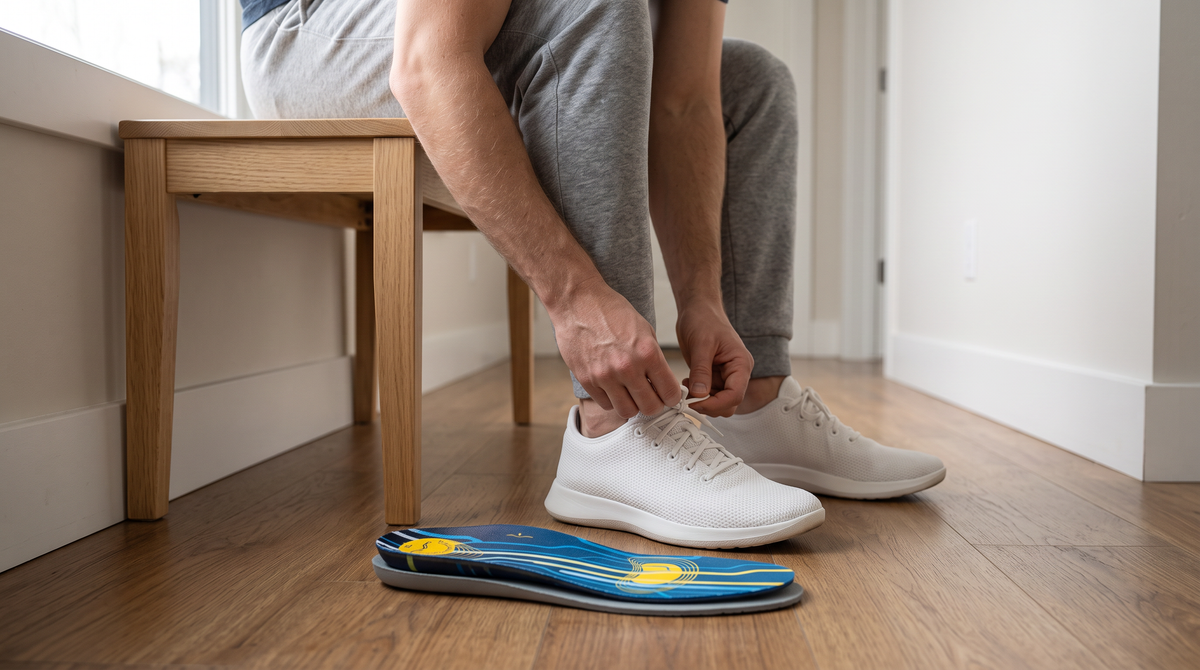
New insoles feel hard? That is expected. Our insoles are built around a firm 2 mm shell, and if you are used to soft foam, the first days feel different: you notice your arch and a small bump under the front of your foot, and your feet may be tired by evening. UK NHS orthotics services build up wear time over about a week [13].
In 30 seconds
- Feeling new insoles at first is common. NHS orthotics services say new insoles may feel uncomfortable at first, like new glasses [12][13].
- Build up slowly. About an hour on day one, then an hour more each day. If your feet ache, stop for the day [13].
- Pain is a stop sign, not a phase. In a trial of 306 naval recruits, 20.3% with contoured insoles reported a side effect vs 12.4% with flat insoles, most often blisters [5].
- Comfort is a useful filter. It reflects real differences in how you move [2], and researchers propose that it keeps you in your natural movement pattern [4].
Why our insoles have a firm shell
Every Step Balance insole has a 2 mm TPU anatomic shell from heel to midfoot, with a molded arch and a metatarsal pad, under softer foams. The foams give the first feel; the shell gives the shape. Soft foam alone feels pleasant in the store but compresses under your weight.
Research favors shape over softness. In a lab study with in-shoe sensors, contoured insoles spread load over a larger area and lowered peak pressure more than flat ones [8]. In a meta-analysis of prevention trials, shock-absorbing insoles showed no significant effect on injuries [7]. We make no injury-prevention claim; the firmness is simply intentional.

Why they feel “too hard” at first
Comfort is relative. In a running lab, the same insert was rated differently after a soft or a hard one [1], so after soft foam a firm shell feels harder. Comfort is also personal: arch height, leg alignment and sole sensitivity shaped which inserts 206 military personnel preferred [3]. And ratings only became reliable after several sessions [1].
Is it normal for new insoles to hurt? Days 1-14
Feeling them is normal. Pain is not. In the recruit trial, blisters (6.6% of participants) and arch pain (3.3%) were the most common side effects [5], and a Cochrane review of two small trials found more rubbing and blistering with contoured orthoses than with flat inserts (risk ratio 1.87) [6]. Recruits train far harder than most of us walk, but the lesson holds: start slowly.
| Usually normal | Stop and get advice |
|---|---|
| Feeling the arch shape [12][13] | Sharp or worsening pain [13][14] |
| Noticing the metatarsal pad [9][10][11] | Blisters, rubbing or red marks [5][6][12] |
| Mildly tired feet, gone by morning [13] | Numbness or tingling [14] |
| “Firmer than my old insoles”, easing day by day [1] | Swelling, heat or a change in skin color [12][14] |
| Discomfort after 7-10 days of gradual wear [13] |
That bump under the front of your foot
The raised area near the front is the metatarsal pad. It should sit just behind the ball of your foot, not under it. In small pressure studies, pads a few millimeters behind the metatarsal heads cut forefoot peak pressure by about a third [9][10], domes about 5 mm behind gave the most balanced result [11], and a pad too far forward could raise pressure [9]. These tested other devices, so they show the principle only. If it feels like a pebble, push the insole fully back and check your size.
How long does it take to break in insoles? A 14-day schedule
No study has tested break-in time for over-the-counter firm insoles, so we follow NHS guidance: an hour on day one, two on day two, and so on, stopping for the day if discomfort starts [13]. Dorset HealthCare builds up faster, to 7 hours or more by day 4 [12]. The sport column is our own suggestion.
| Day | Everyday wear | Sport (our suggestion) | Notes |
|---|---|---|---|
| 1 | 1 hour | None | Factory insole out, laces snug [12][13] |
| 2 | 2 hours | None | Check your feet after each wear [12] |
| 3 | 3 hours | None | Achy? Stop for the day, repeat tomorrow [13] |
| 4 | 4 hours | None | |
| 5 | 5 hours | None | |
| 6 | 6 hours | None | |
| 7 | 7 hours | None | |
| 8 | Full day if comfortable | None | |
| 9-10 | Full day | One short, easy session (20-30 min) | |
| 11-12 | Full day | Normal session, easy to moderate | |
| 13-14 | Full day | Normal training | Still uncomfortable? Get advice [13] |
The 30-second foot check
After each wear, check both feet for [12]:
- Red marks, rubbing or blisters
- Swelling, warmth or a change in skin color
- Cuts or open wounds
Should you remove the original insole? Fit checks
Many “too hard” complaints are really fit problems.
- Choose your usual shoe size (EU 36-45). Unsure? See our size guides.
- Take the factory insole out. Two stacked insoles lift your foot and can rub [12][13].
- Compare outlines. Lay the new insole on the old one; heel and sides should match.
- Seat the heel. Push the insole fully back so it lies flat.
- Stand up. The arch should meet your arch, with the metatarsal pad just behind the ball of the foot [9][10][11].
- Check the room. Your toes should not press on the top of the shoe. Lace-ups work well, and NHS guidance suggests heels under 2.5 cm (1 inch) [13].
- Still not right? Try other shoes or contact us.
Match the insole to the shoe
Sports Performance insoles (4.5-5 mm) go in sneakers and sports shoes. Comfort Every Day insoles (5.5-6 mm) need roomy everyday shoes: they add about half a size and may not fit snug pairs. Slim Fit insoles (3-3.5 mm) suit dress shoes, soccer cleats and other snug shoes. More in our guide to insole size and fit.

Why comfort is your most reliable guide
In 21 recreational runners testing orthoses, 15 measures of movement, force and muscle activity explained about 35% of the differences in comfort [2]. Researchers later proposed the “comfort filter”: we intuitively pick what feels comfortable, which keeps us in our preferred movement path [4].
Caveats: the comfort filter is a hypothesis, and these were small studies. Judge comfort after the wear-in [1]. If discomfort persists after 7-10 days, get advice [13]; it may simply be the wrong insole or shoe for you.
When to stop and see a podiatrist
Stop and see a podiatrist or doctor if you notice any warning sign in the table above, or pain that stops normal activities [12][13][14].
Get urgent help for severe pain, if you cannot walk, or if your foot is hot, swollen and painful [14]. If you have diabetes or reduced feeling in your feet, talk to a healthcare professional before using firm insoles [14]. An insole does not replace a professional assessment.
Where our insoles fit in
Our three insoles come in EU 36-45 and are sold in pairs. All share a carbon-fiber-look PU base, the 2 mm TPU anatomic shell with a molded arch, a metatarsal pad, and super-rebound and extra-absorption foams. The shell gives the structure; the foams give the cushioning.
- Sports Performance insoles: 4.5-5 mm, microfiber top, deep heel cup. For running, padel and sports shoes.
- Comfort Every Day insoles: 5.5-6 mm, six layers. For roomy everyday shoes and long days on your feet.
- Slim Fit insoles: 3-3.5 mm, perforated leather top. For dress shoes, soccer cleats and snug shoes.
Not sure which suits your shoes? Try the insole finder or our size guides. Hand-wash and air-dry away from heat. They are sports and wellness accessories, not a treatment for any condition. Read more: how to choose insoles, insoles for running and padel, insoles for standing all day and when to replace insoles.

Frequently asked questions
Is it normal for new insoles to feel hard?
Yes. Comfort is relative [1], and NHS services say new insoles may feel uncomfortable at first [12][13]. Pain, blisters or numbness are not normal [14].
How long does it take to get used to new insoles?
About a week to reach full-day wear if you add an hour a day, as NHS guidance suggests [13]. Add sport in week two. Still uncomfortable after 7-10 days? Get advice [13].
Should I take the original insole out of my shoes?
Yes, if it comes out. Two insoles lift your foot and can rub [12][13].
Why can I feel a bump under the ball of my foot?
That is the metatarsal pad. It should sit just behind the ball of the foot; too far forward, it can raise pressure [9][10][11]. Push the insole fully back.
Can I run or play padel in new insoles straight away?
Better not. Build up everyday wear first [13], then add short, easy sessions (our suggestion). Under heavy training, contoured insoles caused more blisters than flat ones [5].
Sources
- Mündermann A, Nigg BM, Stefanyshyn DJ, Humble RN. Development of a reliable method to assess footwear comfort during running. Gait & Posture. 2002;16(1):38-45. doi:10.1016/s0966-6362(01)00197-7
- Mündermann A, Nigg BM, Humble RN, Stefanyshyn DJ. Orthotic comfort is related to kinematics, kinetics, and EMG in recreational runners. Medicine & Science in Sports & Exercise. 2003;35(10):1710-1719. doi:10.1249/01.MSS.0000089352.47259.CA
- Mündermann A, Stefanyshyn DJ, Nigg BM. Relationship between footwear comfort of shoe inserts and anthropometric and sensory factors. Medicine & Science in Sports & Exercise. 2001;33(11):1939-1945. doi:10.1097/00005768-200111000-00021
- Nigg BM, Baltich J, Hoerzer S, Enders H. Running shoes and running injuries: mythbusting and a proposal for two new paradigms: ‘preferred movement path’ and ‘comfort filter’. British Journal of Sports Medicine. 2015;49(20):1290-1294. doi:10.1136/bjsports-2015-095054
- Bonanno DR, Murley GS, Munteanu SE, Landorf KB, Menz HB. Effectiveness of foot orthoses for the prevention of lower limb overuse injuries in naval recruits: a randomised controlled trial. British Journal of Sports Medicine. 2018;52(5):298-302. doi:10.1136/bjsports-2017-098273
- Hossain M, Alexander P, Burls A, Jobanputra P. Foot orthoses for patellofemoral pain in adults. Cochrane Database of Systematic Reviews. 2011;(1):CD008402. doi:10.1002/14651858.CD008402.pub2
- Bonanno DR, Landorf KB, Munteanu SE, Murley GS, Menz HB. Effectiveness of foot orthoses and shock-absorbing insoles for the prevention of injury: a systematic review and meta-analysis. British Journal of Sports Medicine. 2017;51(2):86-96. doi:10.1136/bjsports-2016-096671
- Tsung BY, Zhang M, Mak AF, Wong MW. Effectiveness of insoles on plantar pressure redistribution. Journal of Rehabilitation Research and Development. 2004;41(6A):767-774. doi:10.1682/jrrd.2003.09.0139
- Hastings MK, Mueller MJ, Pilgram TK, Lott DJ, Commean PK, Johnson JE. Effect of metatarsal pad placement on plantar pressure in people with diabetes mellitus and peripheral neuropathy. Foot & Ankle International. 2007;28(1):84-88. doi:10.3113/FAI.2007.0015
- Hsi WL, Kang JH, Lee XX. Optimum position of metatarsal pad in metatarsalgia for pressure relief. American Journal of Physical Medicine & Rehabilitation. 2005;84(7):514-520. doi:10.1097/01.phm.0000167680.70092.29
- Landorf KB, Ackland CA, Bonanno DR, Menz HB, Forghany S. Effects of metatarsal domes on plantar pressures in older people with a history of forefoot pain. Journal of Foot and Ankle Research. 2020;13:18. doi:10.1186/s13047-020-00388-x
- Dorset HealthCare University NHS Foundation Trust, Orthotics Service. A guide to your insoles. Accessed October 2026. dorsethealthcare.nhs.uk
- Royal Berkshire NHS Foundation Trust, Department of Orthotics. Guidelines for the use of functional foot orthoses (insoles). Patient information leaflet. May 2025. royalberkshire.nhs.uk (PDF)
- NHS. Pain in the ball of the foot. nhs.uk, page last reviewed 5 November 2025. nhs.uk
About this guide. Prepared by the Step Balance Research Team, the in-house product and research group behind our insoles, compression supports and recovery tools, designed in Spain. Product details come from our own specifications; statements about firm insoles, comfort and getting used to new insoles come from the sources listed above. This guide is for information only and does not replace advice from a healthcare professional.


 Sports Performance Insoles
 Comfort Every Day Insoles
 Slim Fit Insoles