
7-minute read · By the Step Balance Research Team
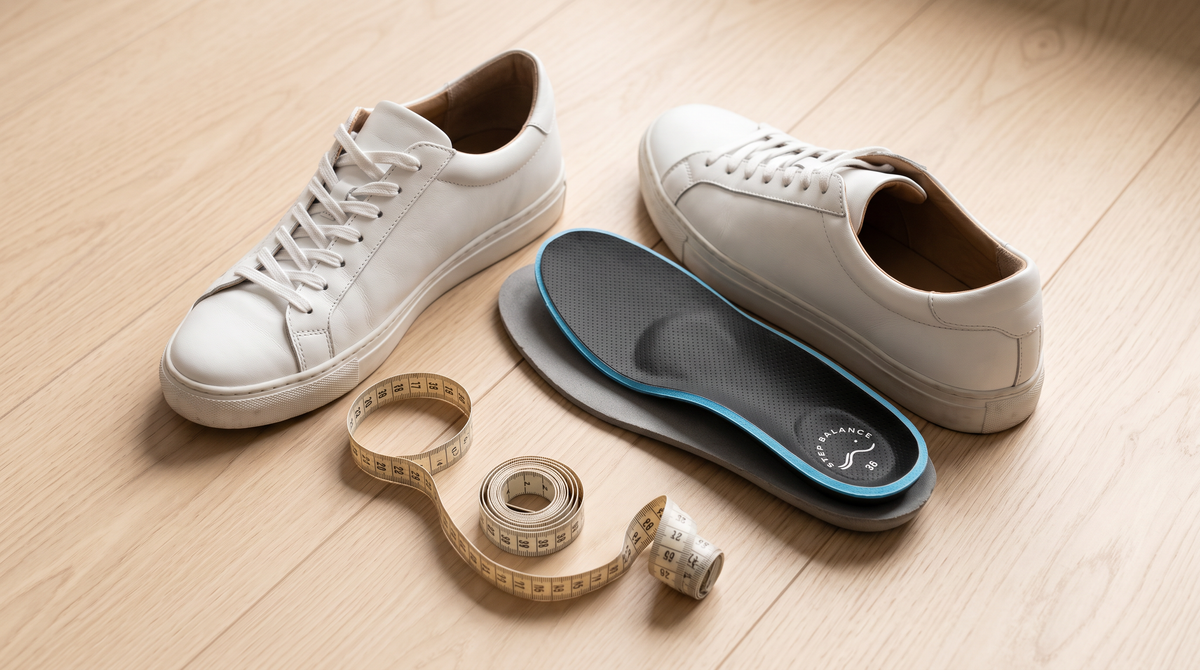
Choosing an insole size is simpler than choosing a shoe size: pick the insole size that matches the EU size printed on the shoe you will put it in. If you wear a 41 in one brand and a 42 in another, go by that specific shoe, not by your feet. Then pick the model by the room inside the shoe: slim for dress shoes and soccer cleats, medium for sports shoes, thicker for roomy everyday shoes.
In 30 seconds
- Match the insole to the shoe, not to your foot. Of 841 women’s running-shoe models labeled US 9, only 60% fit like a true US 9 [5].
- Poor shoe fit is common. In studies, 63-72% of people wore shoes that did not match their foot length or width [1].
- Check fit standing, later in the day. Feet are larger standing [3], and foot volume rose 1.4-2.2% after 30 minutes of standing or running [2].
- Thickness has to suit the shoe. The average shoe is about 2 cm deep at the toes [8]. Keep a thumb’s width in front of your longest toe [8] and a heel that does not slip [10].
Why insole size and fit matter
In a review of 18 studies, 63-72% of participants wore shoes that did not match the width or length of their feet. Too narrow was the most common problem, and tight shoes were strongly linked with foot pain, though these mostly cross-sectional studies show association, not cause [1]. Feet also vary widely: in 1.2 million 3D scans, at least three widths per length were needed to fit 90% of customers [4]. An insole cannot change a shoe’s length or width; it only lifts your foot and fills some of the room.
What size insoles should I get?
Match the EU size on the shoe
Find the EU size inside the tongue or under the factory insole and choose our insole in that size (all three models come in EU 36-45). Take the factory insole out, lay ours on top with heels lined up to compare outlines, then put ours in.
Half sizes: choose the size below
Our insoles come in whole sizes only. If your shoe is a half size, such as EU 42.5 or 42 2/3, choose the size below (42). A full EU size step is two-thirds of a centimeter (about 6.7 mm), so a half size sits only about 3 mm from the next whole size. The size below fits inside the shoe and at most leaves a few millimeters uncovered at the very tip, in front of your toes. The size above can be slightly too long, so it may press into the toe box or curl up at the tip. The heel cup and arch shell are anchored at the heel, so they stay where they should either way. For UK or US half sizes, convert with the chart below first, then round down: US 9.5 sits between EU 42 and 43, so choose 42. Then lay ours on the factory insole: the outline should match or be slightly shorter at the toes.
Different sizes in different brands
Sizes vary between brands and styles, so US orthopedic surgeons advise judging a shoe by its fit, not its label [9][10]. The ideal foot length varied between running-shoe models of the same brand [5]. Choose the size of each specific shoe.
EU and US sizes
The ISO Mondopoint system defines size from foot measurements [6], but European, UK and US sizes grew up separately, and the international conversion standard calls its own tables only a guideline [7]. US men’s and women’s scales also differ by one to two sizes, depending on the brand [13]. For shoes marked only in US sizes, our size chart gives:
| EU size | US size (our size chart) |
|---|---|
| 36 | 5 |
| 37 | 5.5 |
| 38 | 6 |
| 39 | 6.5 |
| 40 | 7 |
| 41 | 8 |
| 42 | 9 |
| 43 | 10 |
| 44 | 11 |
| 45 | 12 |
Use it as a starting point, since conversions differ by brand and between men’s and women’s systems: go by the EU size whenever the shoe shows one. Full charts are in our size guides.
Your feet change during the day
Measure later in the day, standing up
Feet are larger when they carry your weight: in 31 adults, foot length, heel width and forefoot width were greater standing than sitting [3]. In a small German lab study, women’s foot volume rose 1.4% after 30 minutes of standing and men’s 2.2% after a 30-minute run [2]. No study has tracked feet over a full day for shoe fitting, so timing advice comes from professional guidance: check fit in the afternoon or evening [8][9][10], measure both feet and fit shoes to the larger foot [9][10].
The thumb-width toe room check
The Royal College of Podiatry advises about 1-1.5 cm between your longest toe and the end of the shoe, roughly the width of your thumb, checked standing [8]. US guidance gives 10-13 mm [9][10] and research 10-20 mm [1]. Height matters too: the average shoe is about 2 cm deep at the toes [8].
Which insole for which shoe
Pick the model by the room inside the shoe; toe-box shape also changes the pressure on the toes [12].
| Shoe | Our insole | Thickness |
|---|---|---|
| Dress shoes, loafers, snug shoes | Slim Fit | 3-3.5 mm |
| Soccer cleats | Slim Fit | 3-3.5 mm |
| Running, padel, gym and training shoes | Sports Performance | 4.5-5 mm |
| Roomy everyday sneakers, walking shoes | Comfort Every Day | 5.5-6 mm, adds roughly half a size of volume |
| Shoes with a glued-in insole | Slim Fit only; check room first | 3-3.5 mm |
All three replace the removable factory insole; never stack them on top of it. On a glued-in footbed, even 3-3.5 mm takes about a sixth of a 2 cm toe box [8]. No study has measured how insole thickness changes fit: this table is our product guidance, not research. See also thin insoles for dress shoes and soccer cleats and insoles for running and padel.

How to fit your insoles: a step-by-step check
Allow five minutes, later in the day, in your usual socks.
- Check the size. Choose the insole that matches the EU size printed in the shoe. If it is a half size, such as 42.5, choose the size below.
- Take out the factory insole. If it is glued in, only Slim Fit is an option, and only if there is room.
- Compare outlines. Lay our insole on the factory insole, heels lined up.
- Put it in. Slide it in toe first and press the heel fully back. It should lie flat.
- Stand and check. Lace up as usual [8]. Look for a thumb’s width in front of your longest toe [8], room to wiggle your toes [9] and no pressure on top [10].
- Walk for 2-3 minutes. Your heel should not slip [10], and nothing should rub or pinch.
- Build up the time. The firm shell is intentional and takes a few days to get used to; see our guide to the first two weeks with firm insoles.

Troubleshooting common fit problems
Heel slipping
Your heel should not slip [10]. Seat the insole fully at the back and lace to the top eyelet [8]. If slipping began with a thicker model, try a thinner one. If the shoe slipped before, it is too big: a loose shoe lets the foot slide [11], and no insole fixes that.
Toes touching the end or the top
Toes pressing on top mean the insole is too thick for that shoe: switch to a thinner model. Toes at the end even with the factory insole mean the shoe is too short [8].
Insole curling at the toe
Push the heel fully back, check that no factory insole is left underneath, and confirm the EU size printed on this shoe. If it still curls, the shoe may be unusually narrow or pointed [12]; contact us and we will help.
Shoe feels tight: do insoles make shoes tighter?
They can. US orthopedic surgeons say there is no break-in period for shoes that feel too tight [9]: try a thinner model or refit the factory insole. Too narrow is the most common mismatch [1].
When the shoe is the problem, not the insole
If a shoe is too short, narrow or shallow with its own insole, or the heel slips in the unchanged shoe, no insole will fix it: fit the shoe first [9][10]. Wear new shoes for short periods at first; in military studies, more hours in boots before training meant fewer blisters, a finding about footwear, not insoles [11].
See a podiatrist or doctor before changing footwear if foot pain lasts over two weeks or keeps returning [8], if you have numbness or tingling, or if you have diabetes, as poorly fitting shoes have been linked with foot ulcers [1]. Insoles wear out too: see when to replace insoles.
Where our insoles fit in
All three come in EU 36-45, sold in pairs, with a carbon-fiber-look PU base, an internal 2 mm TPU anatomic shell with molded arch support, a metatarsal pad, and super-rebound and extra-absorption foams.
- Slim Fit insoles: 3-3.5 mm, real perforated leather top, for dress shoes, soccer cleats and snug shoes.
- Sports Performance insoles: 4.5-5 mm, technical microfiber top, high-rebound EVA and a deep heel cup, for running, padel and training shoes.
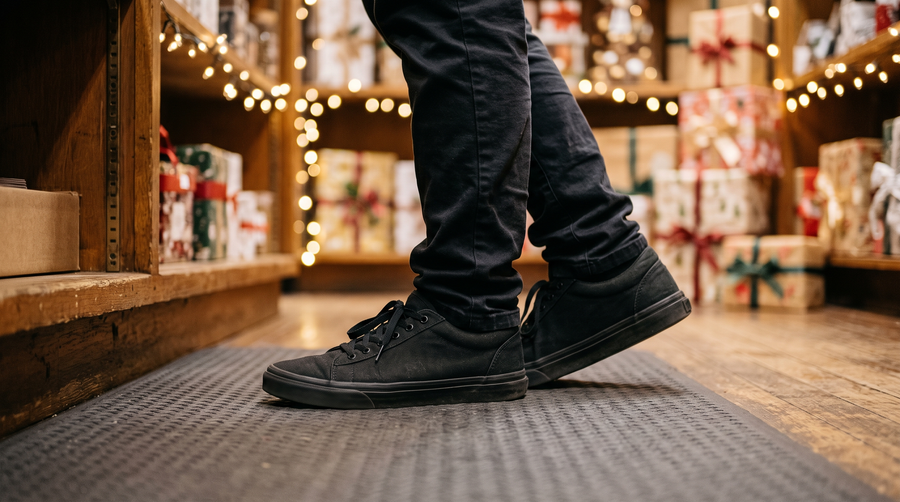
- Comfort Every Day insoles: 5.5-6 mm, six layers with a 3 mm deep-absorption core, for roomy everyday shoes and long days on your feet. By our own guidance they add roughly half a size of volume and may not fit snug shoes.
They are sports and wellness accessories designed in Spain, not a substitute for professional foot care. Our insole finder matches a model to your shoes, our size guides have the full charts, and how to choose insoles gives a wider overview.
Frequently asked questions
What size insoles should I buy?
The EU size printed on the shoe you will wear them in. Compare outlines with the factory insole to confirm.
What size insole should I get if I am a half size?
The size below: for EU 42.5, choose 42. Our insoles come in whole sizes, and the size below fits inside the shoe without pressing into the toe box. Lay it on the factory insole to confirm.
Do insoles make shoes tighter?
They can: they lift your foot, and the average shoe is only about 2 cm deep at the toes [8]. After fitting, check for a thumb’s width at the toe [8] and no heel slip [10].
What size insole should I get if I wear different sizes in different brands?
The size of that specific shoe. Sizes vary between brands and even between models of the same brand [5].
Can I put insoles on top of my existing insoles?
Not ours: all three replace the removable factory insole. If it is glued in, only Slim Fit may work: check room first.
What time of day should I measure my feet?
Afternoon or evening, standing up: feet are larger under body weight [3] and usually largest later in the day [8][9].
Sources
- Buldt AK, Menz HB. Incorrectly fitted footwear, foot pain and foot disorders: a systematic search and narrative review of the literature. Journal of Foot and Ankle Research. 2018;11:43. doi:10.1186/s13047-018-0284-z
- Kunde S, Sterzing T, Milani TL. Der Einsatz von Körperkomposition und sportlicher Aktivität auf die Fußdimension. Deutsche Zeitschrift für Sportmedizin. 2009;60(4). germanjournalsportsmedicine.com
- Sato T, Fukui T, Kawata S, et al. The interrelationship between three-dimensional foot mobility and bodyweight bearing. Journal of Physical Therapy Science. 2023;35(3):199-203. doi:10.1589/jpts.35.199
- Jurca A, Žabkar J, Džeroski S. Analysis of 1.2 million foot scans from North America, Europe and Asia. Scientific Reports. 2019;9:19155. doi:10.1038/s41598-019-55432-z
- Jurca A, Džeroski S. Estimating footwear fit by using 3D foot scans of shoe shoppers. Proceedings of 3DBODY.TECH 2021, Lugano, paper 51. doi:10.15221/21.51
- International Organization for Standardization. ISO 9407:2019 Footwear sizing: Mondopoint system of sizing and marking. Geneva: ISO; 2019. iso.org
- International Organization for Standardization. ISO 19407:2023 Footwear: Sizing: Conversion of sizing systems. Geneva: ISO; 2023. iso.org
- Royal College of Podiatry. Choosing the right shoes for you [patient leaflet]. London: RCPod; 2022 (NHS-hosted copy). hdft.nhs.uk
- American Academy of Orthopaedic Surgeons. Footwear guide. OrthoInfo. Last reviewed April 2019. orthoinfo.aaos.org
- American Orthopaedic Foot & Ankle Society. 10 points of proper shoe fit. FootCareMD. footcaremd.org
- Rushton R, Richie D. Friction blisters of the feet: a critical assessment of current prevention strategies. Journal of Athletic Training. 2024;59(1):8-21. doi:10.4085/1062-6050-0341.22
- Branthwaite H, Chockalingam N, Greenhalgh A. The effect of shoe toe box shape and volume on forefoot interdigital and plantar pressures in healthy females. Journal of Foot and Ankle Research. 2013;6:28. doi:10.1186/1757-1146-6-28
- Sanders JL. Educating patients on the Brannock device and shoe sizes. Podiatry Today (HMP Global Learning Network), 2011. hmpgloballearningnetwork.com
About this guide. Prepared by the Step Balance Research Team, the in-house product and research group behind our insoles, compression supports and recovery tools, designed in Spain. Product details come from our own specifications; statements about shoe fit, foot size and shoe-size conversion come from the sources listed above. This guide is for information only and does not replace advice from a healthcare professional.

 Sports Performance Insoles
 Comfort Every Day Insoles
 Slim Fit Insoles