
8-minute read · By the Step Balance Research Team
Shop floors, wards, kitchens, salons, classrooms and warehouses have one thing in common: hours on your feet with little chance to sit down. By the end of a shift, sore feet and heavy legs are common. This guide looks at what the research says about cushioned insoles for long days standing, what to look for in one, and the other changes that make a bigger difference than any insole on its own.
In 30 seconds
- Standing still is the problem, more than standing itself. Muscles work without a break and blood pools in the lower legs [1][2].
- Cushioning helps: a systematic review found moderate evidence that softer surfaces and cushioned insoles reduce discomfort and fatigue in standing workers [3].
- Cushioning plus shape works better than a soft pad alone: the insole should spread pressure under the arch as well as soften the heel [4].
- Not too soft, not too rigid. Very hard arch supports can feel uncomfortable; very soft soles give little support [4].
- Change position often and walk when you can. No insole replaces movement [1].
Why long hours standing are tiring
Standing is a natural posture and is not harmful in itself. The trouble starts when you stand in one place for most of the day. Keeping the body upright takes constant muscle effort, and muscles that stay tense get less blood flow and tire sooner. Without regular walking, blood also tends to pool in the legs and feet. Occupational health bodies list sore feet, swollen legs, general muscle fatigue and low back pain as the most common complaints in jobs that involve prolonged standing [1].
A review by researchers at the US National Institute for Occupational Safety and Health (NIOSH) reached a similar conclusion: prolonged standing at work is associated with lower back and leg pain, fatigue and discomfort, and interventions such as floor mats, sit-stand options, suitable shoes and shoe inserts can reduce the strain [2].
What the research says about cushioned insoles
The best summary comes from a 2018 systematic review of studies on softer flooring and cushioned insoles for people who stand at work. It found moderate evidence that cushioned materials reduce musculoskeletal discomfort and fatigue, and limited evidence that insoles do better than anti-fatigue mats [3]. The authors also noted that the studies were small and varied, so the effects should not be overstated.
One of the studies behind that conclusion followed assembly-line workers who spent a week of 8-hour shifts in each of four conditions: a hard floor, a floor mat, shoe insoles, and insoles combined with a mat. All three cushioned conditions were rated more comfortable than the hard floor, and the mat and the insoles performed about the same [5]. For anyone who cannot choose their floor, an insole is the cushioning that comes with you.

Cushioning or support? You need both
A 2025 review of footwear for people in prolonged standing jobs looked at how sole and insole design affect foot comfort [4]. Its findings are useful when choosing an insole:
- Soft soles reduce impact and fatigue but give limited support.
- Hard soles improve stability but can create local pressure points.
- Most insoles help by spreading pressure more evenly, mainly by loading the arch instead of leaving the heel and forefoot to carry everything.
- Semi-rigid arch supports can cause discomfort, so the firmness of the arch matters.
In practice, a good insole for standing combines a cushioned layer that softens each step with a contoured arch that shares the load, without a hard, unforgiving shell. Custom orthotics made by a podiatrist performed best for comfort in the studies reviewed [4]; a well-designed off-the-shelf insole is a practical first step for people without a diagnosed foot problem.
What to look for in an insole for standing all day
| Feature | Why it matters for standing |
|---|---|
| Full-length cushioning | When you stand, the whole sole carries load, not just the heel. A layer that runs from heel to toe softens every contact point. |
| Contoured arch | Lets the arch take part of the load, spreading pressure away from the heel and the ball of the foot [4]. |
| Firm but not rigid base | Keeps the insole's shape through the day without the hard edges that can create pressure points [4]. |
| Breathable top | Long shifts mean warm feet. A perforated or breathable cover is more comfortable over many hours. |
| Right thickness for your shoe | An insole that squeezes your foot against the top of the shoe creates new pressure. Remove the factory insole first. |
Where Comfort Every Day fits in
Our Comfort Every Day insole was designed for exactly this: long days walking, standing or traveling. It is the most cushioned insole in our range, with six layers:
- a perforated microfiber top cover that lets air circulate;
- a 3 mm full-length deep-absorption core between two layers of super-rebound foam, so the cushioning runs from heel to toe;
- an extra deep-absorption heel pad;
- an anatomic TPU shell from heel to midfoot, with a molded arch and metatarsal support, that keeps the insole's shape, on a carbon-fiber-look PU base.
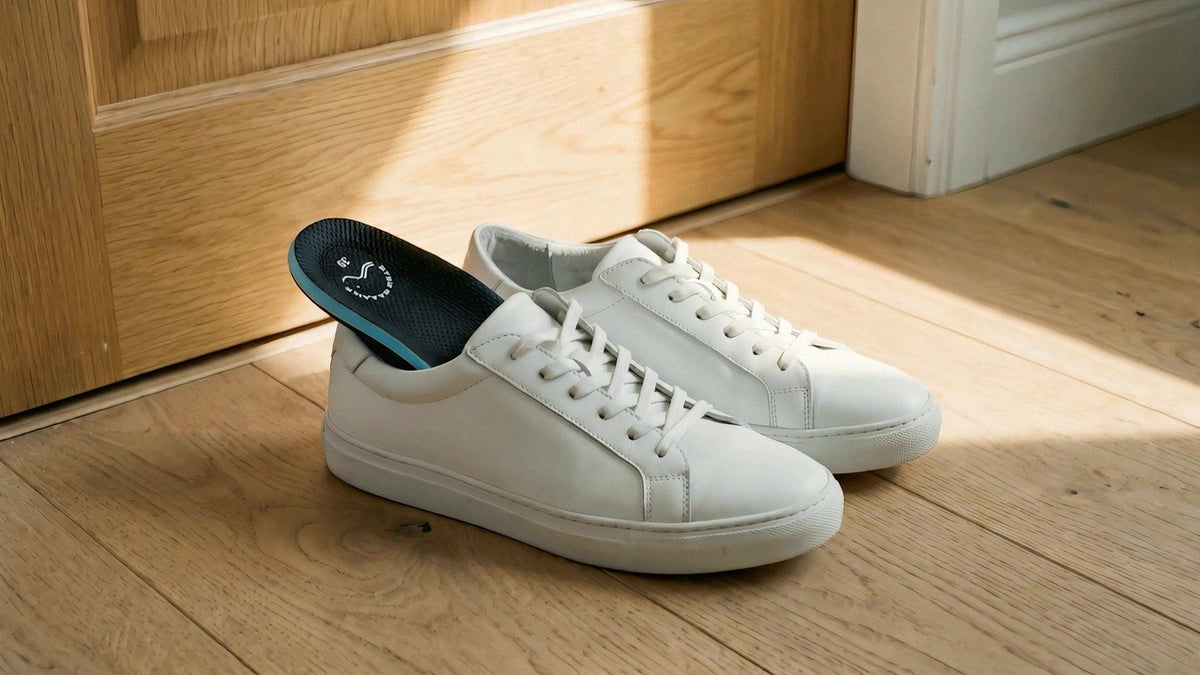
It is 5.5 to 6 mm thick, so it suits sneakers, work shoes and casual shoes with a removable insole. It comes in EU sizes 36 to 45 (US 5 to 12), sold as a pair. If you stand in close-fitting dress shoes, our 3 mm Slim Fit is the better fit; if your day includes training or sport, see Sports Performance. Our guide How to choose the right insole compares all three.

Beyond the insole: what makes the biggest difference
Occupational health guidance is clear that the way the work is organized matters as much as what is under your feet [1]. These habits are worth more than any single product:
- Change position often. Shift your weight, take a few steps, and sit whenever the task allows.
- Use a footrest or rail to rest one foot at a time and change the load between legs.
- Choose shoes that fit: enough room to move your toes, a heel that grips, laces you can tighten, and a low heel rather than a flat or high one [1].
- Stand on something softer if you can. Wood, cork, rubber or an anti-fatigue mat are kinder than concrete [1].
- Use your breaks to move, not only to stand still somewhere else.
Getting used to a new insole
- Take the factory insole out of your shoe and put the new one in, heel right at the back.
- Wear them for an hour or two on the first day, then add time over the following days.
- Expect the arch to feel noticeable at first. That usually settles within a few days as your feet get used to it.
- If you feel a sharp or increasing pain, stop wearing them and check the size and fit.
When to see a professional
An insole is a comfort product, not a treatment. The NHS advises seeing a doctor if foot pain stops you doing normal activities, is getting worse or keeps coming back, has not improved after two weeks of home care, or comes with tingling, loss of feeling or weakness, and to get advice early if you have diabetes [6]. A podiatrist or physical therapist can assess whether you need a custom orthotic.
Frequently asked questions
Are gel insoles better for standing?
The research does not single out one material. What matters is cushioning combined with a shape that spreads pressure [3][4]. A soft pad on its own may feel good at first but gives little support over a long shift.
Insoles or an anti-fatigue mat?
In a direct comparison they performed about the same, and both beat a hard floor [5]. A mat only helps where it lies; an insole goes wherever you walk.
Can I use them in safety shoes?
Many safety shoes have a removable insole, but check with the shoe manufacturer first: replacing the insole can affect the shoe's certification.
How long do they last?
With daily use, cushioning usually starts to feel flatter after 6 to 12 months. Replace them when the heel area no longer springs back.
Sources
- Canadian Centre for Occupational Health and Safety (CCOHS). Working in a standing position: basic information. OSH Answers fact sheet. ccohs.ca
- Waters TR, Dick RB. Evidence of health risks associated with prolonged standing at work and intervention effectiveness. Rehabilitation Nursing. 2015;40(3):148-165. doi:10.1002/rnj.166
- Speed G, Harris K, Keegel T. The effect of cushioning materials on musculoskeletal discomfort and fatigue during prolonged standing at work: a systematic review. Applied Ergonomics. 2018;70:300-314. doi:10.1016/j.apergo.2018.02.021
- Kang LP, Gong TS, Quan XH, Zhang C. Influence of footwear on foot comfort of workers engaged in prolonged standing occupations: a systematic review. Safety and Health at Work. 2025 (online), 17(1):24-32. doi:10.1016/j.shaw.2025.10.003
- King PM. A comparison of the effects of floor mats and shoe in-soles on standing fatigue. Applied Ergonomics. 2002;33(5):477-484. doi:10.1016/s0003-6870(02)00027-3
- NHS. Pain in the bottom of the foot. nhs.uk
About this guide. Prepared by the Step Balance Research Team, the in-house product and research group behind our insoles, compression supports and recovery tools, designed in Spain. Product details come from our own specifications; statements about standing, comfort and health come from the peer-reviewed studies and public health guidance listed above. This guide is for information only and does not replace advice from a healthcare professional.

 Sports Performance Insoles
 Comfort Every Day Insoles
 Slim Fit Insoles