
7-minute read · By the Step Balance Research Team
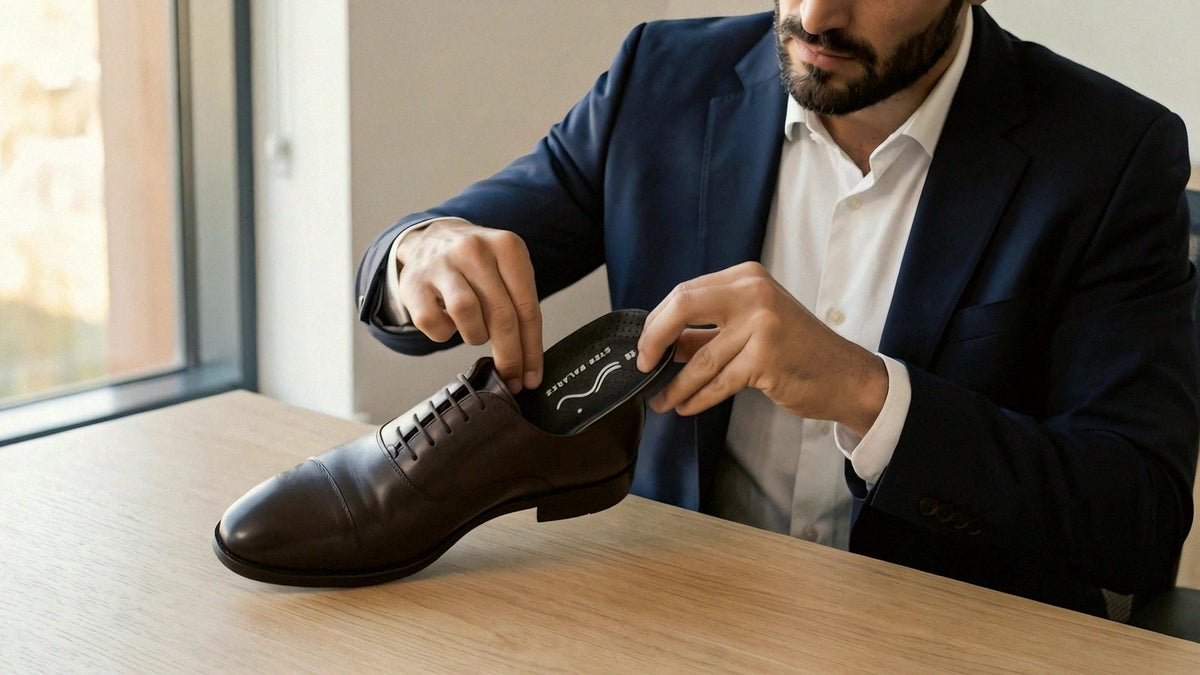
Dress shoes, loafers, ankle boots and soccer cleats have one thing in common: there is very little room inside. An insole that works well in a sneaker can make them tight, lift the heel out of the shoe or press the toes against the top. This guide explains what the research says about fit in low-volume footwear, how to check whether a shoe has space for an insole, and how to fit a thin one properly.
In 30 seconds
- Fit comes first. Around two in three people wear shoes that do not match the length or width of their feet, and poor fit is linked with foot pain, corns and calluses [1].
- Soccer cleats are often worn small. In a study of almost 200 players, about one in four wore cleats that were too small [2].
- Replace, don't stack. Take out the original liner where you can, and check that the new insole lies flat [11][12].
- Thin does not mean flat. A slim insole can still have shape: a contoured arch, a metatarsal pad and a heel pad.
- Comfort is a guide, not a pressure gauge. In soccer cleats, how comfortable a cleat felt was a poor predictor of the pressure under the foot [6].
Why low-volume shoes need a different insole
Most shoes are designed around the liner they come with. A running shoe usually has space for a cushioned insole of 4 to 6 mm. In a leather dress shoe, a loafer or a soccer cleat, the upper sits close to the foot, so every millimeter counts. Add a thick insole and the foot rises: the heel can slip, the toes press against the top of the shoe and the shoe no longer holds the foot where it was designed to.
Fit problems are common. A systematic review of 18 studies found that between 63% and 72% of participants wore shoes that did not fit the length or width of their feet, and that poor fit was associated with foot pain, toe deformities, corns and calluses [1]. Most of those studies were cross-sectional, so they show a link rather than a cause. The message for anyone adding an insole is still clear: do not make a tight shoe tighter.
Soccer cleats: snug by design
Many players choose a close-fitting cleat for a better feel of the ball. In a German study of 198 youth and adult players, 27% wore cleats that were too small [2]. An Australian survey of 576 players found that foot pain caused by cleats was common, and that fewer than half of players asked for advice before buying cleats [3].
The loads inside a cleat are considerable. In international players doing repeated 35 m sprints on artificial turf, sensors inside the cleats recorded peak forces of around 1,900 to 2,200 N under the whole foot [4]. What sits under the foot can change how that load is spread. A small study of academy players tested two cleats with two different insoles: the insoles changed peak pressure under the heel and the outside of the forefoot, especially when braking to turn, and the best result depended on the combination of cleat and insole rather than on either one alone [5].
Two further studies add a useful caution. Players' comfort ratings were only weakly related to the pressure measured inside the cleat [6]. Yet in a 90-minute match simulation, the cleat with higher pressure under the foot caused more foot discomfort in the last 30 minutes [7]. A quick try-on in the store does not tell you everything, so judge a cleat and insole over a full training session.
An honest note: no study has shown that an insole prevents soccer injuries. What a thin insole can do is give the foot a shaped, cushioned surface without taking up the room the cleat needs.
Dress shoes and heels
Formal shoes bring a different challenge: a firm sole and, often, a raised heel. As the heel gets higher, more load moves to the ball of the foot. In a study of 35 women, peak pressure under the forefoot rose significantly from sneakers to 2-inch and 3-inch heels, and the peak moved toward the big toe [8]. The American Academy of Orthopaedic Surgeons (AAOS) notes that pressure under the ball of the foot may double as heel height increases [10].
Shape under the foot can help spread that load. In a lab study of 20 young women walking in flat shoes and in 3.8 cm and 7.6 cm heels, a full-contact insert reduced peak pressure under the inner forefoot, with the largest effect in the highest heel, and improved comfort ratings [9]. That study did not test a thin leather insole and measured short walks in a lab, so read it as a sign of what shape can do, not as a promise.

How to check whether your shoe has room
- Try shoes late in the day, with the socks you will wear. Feet are slightly larger by the evening [10].
- Look for a removable liner. Lift the back of the original liner. If it comes out, the new insole goes in its place. NHS insole leaflets advise removing the original insole where possible [11][12].
- Compare outlines. Lay the new insole on top of the old one: the length and the shape at the toe should match.
- Check that it lies flat. Inside the shoe, the insole should sit flat, with no folds or creases [12].
- Stand and walk. You should be able to wiggle your toes, with about 1 cm of space beyond the longest toe, and your heel should not lift out at each step [10].
- Build up wear. A shoe that fits should feel comfortable from the start; AAOS says there is no such thing as a break-in period [10]. The arch and metatarsal pad of a new insole can feel noticeable at first, so start with an hour or so and add time each day [11].
If the liner is glued in, as in many dress shoes, a thin insole can only go on top if the shoe has a little spare room. If your toes or heel feel squeezed, that pair is not a good candidate.
| Shoe | Original liner | What to check |
|---|---|---|
| Leather dress shoes | Often glued in | Toe room and heel hold with the insole on top |
| Loafers | Often glued in | Heel slip: with no laces, there is little to compensate |
| Ankle boots | Often removable | Length at the toe and the heel seated in the heel cup |
| Soccer cleats | Usually a removable sock liner | Replace the liner; check toe room with match socks on |
| Heeled shoes | Usually glued in | Only if there is spare room; toe space matters most |
Our Slim Fit insole
Our Slim Fit insole is made for exactly these shoes. It measures 3 to 3.5 mm and has five thin layers: a real perforated leather top over a thin super-rebound foam, and a deep-absorption heel pad set into an anatomic TPU shell with a molded arch and metatarsal support, on a carbon-fiber-look PU base. It comes in EU sizes 36 to 45 (US 5 to 12), sold in pairs, and you choose it by your usual shoe size. Leather is one of the breathable materials the NHS suggests for feet [13]. For roomier everyday shoes, see Comfort Every Day; for running and court shoes, Sports Performance. Not sure which suits you? Our guide on how to choose the right insole walks through it.

Frequently asked questions
Will a thin insole change my shoe size?
It should not, if it replaces the original liner. If the liner is glued in and the insole goes on top, check toe and heel room carefully before you wear the shoes for a full day.
Can I use Slim Fit in soccer cleats?
Yes, if the cleat has a removable sock liner: take it out, fit the insole in its place and check toe room with your match socks on. Try it in training before a match.
Why does the arch feel firm at first?
The contoured arch and metatarsal pad give the insole its shape. Most people notice them in the first days, which is why we suggest building up wear gradually [11].
Can I trim it to fit?
Our insoles are made in fixed EU sizes and are not designed to be trimmed. Choose your usual shoe size and compare the outline with your original liner.
When should I see a professional?
If foot pain lasts more than a few weeks, or comes with numbness or tingling, see a podiatrist before changing your insoles [14]. The same applies if you have diabetes.
Sources
- Buldt AK, Menz HB. Incorrectly fitted footwear, foot pain and foot disorders: a systematic search and narrative review of the literature. Journal of Foot and Ankle Research. 2018;11:43. doi:10.1186/s13047-018-0284-z
- Becker S, Maurer L, Dindorf C, Dully J, Fröhlich M, Ludwig O. A potential relationship between soccer shoes and pes cavus: a pilot study. BMC Sports Science, Medicine and Rehabilitation. 2025;17(1):185. doi:10.1186/s13102-025-01242-y
- Phillips CR, Menz HB, Cotchett M, et al. Understanding boot preferences, experiences and beliefs of footballers in Australia: a cross-sectional online survey. Science and Medicine in Football. 2026:1-11. doi:10.1080/24733938.2026.2701677
- Girard O, Millet GP, Thomson A, Brocherie F. Is plantar loading altered during repeated sprints on artificial turf in international football players? Journal of Sports Science and Medicine. 2018;17(3):359-365. PubMed 30116108
- Nunns M, Dixon S, Clarke J, Carré M. Boot-insole effects on comfort and plantar loading at the heel and fifth metatarsal during running and turning in soccer. Journal of Sports Sciences. 2016;34(8):730-737. doi:10.1080/02640414.2015.1069378
- Okholm Kryger K, Jarratt V, Mitchell S, Forrester S. Can subjective comfort be used as a measure of plantar pressure in football boots? Journal of Sports Sciences. 2017;35(10):953-959. doi:10.1080/02640414.2016.1206661
- Okholm Kryger K, Mutamba K, Mitchell S, Miller SC, Forrester S. Physical performance and perception of foot discomfort during a soccer-specific match simulation. A comparison of football boots. Journal of Sports Sciences. 2021;39(9):1046-1054. doi:10.1080/02640414.2020.1856461
- Mandato MG, Nester E. The effects of increasing heel height on forefoot peak pressure. Journal of the American Podiatric Medical Association. 1999;89(2):75-80. doi:10.7547/87507315-89-2-75
- Hong WH, Lee YH, Chen HC, Pei YC, Wu CY. Influence of heel height and shoe insert on comfort perception and biomechanical performance of young female adults during walking. Foot & Ankle International. 2005;26(12):1042-1048. doi:10.1177/107110070502601208
- American Academy of Orthopaedic Surgeons. Footwear guide. OrthoInfo. orthoinfo.aaos.org
- Royal Devon University Healthcare NHS Foundation Trust, Podiatry. Advice for wearing orthotic (insole) devices. Patient leaflet 275. royaldevon.nhs.uk
- Rotherham Doncaster and South Humber NHS Foundation Trust. Insoles/foot orthoses. Patient leaflet. dbth.nhs.uk
- NHS. Smelly feet. nhs.uk
- Royal College of Podiatry. Sore feet. rcpod.org.uk
About this guide. Prepared by the Step Balance Research Team, the in-house product and research group behind our insoles, compression supports and recovery tools, designed in Spain. Product details come from our own specifications; statements about footwear fit and plantar pressure come from the studies and health-service sources listed above. This guide is for information only and does not replace advice from a healthcare professional.

 Sports Performance Insoles
 Comfort Every Day Insoles
 Slim Fit Insoles