
6-minute read · By the Step Balance Research Team
Insoles do not fail overnight. The cushioning flattens a little at a time, the top cover wears, and one day the shoe simply does not feel the same. This guide explains how cushioning materials wear out, the signs that an insole needs replacing, how often to expect that, and how to care for insoles so they last as long as they should.
In 30 seconds
- Cushioning wears out gradually, and much of the change happens early in a material's life [1][2].
- You probably will not feel it. Runners did not notice a 16% to 33% loss of heel cushioning in their shoes [3]. Look at your insoles; do not rely on feel alone.
- Our guidance: with daily use, replace Step Balance insoles every 6 to 12 months, or sooner if you see signs of wear.
- Clean gently: mild soap and cool water, then air dry fully, away from radiators and hair dryers [5][6].
- Keep things dry: take insoles out to air, rotate your shoes and wear clean socks every day [7][8].
How cushioning wears out
Most of the research on cushioning wear comes from running shoes, whose foam midsoles are made of materials similar to insole foams. In a classic laboratory study, running shoes kept about 75% of their original shock absorption after the equivalent of 80 km, about 67% after 160 to 240 km, and less than 60% somewhere between 400 and 800 km. Shoes worn by real runners kept around 70% at 800 km. Price and brand made no difference [1].
Insole materials behave in a similar way. In a lab test that pressed insole materials 100,000 times to simulate walking, every material combination lost performance, and the greatest losses came in the first 10,000 cycles [2]. In other words, foam settles quickly at first, then more slowly.
The surprising part is how little we notice. In a study of 15 runners, the heel cushioning of their shoes fell by 16% to 33% after 480 km, yet none of them reported feeling a difference [3]. Another study found that as cushioning wore down, runners subtly changed how they ran, so the forces measured at the ground stayed about the same [4]. Worn cushioning has not been shown to cause injuries, but it does change what is under your foot, which is why a regular visual check is worth doing.
Signs it is time to replace your insoles
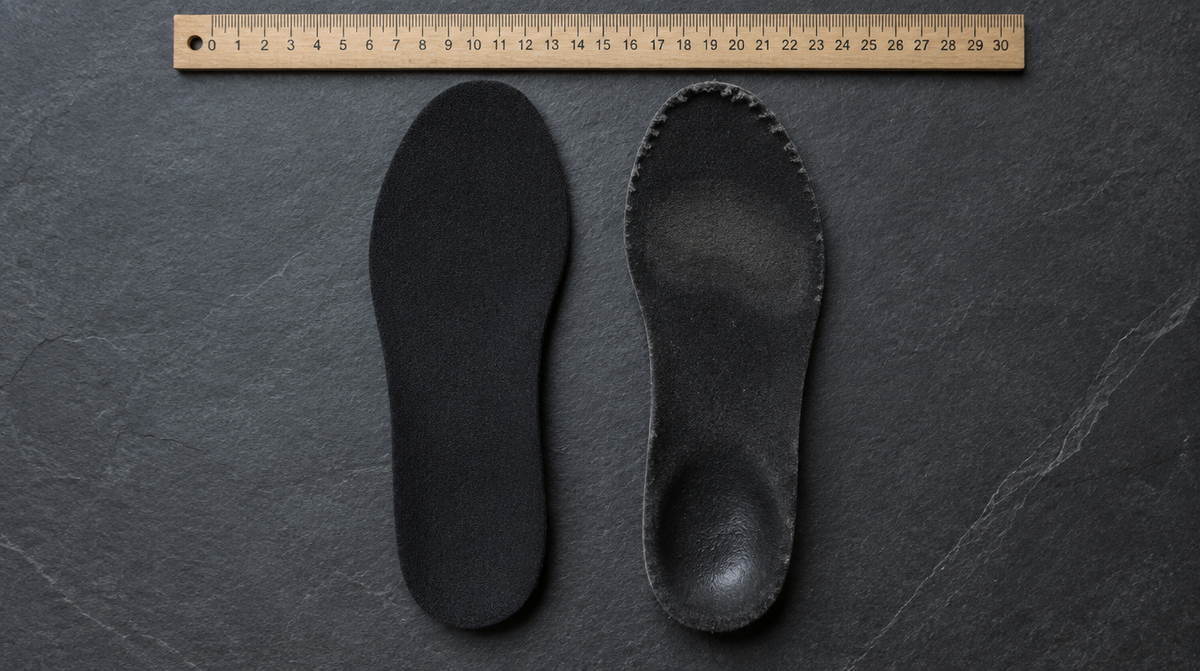
- The heel or forefoot looks visibly flattened or has a deep footprint pressed into it.
- The top cover is worn through, peeling or torn.
- The insole has cracked, lost its shape or no longer lies flat in the shoe.
- An odor remains even after cleaning and drying.
- The comfort you had at first has gone, or discomfort you had before has come back.
How often?
There is no single clinical rule for everyday insoles. NHS services that supply prescribed insoles give a range of about 12 to 24 months for those devices, depending on use and type, and some trusts say around a year [5][6][7]. Prescribed orthoses are built differently from retail insoles, so treat those figures as a reference point rather than a target.
Our own care guidance for Step Balance insoles is 6 to 12 months with daily use. The more you are on your feet, the closer to 6 months you should check:
| How you use them | When to check closely |
|---|---|
| Daily, long hours standing or walking | From about 6 months |
| Daily, mostly seated work and commuting | From about 9 to 12 months |
| Sport three or more times a week | Every 3 months, and replace when you see the signs above |
| Occasional use | Once or twice a year |
Always replace both insoles together, and consider fresh insoles when you change to new shoes, so that both start in good condition.
How to care for insoles
- Air them. Take insoles out of your shoes from time to time, ideally at night, so both can dry [7].
- Clean by hand. Wipe or gently hand wash with mild soap and cool water [5][6]. Do not put them in the washing machine or tumble dryer.
- Dry naturally. Let them air dry completely before you put them back. Keep them away from radiators, hair dryers and direct heat, which can distort the material [5][7].
- Rotate your shoes. The NHS advises not wearing the same pair for more than 2 to 3 days in a row, and letting shoes dry out between wears [8][9].
- Look after your feet too. Dry them well after washing, especially between the toes, and wear clean socks every day [8].
Sweat and damp are what allow foot odor and athlete's foot to take hold, so keeping feet, socks and insoles dry is the best prevention [8][9]. If you think you have athlete's foot, a pharmacist can advise on treatment [8].

Our insoles
All three Step Balance insoles, Comfort Every Day, Sports Performance and Slim Fit, share an anatomic TPU shell with a molded arch and metatarsal support, which helps them keep their shape, on a carbon-fiber-look PU base. The full care instructions for every product are on our Product Care page.
Frequently asked questions
Can I put my insoles in the washing machine?
No. Machine washing and tumble drying can damage the layers and the glue that holds them together. Hand wash with mild soap and let them air dry.
Does a smell mean I need new insoles?
Not necessarily. Clean them, let them dry fully and rotate your shoes. If the odor comes back quickly after cleaning, or the insole also shows wear, it is time to replace it.
Can I move insoles between shoes?
Yes, as long as each shoe has room and the insole lies flat. Insoles used in several pairs every day will wear sooner.
Do I need to replace both insoles if only one looks worn?
Yes. Replace them as a pair so that both feet have the same support and cushioning.
Sources
- Cook SD, Kester MA, Brunet ME. Shock absorption characteristics of running shoes. American Journal of Sports Medicine. 1985;13(4):248-253. doi:10.1177/036354658501300406
- Foto JG, Birke JA. Evaluation of multidensity orthotic materials used in footwear for patients with diabetes. Foot & Ankle International. 1998;19(12):836-841. doi:10.1177/107110079801901208
- Cornwall MW, McPoil TG. Can runners perceive changes in heel cushioning as the shoe ages with increased mileage? International Journal of Sports Physical Therapy. 2017;12(4):616-624. PubMed 28900568
- Kong PW, Candelaria NG, Smith DR. Running in new and worn shoes: a comparison of three types of cushioning footwear. British Journal of Sports Medicine. 2009;43(10):745-749. doi:10.1136/bjsm.2008.047761
- Royal Devon University Healthcare NHS Foundation Trust, Podiatry. Advice for wearing orthotic (insole) devices. Patient leaflet 275. royaldevon.nhs.uk
- University Hospitals Birmingham NHS Foundation Trust, Orthotics. Orthotic insoles. Patient information. uhb.nhs.uk
- Rotherham Doncaster and South Humber NHS Foundation Trust. Insoles/foot orthoses. Patient leaflet. dbth.nhs.uk
- NHS. Athlete's foot. nhs.uk
- NHS. Smelly feet. nhs.uk
About this guide. Prepared by the Step Balance Research Team, the in-house product and research group behind our insoles, compression supports and recovery tools, designed in Spain. Product details come from our own specifications; statements about cushioning wear and foot hygiene come from the studies and health-service sources listed above. This guide is for information only and does not replace advice from a healthcare professional.

 Sports Performance Insoles
 Comfort Every Day Insoles
 Slim Fit Insoles