

7-minute read · By the Step Balance Research Team
Foam rollers have become a fixture in gyms, and handheld wooden rollers are a common sight in physical therapy clinics and sports bags. Both promise looser muscles before training and less soreness after it. This guide looks at what the research actually shows, where a handheld roller and a foam roller differ, and how to use one well.
In 30 seconds
- Rolling reliably improves range of motion for a short time, about as much as stretching [1][2].
- Before training it can help a little and does not reduce strength [2][3].
- After training it can ease the feeling of soreness slightly; it does not speed up the repair of damaged muscle [2][4][5].
- Foam roller or handheld roller? Both work in the studies. Foam suits the back and large muscles; a handheld roller gives you control and travels anywhere [2].
- Dose: 30 to 60 seconds per muscle before training, around 90 seconds per muscle after [3][5].
Two tools, one idea
Both tools apply rolling pressure to a muscle. The difference is where the pressure comes from. With a foam roller, you lie on the roller and use your body weight. With a handheld roller (also called a roller massager or massage stick), you hold the handles and press with your arms. Researchers describe the handheld version as a more portable device that uses the upper body, rather than body weight, to provide the rolling force [3].

What the research shows
Range of motion: a clear, short-term effect
The strongest finding is for flexibility. A 2020 meta-analysis of 26 high-quality trials found that rolling produced a large, immediate improvement in joint range of motion compared with doing nothing, and was about as effective as stretching [1]. Even very short bouts work: in one study, rolling the hamstrings with a handheld roller for 5 to 10 seconds increased sit-and-reach range by about 4%, with no loss of muscle strength [3].
Performance before training: small but real
A 2019 meta-analysis of 21 studies looked at rolling before exercise. It found a small improvement in sprint performance and flexibility, and negligible effects on jumping and strength [2]. Importantly, rolling before exercise did not reduce strength or jump performance. A later meta-analysis found that rolling as a warm-up performs at least as well as stretching, and slightly better than static stretching in some situations [6]. The same research group found that rolling regularly for weeks does not, on its own, improve performance [7].
After training: a little less soreness, not faster repair
Rolling after exercise reduced the perception of muscle pain in the 2019 meta-analysis, and slightly lessened the drop in sprint and strength performance [2]. A systematic review of rolling duration found that relief of soreness is the best-supported benefit, with about 90 seconds per muscle appearing to be a useful minimum [5]. However, a 2023 meta-analysis that looked at measurable markers of muscle damage found no clear difference between rolling and doing nothing [4]. The honest summary: rolling may make you feel less sore, but it does not repair muscle faster.
The authors of the 2019 meta-analysis summed it up well: the effects are rather small, but can be relevant, and the evidence supports rolling more as a warm-up than as a recovery tool [2].
Foam roller or handheld roller?
The 2019 meta-analysis compared the two types of device. Before exercise, the differences were too small to matter in practice. After exercise, foam rollers showed a tendency toward a larger effect on the recovery of strength, but the number of studies was small [2]. So the choice comes down mostly to practicality:
| Foam roller | Handheld roller | |
|---|---|---|
| Pressure comes from | Your body weight | Your arms |
| Control over pressure | Adjusted by shifting your weight | Fine control, easy to go lighter |
| Best for | Back, glutes, large leg muscles | Calves, thighs, forearms, shoulders |
| Where you can use it | On the floor, with space | Seated, standing, at the side of a field or court |
| Portability | Bulky | Fits in a sports bag |
Many people use both: a foam roller at home for the back and hips, and a handheld roller in the gym bag for a quick warm-up of the legs before training or a match.
Why wood?
The studies compare devices by how they apply pressure, not by material, so there is no evidence that wood works better than foam or plastic. What wood does change is the feel. Solid wood does not compress, so the pressure is more direct than with a soft foam roller. Rollers made of separate rings also follow the curve of a muscle more closely than one solid cylinder. Because of that firmer feel, start with light pressure and build up.

How to use a handheld roller
Before training (1 to 3 minutes in total)
- Choose the muscles you are about to use, for example calves and thighs before running or padel.
- Roll each muscle for 30 to 60 seconds at a steady pace, from one end of the muscle to the other.
- Use moderate pressure: firm but comfortable, never sharp pain.
- Follow with your usual dynamic warm-up.
After training or at the end of the day
- Roll each tired muscle for around 90 seconds [5], more slowly than before training.
- Pause briefly on tight spots, keep breathing, and ease off if it becomes painful.
Avoid rolling directly over bones, joints, the front of the neck, bruises, varicose veins, open wounds or a recent injury. If you have a circulation or clotting disorder, are pregnant, or are recovering from an injury or surgery, ask a healthcare professional first.
Our MuscleGlide
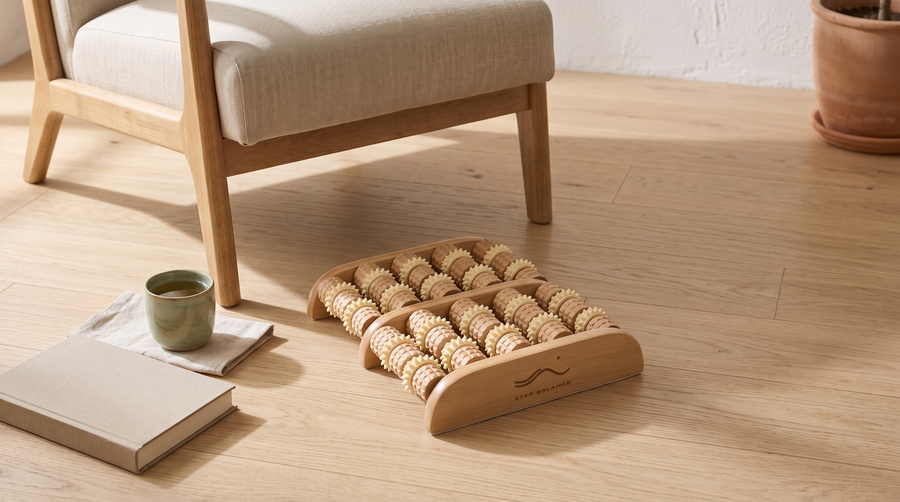
Our MuscleGlide is a handheld wooden roller with nine rings carved from solid Schima wood that turn independently on a steel axle, so each ring follows the shape of the muscle. You hold it by the two handles and set the pressure with your hands. It measures 38.4 cm and weighs 240 g, needs no batteries or charging, and fits in a sports bag. For the soles of the feet, our ReflexRoll foot roller is designed to be used seated, under a desk or by the sofa.
Frequently asked questions
Does rolling break up fascia or "release" knots?
That is a popular explanation, but a review of the possible mechanisms found insufficient evidence that rollers physically release the fascia. The short-term effects are more likely explained by changes in tissue properties and in how the nervous system responds to pressure and stretch [8].
Should rolling hurt?
No. Firm pressure can feel intense, but it should never be sharp. More pain does not mean more benefit.
Can I roll every day?
Short sessions are generally fine for healthy people. Just avoid rolling the same sore spot hard for long periods.
Rolling or stretching?
For range of motion they are about equal [1][6]. Before explosive sport, rolling has the advantage of not reducing strength [3]. Combining the two is fine.
Sources
- Wilke J, Müller AL, Giesche F, Power G, Ahmedi H, Behm DG. Acute effects of foam rolling on range of motion in healthy adults: a systematic review with multilevel meta-analysis. Sports Medicine. 2020;50(2):387-402. doi:10.1007/s40279-019-01205-7
- Wiewelhove T, Döweling A, Schneider C, et al. A meta-analysis of the effects of foam rolling on performance and recovery. Frontiers in Physiology. 2019;10:376. doi:10.3389/fphys.2019.00376
- Sullivan KM, Silvey DB, Button DC, Behm DG. Roller-massager application to the hamstrings increases sit-and-reach range of motion within five to ten seconds without performance impairments. International Journal of Sports Physical Therapy. 2013;8(3):228-236. PubMed 23772339
- Medeiros F, Martins W, Behm D, et al. Acute effects of foam roller or stick massage on indirect markers from exercise-induced muscle damage in healthy individuals: a systematic review and meta-analysis. Journal of Bodywork and Movement Therapies. 2023;35:273-283. doi:10.1016/j.jbmt.2023.04.016
- Hughes GA, Ramer LM. Duration of myofascial rolling for optimal recovery, range of motion, and performance: a systematic review of the literature. International Journal of Sports Physical Therapy. 2019;14(6):845-859. PubMed 31803517
- Konrad A, Tilp M, Nakamura M. A comparison of the effects of foam rolling and stretching on physical performance: a systematic review and meta-analysis. Frontiers in Physiology. 2021;12:720531. doi:10.3389/fphys.2021.720531
- Konrad A, Nakamura M, Behm DG. The effects of foam rolling training on performance parameters: a systematic review and meta-analysis including controlled and randomized controlled trials. International Journal of Environmental Research and Public Health. 2022;19(18):11638. doi:10.3390/ijerph191811638
- Behm DG, Wilke J. Do self-myofascial release devices release myofascia? Rolling mechanisms: a narrative review. Sports Medicine. 2019;49(8):1173-1181. doi:10.1007/s40279-019-01149-y
About this guide. Prepared by the Step Balance Research Team, the in-house product and research group behind our insoles, compression supports and recovery tools, designed in Spain. Product details come from our own specifications; statements about rolling, flexibility and recovery come from the peer-reviewed studies listed above. This guide is for information only and does not replace advice from a healthcare professional.
 MuscleGlide™ Wooden Recovery Stick
 ReflexRoll™ Wooden Foot Massager
 AcuNomad™ Foldable Acupressure Mat
 AcuEarth™ Acupressure Set