
5-minute read · By the Step Balance Research Team
Wood is a natural material that keeps responding to its surroundings long after it has been turned into a tool. It takes up and releases moisture from the air, its grain can rise when it gets wet, and it rewards a little care with a surface that gets smoother with the years. This guide explains how to look after our ReflexRoll and MuscleGlide, or any wooden recovery tool, and the wood science behind each step.
In 30 seconds
- Wipe after use, wash only when needed. A dry or slightly damp cloth after each session is enough most of the time. Never soak wood or put it in the dishwasher.
- Water and heat are what damage wood. Wood swells as it takes up moisture and shrinks as it dries [1], so avoid soaking, radiators, direct sun and leaving tools in a damp bag.
- Oil a few times a year, if the wood looks dry. A thin coat of a non-drying, food-safe oil or a wood balm is enough. Keep oil off the cream TPR spikes and the rubber base.
- Clean, dry wood is not a hygiene problem. Research on wood in contact with food finds that its porous surface tends to be unfavourable for microorganisms [2].
Why wood needs a little care
Wood is hygroscopic: it constantly exchanges moisture with the surrounding air, swelling as it takes up water and shrinking as it dries [1]. A quick wipe with a damp cloth is no problem. Soaking, a dishwasher cycle or drying on a radiator is: the surface swells, the grain lifts and feels rough, and repeated cycles can open small cracks or change how smoothly the rollers turn. Most wood care comes down to one rule: let water in only briefly, and let it leave slowly.
What our tools are made of
| Part | Material | Care |
|---|---|---|
| Frame, rollers, rings and handles | Solid Schima hardwood | Wipe after use; light oil a few times a year |
| Cream spikes (ReflexRoll) | TPR, a soft thermoplastic rubber | Mild soapy water; no oil |
| Base (ReflexRoll) | Rubber | Damp cloth; no oil |
| Axle (MuscleGlide) | Steel | Keep dry; dry straight away if it gets wet |
Cleaning: after every session and once a week
- After each use: wipe with a dry or barely damp cotton cloth to remove sweat and skin oils. Using the tools on clean, dry skin does more for hygiene than any cleaner.
- Once a week, or when it looks dull: dip a cloth in warm water with a drop of mild soap, wring it out well and wipe the wood and the spikes. Use a soft brush for the gaps between rollers and rings.
- Rinse and dry: wipe again with a cloth dampened in clean water, then dry everything with a towel.
- Air-dry: leave the tool at room temperature for a few hours before putting it away, with the rollers free to turn.
Avoid bleach, solvents, abrasive pads and long soaks in disinfectant. If a tool is shared, for example in a studio or gym, wipe it with a cloth lightly moistened with a gentle disinfectant and then dry it; what matters is that the wood never stays wet.

Drying and storage
- Keep the tools away from radiators, heaters and direct sun. Fast drying is what causes small cracks.
- Do not leave the MuscleGlide in a closed, damp sports bag after a session. Take it out at home and let it air.
- If a tool gets soaked (rain, a spilled drink), wipe it and let it dry slowly at room temperature, never with a hairdryer.
- Store it where you use it: the ReflexRoll under the desk or by the sofa, the MuscleGlide in a drawer or on a shelf.
Oiling: a few times a year
Over the months, sweat, washing and dry indoor air can leave wood looking pale and feeling slightly rough. A light coat of oil brings the surface back:
- Make sure the tool is clean and completely dry.
- Put a few drops of a non-drying, food-safe oil (such as a mineral oil sold for wooden chopping boards) or a beeswax wood balm on a soft cloth.
- Rub a thin layer into the frame, handles, rollers and rings, following the grain.
- Leave it for 20 to 30 minutes, then buff off whatever has not soaked in. The surface should feel dry, not sticky.
- Keep oil off the cream TPR spikes and the rubber base: oils can soften some rubbers.
If the grain feels raised after a wash, a very light pass with fine sandpaper (240 grit or finer) along the grain, followed by a little oil, makes it smooth again. Do this only on the wood, never on the spikes.
A safety note on linseed and tung oil
If you prefer a drying oil such as linseed (flax) or tung oil, take care with the cloths. These oils cure by oxidising, which releases heat, and a crumpled pile of oil-soaked rags can heat up enough to catch fire on its own. Fire services advise laying used cloths flat outdoors until completely dry, or storing them in a closed metal container [3]. The risk comes from drying oils, which is one reason we suggest a non-drying oil.
Hygiene, without the myths
People sometimes worry that wood is less hygienic than plastic because it is porous. Research on wood in contact with food points the other way: a review of 20 years of studies concluded that the porous structure of wood is not what limits its hygiene, that its surface often creates unfavourable conditions for microorganisms, and that some woods contain natural compounds that can limit microbial growth [2]. The practical lesson is the same as for a wooden chopping board: keep it clean, keep it dry, and replace it if it cracks deeply.
When to check or replace
- A roller or ring that no longer turns freely: clean the gaps with a soft brush and let the tool dry; do not force it.
- A crack you can feel with a fingernail, a sharp edge or a loose part: stop using the tool and contact us.
- A torn spike: stop using the roller, since a torn edge can scratch the skin.
Our wooden tools
Our ReflexRoll foot roller and MuscleGlide massage stick are turned from solid Schima hardwood. With a wipe after use and a little oil now and then, they are made to last for years, with no cables, no charging and nothing to wear out but the wood itself. To get the most from them, see our guide to choosing a foot massager and our massage-stick routine for runners.

Frequently asked questions
Can I rinse it under the tap?
A quick rinse is fine if you dry it straight away. Never soak it or put it in the dishwasher.
Which oil should I use?
A non-drying, food-safe oil or a beeswax wood balm. Avoid cooking oils such as olive or sunflower oil, which can turn sticky and smell over time.
Can I use massage oil with the tools?
You can, but wipe the tool afterwards. Oil left on the spikes or the rubber base can soften them over time.
How often should I oil it?
When the wood looks pale or feels dry, typically a few times a year. More often is not better: a thin coat is enough.
Sources
- Glass SV, Zelinka SL. Chapter 4: Moisture relations and physical properties of wood. In: Wood handbook: wood as an engineering material. General Technical Report FPL-GTR-282. Madison, WI: USDA Forest Service, Forest Products Laboratory; 2021. research.fs.usda.gov
- Aviat F, Gerhards C, Rodriguez-Jerez JJ, et al. Microbial safety of wood in contact with food: a review. Comprehensive Reviews in Food Science and Food Safety. 2016;15(3):491-505. doi:10.1111/1541-4337.12199
- Fire and Emergency New Zealand, Fire Research and Investigation Unit. Heads Up 023: The hazards of linseed oil. 2015. fireandemergency.nz
About this guide. Prepared by the Step Balance Research Team, the in-house product and research group behind our insoles, compression supports and recovery tools, designed in Spain. Product details come from our own specifications; statements about wood, cleaning and oils come from the sources listed above. This guide is for information only and does not replace advice from a healthcare professional.


 MuscleGlide™ Wooden Recovery Stick
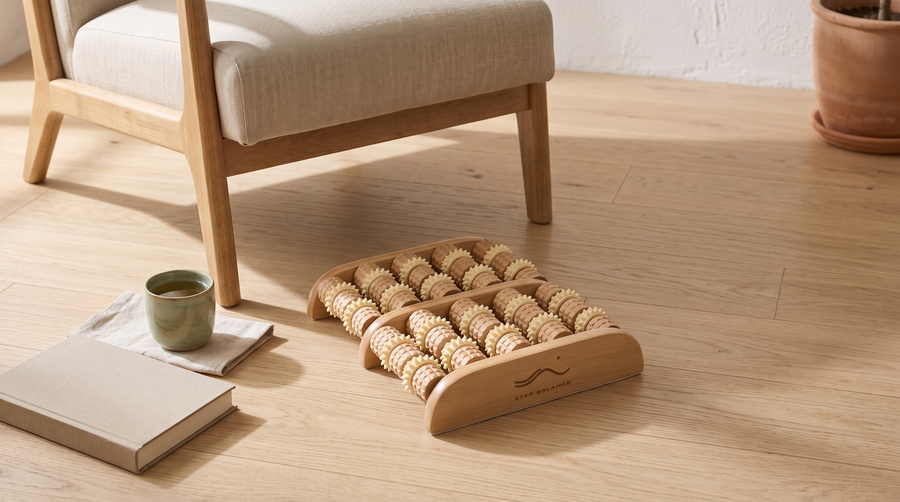
 ReflexRoll™ Wooden Foot Massager
 AcuNomad™ Foldable Acupressure Mat
 AcuEarth™ Acupressure Set