
6-minute read · By the Step Balance Research Team
Most office days follow the same pattern: a long stretch at the screen, a meeting, another long stretch. By late afternoon the feet feel heavy and the legs stiff. A standing desk looks like the answer, until you notice that standing all afternoon does not feel much better. This guide looks at what the research says about long stretches in one position, and gives you a five-minute reset you can do right next to your desk.
In 30 seconds
- Sitting still adds up. Two hours of uninterrupted computer work while seated increased discomfort in every body area in a laboratory study, most of all in the lower back, hips and thighs [1].
- Standing still does too. Two hours of uninterrupted standing had the same effect [2], and a review of 25 studies suggests not standing still for more than about 40 minutes at a time [3].
- Change is what helps. Switching between sitting and standing every 30 minutes reduced fatigue and lower-back discomfort over a working week [4], and short breaks give a small but consistent lift in energy [5].
- Our routine: a one-minute move every half hour, and a five-minute reset for feet and legs twice a day.
What the research says
Sitting still: discomfort builds within two hours
In a study at Curtin University in Australia, 20 adults did two hours of ordinary computer work, seated, without a break. Discomfort rose steadily in every part of the body and reached levels the researchers considered meaningful in the lower back and in the hip, thigh and buttock area. Errors in a creative problem-solving task went up too [1]. The authors’ recommendation was simple: interrupt long periods of sitting.
Standing still is not the fix
The same team repeated the experiment with two hours of standing. Discomfort increased in all body areas again, and reaction times got slower [2]. A systematic review of 25 laboratory studies found that lower-back discomfort reached a meaningful level after about 71 minutes of uninterrupted standing, and sooner in people prone to it. The authors suggested avoiding standing for more than about 40 minutes at a time [3]. A standing desk is a good tool, but only if you keep switching.
Change position, and take short breaks
In a randomised crossover trial, 23 office workers spent one week working seated and another alternating between sitting and standing every 30 minutes. With the alternating routine, fatigue scores were lower and lower-back discomfort fell by about 32%, while overall productivity held steady [4]. A 2022 meta-analysis of 22 study samples found that micro-breaks of up to ten minutes give a small but consistent boost in energy and a reduction in fatigue [5]. The World Health Organization also recommends that adults limit the time they spend sedentary and replace some of it with movement of any intensity [6].
Where massage fits in
Self-massage does not replace moving, but it is a pleasant way to fill a break. In a small trial, two minutes of rolling each sole over a ball improved a sit-and-reach test straight away [7], and rolling the back of the thigh with a handheld roller for as little as 5 to 10 seconds increased range of motion without reducing muscle performance [8]. Both effects are short-term, which is exactly what a break is for.
| When | What | Time |
|---|---|---|
| Every 30 minutes | Stand up, change position or walk a few steps | 1 minute |
| Late morning | The full desk-day reset (below) | 5 minutes |
| Mid-afternoon | The full desk-day reset | 5 minutes |
| During calls | Feet on the foot roller | A few minutes |
The 5-minute desk-day reset
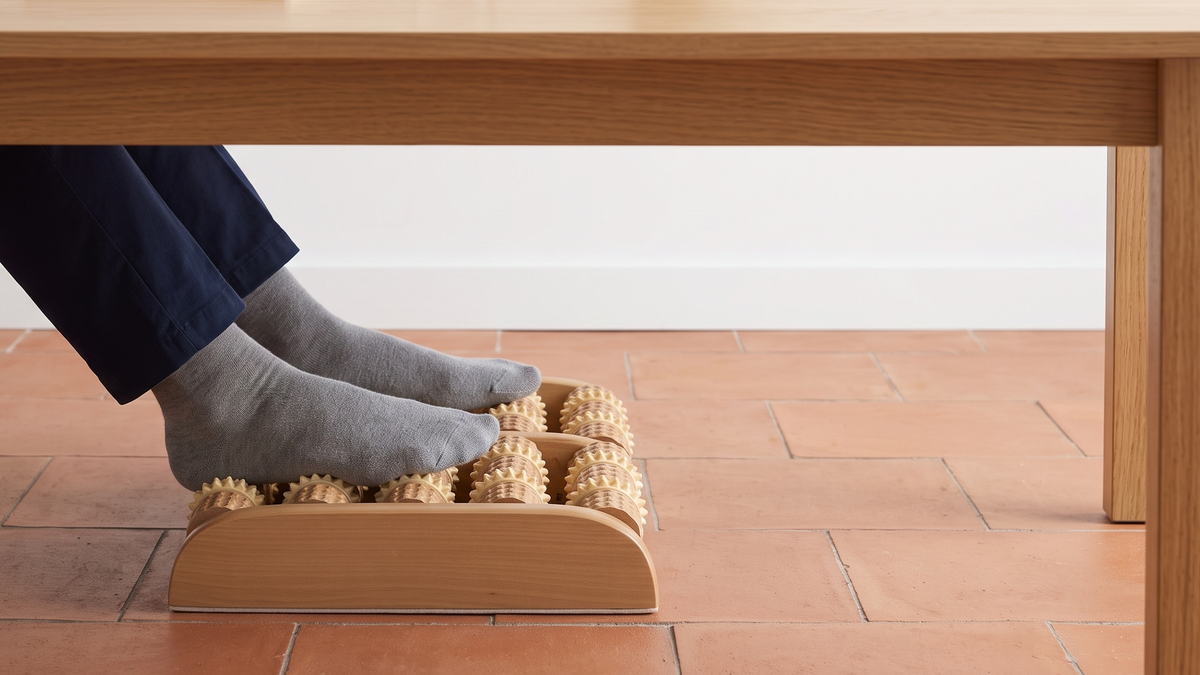
You need a chair, a foot roller under the desk and a massage stick within reach. Socks or bare feet both work.
- Stand and shift (45 seconds). Stand up, shift your weight from one foot to the other, then do 15 slow heel raises, holding the desk lightly for balance.
- Soles (90 seconds). Sit down with both feet on the foot roller. Roll from heel to toes for 30 seconds, then lean forward slightly and work the arches for 60 seconds.
- Toes and ankles (30 seconds). Spread and lift your toes ten times, then draw five slow circles with each ankle.
- Calves (60 seconds). Sit near the front of the chair with one heel on the floor and the leg relaxed. Roll the massage stick from just above the ankle to just below the back of the knee for 30 seconds, then switch legs.
- Front of the thighs (30 seconds). Roll the stick over the front and outside of each thigh, 15 seconds per leg, with light pressure.
- Walk it off (45 seconds). Walk to refill your water bottle, or take the stairs for one floor.

Pressure: firm but comfortable, never sharp. Keep the stick moving and do not roll over the back of the knee, bony areas, bruises or varicose veins. Check first with a healthcare professional if you have reduced feeling in your feet, diabetes, a circulation disorder, a recent injury, or are pregnant.
Make it a habit
- Link it to something that already happens: after your first call of the afternoon, or when your coffee cup is empty.
- Keep the tools in sight. The foot roller lives under the desk; the massage stick fits in a drawer or a work bag.
- Use your calendar. The half-hour rhythm of meetings is a natural cue to stand up.
- Shorter is fine. On busy days, steps 2 and 6 alone take just over two minutes.
The tools we use
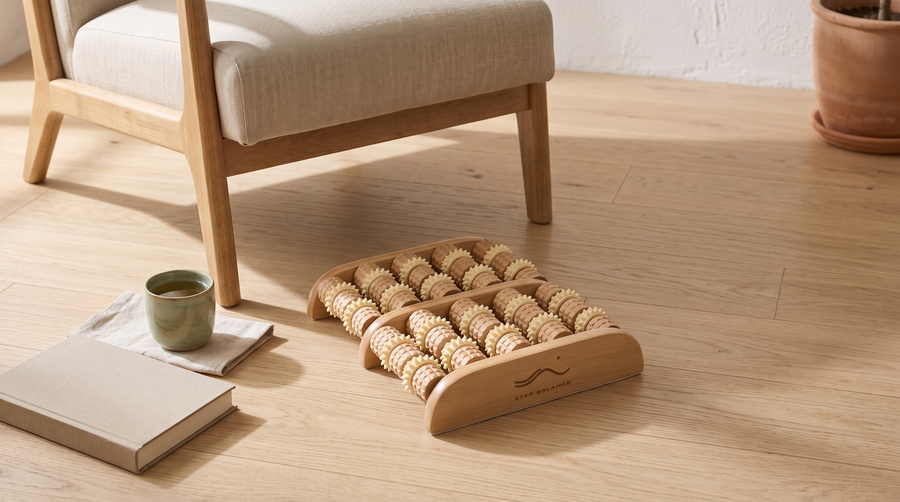
ReflexRoll is a wooden foot roller with 50 rollers in two textures, 25 in smooth Schima hardwood and 25 with TPR spikes, two channels so you can use one foot or both, and a rubber base that stays put under a desk. MuscleGlide is a wooden massage stick with nine gear-cut rings in solid Schima hardwood that turn independently, between two turned handles in the same wood; at 38.4 cm and 240 g it fits in a drawer or a work bag. No cables, no charging and no noise in the office. To compare foot massagers, see our guide to choosing one.

Frequently asked questions
Is a standing desk worth it?
Yes, if you use it to alternate. The research supports changing position regularly, not standing all day [2][3][4].
Can I use the foot roller during video calls?
Yes. It is silent and stays in place, so it is easy to use while you listen.
How often should I do the full reset?
Twice a day is a good rhythm. The one-minute move every half hour matters more than any single routine.
Will this fix my back or leg pain?
We do not make claims about any condition. Pain that persists should be checked by a doctor or physiotherapist.
Sources
- Baker R, Coenen P, Howie E, Williamson A, Straker L. The short term musculoskeletal and cognitive effects of prolonged sitting during office computer work. International Journal of Environmental Research and Public Health. 2018;15(8):1678. doi:10.3390/ijerph15081678
- Baker R, Coenen P, Howie E, Lee J, Williamson A, Straker L. A detailed description of the short-term musculoskeletal and cognitive effects of prolonged standing for office computer work. Ergonomics. 2018;61(7):877-890. doi:10.1080/00140139.2017.1420825
- Coenen P, Parry S, Willenberg L, Shi JW, Romero L, Blackwood DM, Healy GN, Dunstan DW, Straker LM. Associations of prolonged standing with musculoskeletal symptoms: a systematic review of laboratory studies. Gait & Posture. 2017;58:310-318. doi:10.1016/j.gaitpost.2017.08.024
- Thorp AA, Kingwell BA, Owen N, Dunstan DW. Breaking up workplace sitting time with intermittent standing bouts improves fatigue and musculoskeletal discomfort in overweight/obese office workers. Occupational and Environmental Medicine. 2014;71(11):765-771. doi:10.1136/oemed-2014-102348
- Albulescu P, Macsinga I, Rusu A, Sulea C, Bodnaru A, Tulbure BT. “Give me a break!” A systematic review and meta-analysis on the efficacy of micro-breaks for increasing well-being and performance. PLoS One. 2022;17(8):e0272460. doi:10.1371/journal.pone.0272460
- Bull FC, Al-Ansari SS, Biddle S, et al. World Health Organization 2020 guidelines on physical activity and sedentary behaviour. British Journal of Sports Medicine. 2020;54(24):1451-1462. doi:10.1136/bjsports-2020-102955
- Grieve R, Goodwin F, Alfaki M, Bourton AJ, Jeffries C, Scott H. The immediate effect of bilateral self myofascial release on the plantar surface of the feet on hamstring and lumbar spine flexibility: a pilot randomised controlled trial. Journal of Bodywork and Movement Therapies. 2015;19(3):544-552. doi:10.1016/j.jbmt.2014.12.004
- Sullivan KM, Silvey DB, Button DC, Behm DG. Roller-massager application to the hamstrings increases sit-and-reach range of motion within five to ten seconds without performance impairments. International Journal of Sports Physical Therapy. 2013;8(3):228-236. PubMed 23772339
About this guide. Prepared by the Step Balance Research Team, the in-house product and research group behind our insoles, compression supports and recovery tools, designed in Spain. Product details come from our own specifications; statements about sitting, standing, breaks and massage come from the sources listed above. This guide is for information only and does not replace advice from a healthcare professional.

 MuscleGlide™ Wooden Recovery Stick
 ReflexRoll™ Wooden Foot Massager
 AcuNomad™ Foldable Acupressure Mat
 AcuEarth™ Acupressure Set