
8-minute read · By the Step Balance Research Team
Sports insoles are usually sold on one word: cushioning. The research tells a more useful story. Cushioning matters, but mostly for comfort; support and stability matter more when a sport is full of sudden stops and turns; and the best filter for choosing is how the insole feels when you actually move. This guide looks at what studies show for running and for padel, and how to choose and fit an insole for each.
In 30 seconds
- Cushioning on its own has not been shown to prevent injuries. In a meta-analysis, shock-absorbing insoles did not reduce injuries; foot orthoses shaped to support the foot did reduce overall injuries and stress fractures, mostly in military trials [2].
- Softer is not automatically better. In a trial of 848 runners, softer shoes were linked to fewer injuries, but the effect was clear only in lighter runners [1].
- Comfort is a sound filter. Researchers propose choosing what feels comfortable, and comfort ratings reflect measurable differences in movement [3][4].
- Padel is a sport of accelerations. Professional players make around 400 accelerations per hour [5], so stability and a secure fit in a proper court shoe matter [10].
- Foam wears out. AAOS reports that shoe foam loses about 45% of its shock absorption by around 800 km [10].
Cushioning: what it does and does not do
The biggest trial on the question gave 848 recreational runners one of two shoes that were identical except for the cushioning. Over six months, runners in the harder shoe had a higher injury risk overall. When the researchers split runners by body mass, the difference was only clear in the lighter half; in heavier runners it was not significant [1]. The intuitive idea that heavier people need more cushioning was not supported.
Insoles tell a similar story. A meta-analysis of prevention trials found that shock-absorbing insoles did not reduce injuries, stress fractures or soft-tissue injuries. Foot orthoses, which are shaped to support the foot, were linked to about 28% fewer injuries overall and 41% fewer stress fractures, although most of those trials were in military recruits and their quality varied [2]. The honest summary: cushioning makes an insole comfortable, and that is worth having, but it is not a protective shield.
Comfort: the most useful filter
In 2015, a group of biomechanics researchers reviewed decades of running-shoe research and concluded that neither impact forces nor pronation had been shown to predict injury conclusively. They proposed a different approach: runners intuitively choose what feels comfortable, and that comfort helps them keep their natural way of moving [3]. Comfort is not just a feeling. In a study of 21 runners, measured differences in movement and muscle activity explained about 35% of the differences in how comfortable each insert felt [4].
In practice, that means testing an insole by moving in it: jog, change direction, stop. Pressing the foam with your thumb tells you very little.

Padel is not running
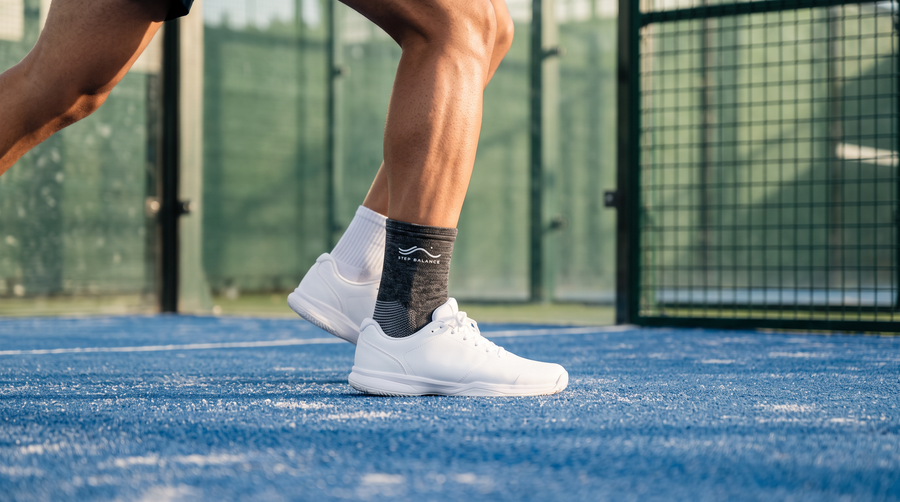
Running is a repeated forward movement. Padel is short sprints, lunges, braking and changes of direction on a small court. In professional matches, winners covered about 2,500 m per hour and made around 415 accelerations per hour [5]. Recreational games are slower, but the pattern is the same: the foot spends much of its time pushing sideways and stopping.
The surface matters too. Most padel courts are artificial grass with sand. There are no published plantar-pressure studies on padel courts yet, but in tennis, the pressure under the back foot during the serve was 18.5% lower on clay than on a hard court, and more even between the two feet [6]. Surveys of padel players have linked injuries to court type, sole pattern and playing hours, although they cannot show cause and effect [7]. One small Spanish survey even found more injuries among players wearing padel-specific shoes, most likely because more committed players both buy them and play more [8].
Shape under the foot also involves trade-offs. In a 2026 study of badminton lunges, an arch-support insole lowered the rate at which load hit the body, but increased stress on the kneecap joint [9]. No insole changes only one thing. If an insole makes your knees or another joint feel worse, stop using it and get advice.
What to look for
| Running | Padel | |
|---|---|---|
| Main movement | Repeated forward strides | Lunges, braking, side steps, short sprints |
| Start with the shoe | A running shoe that feels comfortable on a test run | A court shoe built for stability in all directions [10] |
| In the insole | Comfortable heel and forefoot cushioning, a breathable top | A firm base that resists twisting, a secure heel, cushioning at heel and forefoot |
| Check | No pressure points after a 20 to 30 minute run | Heel stays put and the foot does not slide when you stop sharply |
AAOS recommends a sport-specific shoe if you play a sport more than twice a week, and fitting shoes at the end of the day with the socks you play in, leaving about 1 cm beyond the longest toe [10].
How to fit a sports insole
- Take out the factory insole. Sports insoles replace it; two insoles on top of each other cost space and hold.
- Compare outlines and check that the new insole lies flat, with the heel seated in the heel cup.
- Lace up properly and test with a few accelerations and stops before a full session.
- Build up use over the first week: a shorter run or a few games first, then your normal volume.
- Check for wear every few months. Our guide on when to replace insoles explains the signs.
Our Sports Performance insole
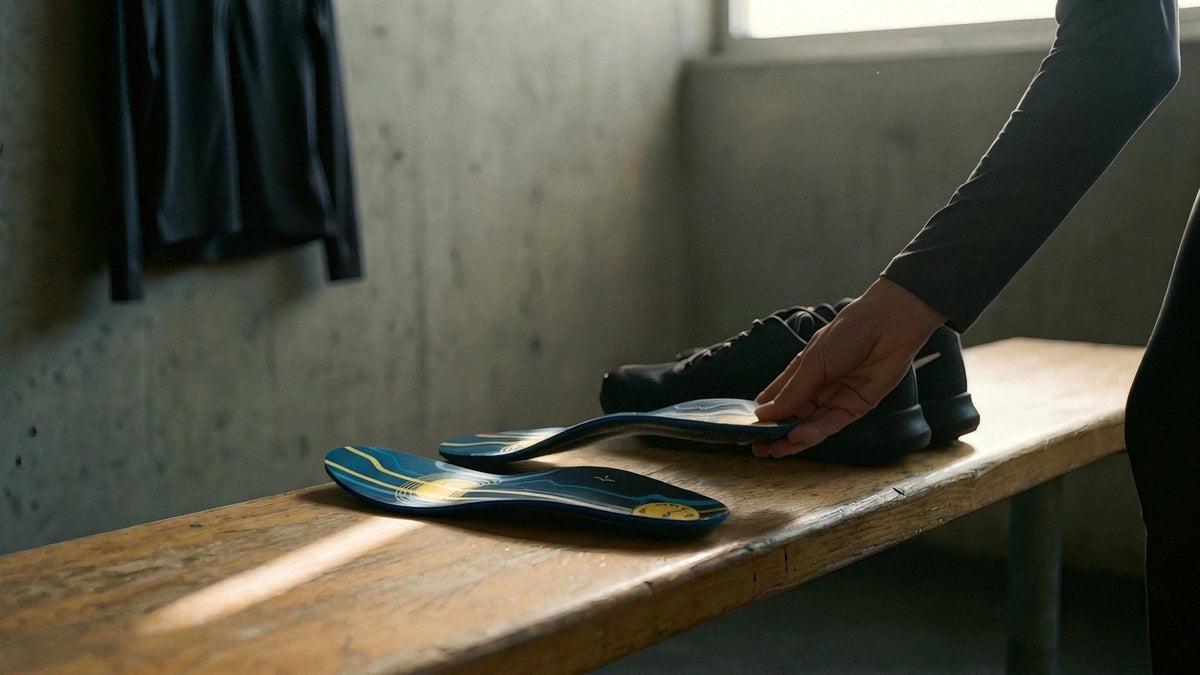
Our Sports Performance insole is 4.5 to 5 mm thick, with five layers: a full-length 3 mm high-rebound EVA layer with deep-absorption pads set into it at the heel and forefoot, over an anatomic TPU shell and a carbon-fiber-look PU base. A contoured arch and a metatarsal pad keep the foot well positioned, and a breathable top fabric moves moisture away during long sessions. It comes in EU sizes 36 to 45 (US 5 to 12), sold in pairs, and works in running shoes, gym sneakers and soccer or court shoes. For long days of walking and standing, Comfort Every Day offers more cushioning across the whole foot.

Frequently asked questions
Do I need different insoles for running and padel?
Not necessarily. The same insole can work in both, as long as each shoe fits well with it. What changes is the shoe: a running shoe for running, a court shoe for padel.
Should heavier players choose more cushioning?
Not on that basis alone. In the largest trial, the benefit of softer shoes was clear only in lighter runners [1]. Choose what feels comfortable and stable.
Can I keep the factory insole underneath?
No. Replace it. Stacking insoles raises the foot, reduces heel hold and can make the shoe too tight.
Will an insole prevent sprains or other injuries?
There is no good evidence that a cushioning insole prevents injuries [2]. What it can offer is comfort and a well-shaped surface under the foot.
Sources
- Malisoux L, Delattre N, Urhausen A, Theisen D. Shoe cushioning influences the running injury risk according to body mass: a randomized controlled trial involving 848 recreational runners. American Journal of Sports Medicine. 2020;48(2):473-480. doi:10.1177/0363546519892578
- Bonanno DR, Landorf KB, Munteanu SE, Murley GS, Menz HB. Effectiveness of foot orthoses and shock-absorbing insoles for the prevention of injury: a systematic review and meta-analysis. British Journal of Sports Medicine. 2017;51(2):86-96. doi:10.1136/bjsports-2016-096671
- Nigg BM, Baltich J, Hoerzer S, Enders H. Running shoes and running injuries: mythbusting and a proposal for two new paradigms: 'preferred movement path' and 'comfort filter'. British Journal of Sports Medicine. 2015;49(20):1290-1294. doi:10.1136/bjsports-2015-095054
- Mündermann A, Nigg BM, Humble RN, Stefanyshyn DJ. Orthotic comfort is related to kinematics, kinetics, and EMG in recreational runners. Medicine and Science in Sports and Exercise. 2003;35(10):1710-1719. doi:10.1249/01.MSS.0000089352.47259.CA
- Miralles R, Martínez-Gallego R, Guzmán J, Ramón-Llin J. Movement patterns and player load: insights from professional padel. Biology of Sport. 2025;42(1):163-169. doi:10.5114/biolsport.2025.139856
- Girard O, Micallef JP, Millet GP. Effects of the playing surface on plantar pressures during the first serve in tennis. International Journal of Sports Physiology and Performance. 2010;5(3):384-393. doi:10.1123/ijspp.5.3.384
- Rocamora-López G, Mateo-Orcajada A. Analysis of differences in injuries in padel players according to sport-specific factors, level of physical activity, adherence to the Mediterranean diet, and psychological status. Sports. 2025;13(7):228. doi:10.3390/sports13070228
- Priego Quesada JI, Sanchís Almenara M, Kerr ZY, Alcantara E. Examination of the risk factors associated with injured recreational padel players in Spain. Journal of Sports Medicine and Physical Fitness. 2018;58(1-2):98-105. doi:10.23736/S0022-4707.16.06729-3
- Wu X, Liang H, He C, et al. The immediate effect of arch support insoles on the biomechanics of the lower limbs during the forward lunge step in badminton. PeerJ. 2026;14:e21113. doi:10.7717/peerj.21113
- American Academy of Orthopaedic Surgeons. Athletic shoes. OrthoInfo. orthoinfo.aaos.org
About this guide. Prepared by the Step Balance Research Team, the in-house product and research group behind our insoles, compression supports and recovery tools, designed in Spain. Product details come from our own specifications; statements about cushioning, comfort and court sports come from the studies and health-service sources listed above. This guide is for information only and does not replace advice from a healthcare professional.
 Sports Performance Insoles
 Comfort Every Day Insoles
 Slim Fit Insoles