
7-minute read · By the Step Balance Research Team
Search for ankle support for padel, running or soccer and you will see sleeves, braces and tape side by side. They are not the same thing. The trials that show fewer ankle sprains used braces, tape or balance training, mostly in people who had sprained before. We found no trial of a knit compression sleeve.
Below: how sprains happen in each sport, ankle sleeve vs ankle brace vs tape, what a sleeve honestly offers, and a balance routine with a trial-based dose.
In 30 seconds
- Sprains are common in court and field sports. Court sports have the highest rates [1]; in elite men’s soccer about 1 in 8 injuries involves the ankle [2]. In padel and running they are a smaller share of injuries [3][4].
- Prevention evidence is for braces, tape and training, not sleeves. Guidelines support braces and tape after a previous sprain [5][6]; balance training cut repeat sprains from 33% to 22% in one trial [10].
- A soft sleeve does not stop an ankle roll. In a lab study, a semi-rigid brace reduced ankle roll and a soft support did not [13]. Evidence on position sense is mixed [12][14].
- Wear a sleeve for comfort and feel, and train for resilience. After a fresh sprain, see a professional first [15].
How ankle sprains happen in padel, running and soccer
Most sprains happen when the foot rolls inward and overstretches the outer ankle ligaments. A review of 181 prospective studies found this the most common type, with the highest rates in indoor and court sports (about 7 per 1,000 exposures) and higher rates in women than men [1]. Definitions varied a lot, so read the figures as rough guides.
Padel
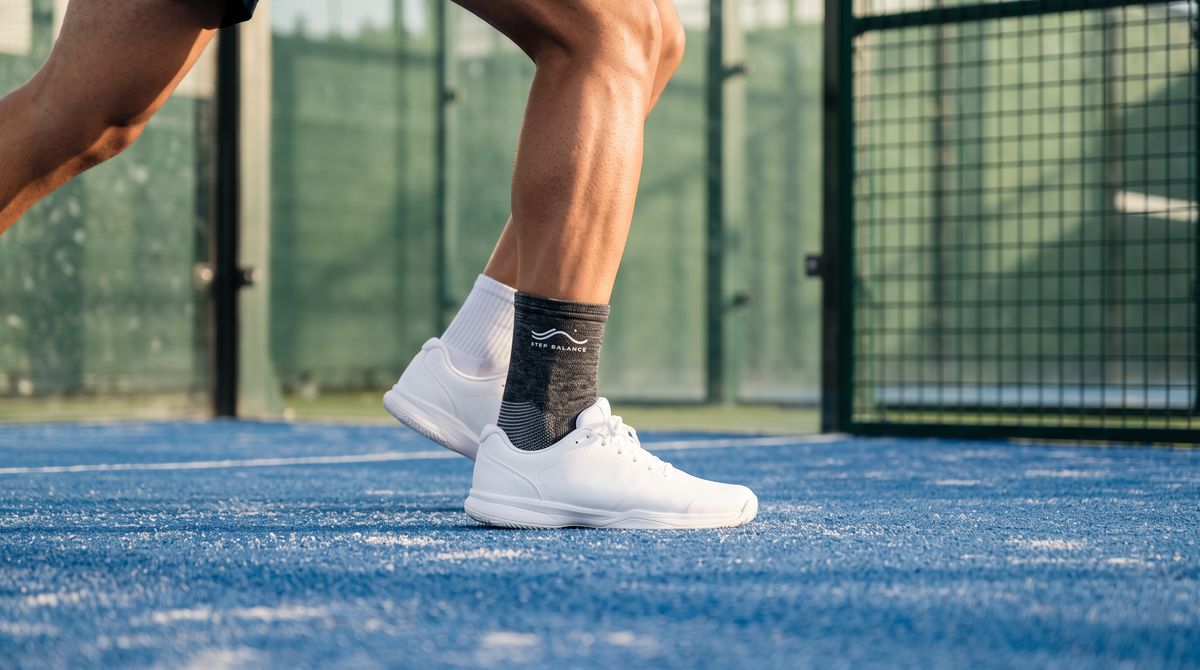
Padel is all split-steps, lunges and sideways moves. Yet in a review of 2,022 players the elbow was injured most often, then the knee, shoulder and lower back. Ankle sprains were roughly 7-10% of reported injuries in studies that were few and mostly questionnaires [3]. More in our guide to padel for feet, knees and elbows.
Running
Running injuries come mostly from overload, not twisting. In one review, ankle sprains were 5.8% of new injuries, behind Achilles tendon problems, shin pain and pain around the kneecap. In ultramarathon runners, though, the ankle was the most injured site [4].
Soccer
Over 11 seasons of Champions League injury data, the ankle accounted for 13% of injuries, and half of those were sprains of the outer ligaments. Foul play was involved in 40% of match ankle sprains [2]. Amateur and women’s soccer may differ.
Ankle sleeve vs ankle brace vs tape: what the evidence covers
Guidelines say people who have sprained before should consider a brace or tape plus exercise [5][6]. In large trials, lace-up braces lowered acute ankle injuries in high school basketball (0.47 vs 1.41 per 1,000 exposures) and football (0.48 vs 1.12) [7][8]. A semi-rigid brace also beat home training for repeat sprains (15% vs 27% over a year) [9]. None of these studies used a knit sleeve.
| Knit compression sleeve | Lace-up or semi-rigid brace | Athletic tape | |
|---|---|---|---|
| Structure | Elastic knit, no straps or stays | Laces, straps or side shells | Rigid tape applied each session |
| Limits ankle roll? | No evidence that it does [13] | Yes, semi-rigid reduced peak ankle roll [13] | Partly; mixed evidence compared with braces [6] |
| Sprain-prevention trials | None found | Yes [7][8][9] | Some; weaker than a brace in some comparisons [6] |
| Days lost if a sprain happens | Unknown | No reduction shown [7][8] | Not shown |
| Suited to | Comfort, warmth and feel | People with a previous sprain, on professional advice [5][6] | The same; needs skill to apply |
In the athletic trainers’ position statement, bracing prevented one sprain per 5 previously injured athletes, against one per 57 never-injured athletes [6]. A sleeve is a different product.
What an ankle compression sleeve can do, and what it can’t
A knit sleeve has nothing that can hold the ankle in place. In a lab study of 45 people making fast 180° turns, a semi-rigid brace reduced how far and how fast the ankle rolled; a soft brace had no effect [13].
Position sense is less clear. In a trial of 66 athletes with repeat sprains, a neoprene support immediately improved how accurately they reproduced ankle angles [14], yet a pooled analysis of tape and brace studies found no overall effect [12]. Many people simply like the light, even hug: it feels warm and makes them more aware of the ankle. That is a fine reason to wear one, alongside training, not instead of it.

A balance routine for stronger ankles
Balance training has the strongest support here. In a trial of 522 athletes who had sprained, an unsupervised balance-board program cut repeat sprains from 33% to 22%, about one sprain prevented for every 9 people who trained. It ran 8 weeks, 3 sessions a week, up to 30 minutes, ideally in the warm-up [10]. Athletic trainers recommend at least 3 months [6]. This sample plan is not the trial’s exact program; a physical therapist can tailor it.
- Single-leg stand (weeks 1-2). Barefoot, 30 seconds per leg, knee soft; then eyes closed, by a wall.
- Soft surface (weeks 3-4). On a folded cushion or balance board.
- Add a task. Throw and catch a ball, or make slow shadow strokes with your racket.
- Hops and landings (weeks 5-6). Small hops in all directions; hold each landing for two seconds.
- Sport moves (week 7 on). Split-step into a side lunge, or a controlled cut for soccer.
Only about a quarter of the trial’s athletes completed it, so consistency is the hard part [10]. Soccer players can use FIFA 11+, a warm-up linked to about 39% fewer injuries overall [11]. After a recent sprain, start when your clinician says so [5]. Coming back after a break? See our 4-week back-to-running plan.
Choosing shoes and surface for padel
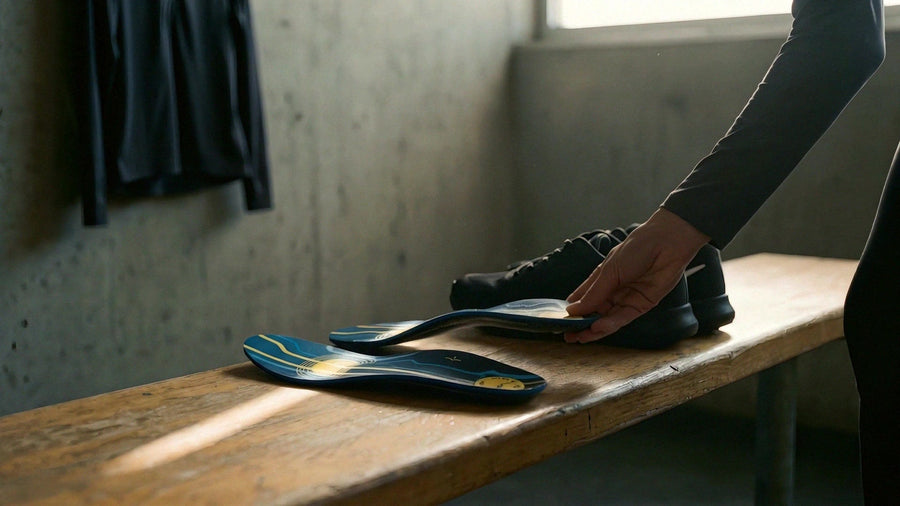
Practical advice, not trial evidence: most courts are artificial grass with sand, and padel shoes have a herringbone or mixed sole made for it and for sideways moves. Soft, high running shoes can feel less steady when you push off sideways. Replace shoes with smooth, worn soles. For insoles, see insoles for running and padel.
When to see a professional
Get your ankle checked by a doctor or physical therapist if [15]:
- you cannot put weight on it or walk more than a few steps;
- pain or swelling is large or getting worse;
- it is very stiff or not improving with self-care;
- it keeps giving way during sport [5].
- Go to emergency care if you heard a crack, it looks deformed, feels numb or tingly, or the skin is blue, gray or cold [15].
Most sprains feel better in about 2 weeks, but avoid strenuous exercise such as running for up to 8 weeks [15].
Our Ankle Support Sleeve
Our Ankle Support Sleeve is a gray knit compression sleeve that goes on like a sock. No straps, stays or grip bands. Choose it by EU shoe size: S 36-38, M 39-41, L 42-45 (see our size guides and how to measure for a support). Sold singly; hand wash. The fabric is naturally odor-resistant, with no chemical finish.
It suits people who want light compression and a warm, comfortable feel for padel, running, soccer or the gym. It is not a brace, so it is not meant for people who need rigid support after an injury. For the fit:
- Firm but comfortable: one finger should slide under the fabric.
- Between two sizes, choose the larger.
- Take it off if you feel tingling, numbness or discomfort, and try the next size up.
- Never use it to play through pain.
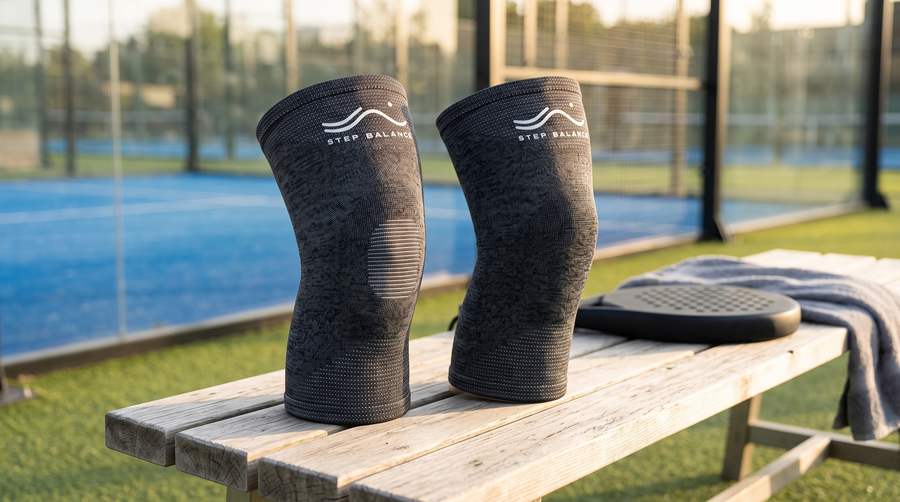
Knee sleeve too? See our guide to knee compression sleeves.
Frequently asked questions
Does an ankle compression sleeve prevent sprains?
No trial has shown that. The prevention evidence is for balance training, braces and tape, mainly after a previous sprain [6][10].
What is the difference between an ankle sleeve and an ankle brace?
A sleeve is soft knit with no rigid parts. A brace uses laces, straps or shells to limit ankle roll [13].
Is it worth wearing an ankle support for padel?
Ankle sprains are a minority of padel injuries; the elbow is hurt most [3]. Wear a sleeve if you like the feel. If you have sprained before, ask a physical therapist about a brace or tape [6].
Should runners wear an ankle sleeve?
Most running injuries come from overload, and sprains are about 6% of them [4]. Training load and balance work matter more; a sleeve is a comfort choice.
Can I wear an ankle sleeve after a sprain?
See a doctor or physical therapist first [15]. A sleeve is not a treatment and does not replace the plan they recommend [5].
Sources
- Doherty C, Delahunt E, Caulfield B, et al. The incidence and prevalence of ankle sprain injury: a systematic review and meta-analysis of prospective epidemiological studies. Sports Medicine. 2014;44(1):123-140. doi:10.1007/s40279-013-0102-5
- Waldén M, Hägglund M, Ekstrand J. Time-trends and circumstances surrounding ankle injuries in men’s professional football: an 11-year follow-up of the UEFA Champions League injury study. British Journal of Sports Medicine. 2013;47(12):748-753. doi:10.1136/bjsports-2013-092223
- Dahmen J, Emanuel KS, Fontanellas-Fes A, et al. Incidence, prevalence and nature of injuries in padel: a systematic review. BMJ Open Sport & Exercise Medicine. 2023;9(2):e001607. doi:10.1136/bmjsem-2023-001607
- Kakouris N, Yener N, Fong DTP. A systematic review of running-related musculoskeletal injuries in runners. Journal of Sport and Health Science. 2021;10(5):513-522. doi:10.1016/j.jshs.2021.04.001
- Vuurberg G, Hoorntje A, Wink LM, et al. Diagnosis, treatment and prevention of ankle sprains: update of an evidence-based clinical guideline. British Journal of Sports Medicine. 2018;52(15):956. doi:10.1136/bjsports-2017-098106
- Kaminski TW, Hertel J, Amendola N, et al. National Athletic Trainers’ Association position statement: conservative management and prevention of ankle sprains in athletes. Journal of Athletic Training. 2013;48(4):528-545. doi:10.4085/1062-6050-48.4.02
- McGuine TA, Brooks A, Hetzel S. The effect of lace-up ankle braces on injury rates in high school basketball players. American Journal of Sports Medicine. 2011;39(9):1840-1848. doi:10.1177/0363546511406242
- McGuine TA, Hetzel S, Wilson J, et al. The effect of lace-up ankle braces on injury rates in high school football players. American Journal of Sports Medicine. 2012;40(1):49-57. doi:10.1177/0363546511422332
- Janssen KW, van Mechelen W, Verhagen EALM. Bracing superior to neuromuscular training for the prevention of self-reported recurrent ankle sprains: a three-arm randomised controlled trial. British Journal of Sports Medicine. 2014;48(16):1235-1239. doi:10.1136/bjsports-2013-092947
- Hupperets MDW, Verhagen EALM, van Mechelen W. Effect of unsupervised home based proprioceptive training on recurrences of ankle sprain: randomised controlled trial. BMJ. 2009;339:b2684. doi:10.1136/bmj.b2684
- Thorborg K, Krommes KK, Esteve E, et al. Effect of specific exercise-based football injury prevention programmes on the overall injury rate in football: a systematic review and meta-analysis of the FIFA 11 and 11+ programmes. British Journal of Sports Medicine. 2017;51(7):562-571. doi:10.1136/bjsports-2016-097066
- Raymond J, Nicholson LL, Hiller CE, et al. The effect of ankle taping or bracing on proprioception in functional ankle instability: a systematic review and meta-analysis. Journal of Science and Medicine in Sport. 2012;15(5):386-392. doi:10.1016/j.jsams.2012.03.008
- Fuerst P, Gollhofer A, Wenning M, et al. People with chronic ankle instability benefit from brace application in highly dynamic change of direction movements. Journal of Foot and Ankle Research. 2021;14(1):13. doi:10.1186/s13047-021-00452-0
- Salemi P, Abbasi L, Naimi SS, et al. The immediate effect of kinesiotaping versus neoprene brace on the ankle joint position sense in athletes with recurrent ankle sprain: a randomized controlled trial. BMC Sports Science, Medicine and Rehabilitation. 2026;18(1):309. doi:10.1186/s13102-026-01636-6
- NHS (UK National Health Service). Sprains and strains. Page last reviewed 23 April 2024. nhs.uk/conditions/sprains-and-strains
About this guide. Prepared by the Step Balance Research Team, the in-house product and research group behind our insoles, compression supports and recovery tools, designed in Spain. Product details come from our own specifications; statements about ankle sprains, ankle supports and balance training come from the sources listed above. This guide is for information only and does not replace advice from a healthcare professional.
 Ankle Support Sleeve
 Elbow Support Sleeve
 Gel Knee Support Sleeve
 Knee Support Sleeve