
7-minute read · By the Step Balance Research Team
Wrist support means different things in different places. In the gym it usually means wraps for heavy pressing. On a padel or tennis court it may be a sweatband or a compression sleeve. At a desk it is mostly about how your wrists sit on the keyboard and mouse.
The short answer: we found no study that has tested a knit wrist compression sleeve for injury prevention or performance. The evidence points to feel and comfort. Technique, load, breaks and set-up do the real work, and some symptoms call for a professional, not a product.
In 30 seconds
- The wrist is rarely the main problem area. In padel the elbow leads and the wrist accounts for roughly 3-12% of injuries [1]. In lifting, the spine, shoulder and knee come first [3]. Tennis is the exception [2].
- Wraps feel more stable but did not add strength. In a small randomized trial, lifters rated wraps more stable on the bench press, with no change in strength or power, and less comfortable [4].
- At a desk, straight wrists and regular breaks are the basics. Keep your wrists in line with your forearms [10] and move for 5-10 minutes every hour [11], though even this has modest proof [9].
- Numbness, tingling, night symptoms or weakness need a professional. A sleeve is not the answer, and one that causes tingling should come off straight away [13][14].
Wrist support for the gym: sleeves, wraps and technique
Bench presses, overhead presses and push-ups load the wrist bent back, with your body weight or a bar on top. That can feel uncomfortable, especially when you add weight quickly. Keep it in proportion, though: a systematic review of weightlifting and powerlifting injuries found the spine, shoulder and knee were the most common sites, with the wrist near the top in only one study [3]. Those were competitive lifters; we found no good data for everyday gym-goers.
Wrist wraps vs compression sleeves
Wrist wraps are long, firm elastic bands wound tightly around the joint. In a randomized crossover trial, 18 trained lifters (9 men, 9 women) did the bench press with a flexible wrap, a stiff wrap and no wrap [4]. One-rep max, power and bar velocity did not change. Both wraps felt more stable than no wrap, and less comfortable. In a survey of 70 competing powerlifters, wraps were widely used, yet no wrap variable predicted bench strength [5].
A knit compression sleeve is the lighter option: even, gentle pressure without the stiffness of a wrap. In a small trial in 68 healthy students, an elastic bandage or tape improved wrist position sense while it was worn [6]. That was a bandage, not a sleeve, and nobody knows whether it changes injury risk. Think comfort and feel, not protection or extra strength.
Technique and grip come first
Coaches start with position, not equipment. These pointers are common coaching practice, not tested in trials:
- Let the bar sit low in the palm, over the forearm bones, not near the fingers, where it levers the wrist back.
- For push-ups, spread your fingers and press through the whole hand, or try push-up handles or dumbbells to keep the wrist straighter.
- Add load gradually and warm up your wrists with gentle circles and light sets.
- If a wrist hurts and does not settle, or keeps coming back, get it assessed rather than wrapping it tighter [13].
Wrist support for padel and tennis
In padel, the research points mainly at the elbow. A systematic review of 8 studies and 2,022 players found the elbow was the most common injury site, followed by the knee, shoulder and lower back [1]. In individual studies the elbow made up 20-37% of injuries and the wrist roughly 3-12%. Most data come from surveys, so these figures are rough. See also our padel guide to feet, knees and elbows.
Tennis is different. At the US Open (1994-2009), the wrist was the second most common site of acute injury after the ankle, and elite junior players reported it among their most common problem areas [2]. One overuse problem named in the review involves a tendon on the little-finger side of the wrist (the ECU tendon) [2].
Grip size, technique and load
Clinicians and coaches look at technique, equipment and playing load, not just the wrist [2]. Ask a coach to check your grip size, how hard you squeeze and how you play late balls, and add playing time gradually. We found no good studies linking a particular grip size to wrist problems, so this is coaching common sense rather than proven science. A sleeve can be a comfortable accessory that also catches sweat. If your elbow is the issue, read our guide to elbow supports for padel, tennis and golf; to get ready before you play, see our 8-minute padel warm-up.

Wrist support for keyboard and mouse work
At a desk, wrist support is mostly about position. A proficient typist can exceed 18,000 keystrokes an hour [10]. In a lab study of 20 healthy people, bending the wrist upward or toward the thumb while typing raised the pressure in the narrow passage at the base of the palm where a major nerve runs [8]. That is a stand-in measure, not a diagnosis, but it supports a neutral wrist as the default. A quick check based on OSHA and UK Health and Safety Executive guidance:
- Keyboard straight ahead. Shoulders relaxed, elbows close to your body and at about keyboard height [10].
- Wrists straight. In line with your forearms. Fold the keyboard feet away if they bend your wrists up [10][8].
- Mouse close by. Right next to the keyboard, so you are not reaching out [10].
- Move every hour. 5-10 minutes every hour is better than 20 minutes every two hours [11]. Stand, walk or stretch.
Be realistic: a Cochrane review of 15 trials in 2,165 office workers rated most of the evidence as weak [9]. Extra breaks reduced forearm, wrist and hand discomfort only slightly, and workstation adjustment showed no clear effect on arm pain. A soft sleeve at the keyboard is a comfort choice; it does not hold your wrist in a neutral position. For your legs and feet, see our desk-day reset routine.
Wrist sleeve vs wrist wrap vs splint
They are often sold side by side, but they do different jobs.
| Compression sleeve | Wrist wrap | Rigid splint | |
|---|---|---|---|
| What it is | Soft knit tube with a thumb opening | Long, firm elastic band wound tightly | Brace with a stiff insert that holds the wrist still |
| Typical use | Training, racket sports, keyboard days | Heavy pressing, short sets | Advised by a healthcare professional for a specific problem |
| Evidence | May sharpen wrist position sense while worn, in small lab studies [6] | Feels more stable, no strength change [4] | An NHS night-time self-care option for some nerve symptoms [12] |
| Who chooses it | You, for comfort | You, for heavy lifts | A healthcare professional |
Nor is a sleeve a wrist guard. In snowboarding, rigid guards were linked to fewer wrist injuries in falls (odds ratio 0.33) [7], but that comes from a stiff design built for impacts and does not carry over to a knit sleeve. Splints are a clinician’s device, and we do not make them.
How a wrist sleeve should fit
A sleeve that is too tight is worse than none. Measure around your wrist at its narrowest point; between two sizes, choose the larger. Then run this one-minute check:
- Thumb through the opening. The fabric lies flat, with no rolled edges.
- One finger under the fabric. Firm but comfortable.
- Fist and spread. All fingers move freely and comfortably [14].
- Check after 10-15 minutes. Your fingers match the other hand in color and warmth, with no tingling or numbness [14].
- Check your skin. Light marks that fade within about 30 minutes are normal; marks that persist mean it is too tight [14].
Warning signs: tingling, numbness, burning, more pain, or pale, blue, cold or swollen fingers. Take the sleeve off and raise your hand for 10 minutes [14], then try the next size up. If symptoms do not settle, get medical advice. There is no reason to wear a sleeve overnight.
When to see a professional
The NHS advice is clear: do not try to diagnose wrist pain yourself [13].
Get urgent help
- Severe pain, or a snap, pop or grinding noise at the moment of injury.
- You cannot move the wrist or hold things.
- The wrist has changed shape or color, or you have lost feeling in the hand.
See a doctor or physical therapist
- Pain that stops normal activities, gets worse, keeps coming back or has not improved after 2 weeks.
- Numbness, tingling or a weak grip, or pain that wakes you at night.
- A wrist that is painful, warm, swollen and stiff, or wrist symptoms if you have diabetes.
Numbness or pins and needles in the hand, a weak thumb or difficulty gripping, often worse at night, can be signs of carpal tunnel syndrome, which needs a professional assessment [12]. The NHS self-care option is a splint that keeps the wrist straight at night, a different product from a sleeve [12]. Our sleeve is not a treatment for this or any other condition.
Our Wrist Support Sleeve
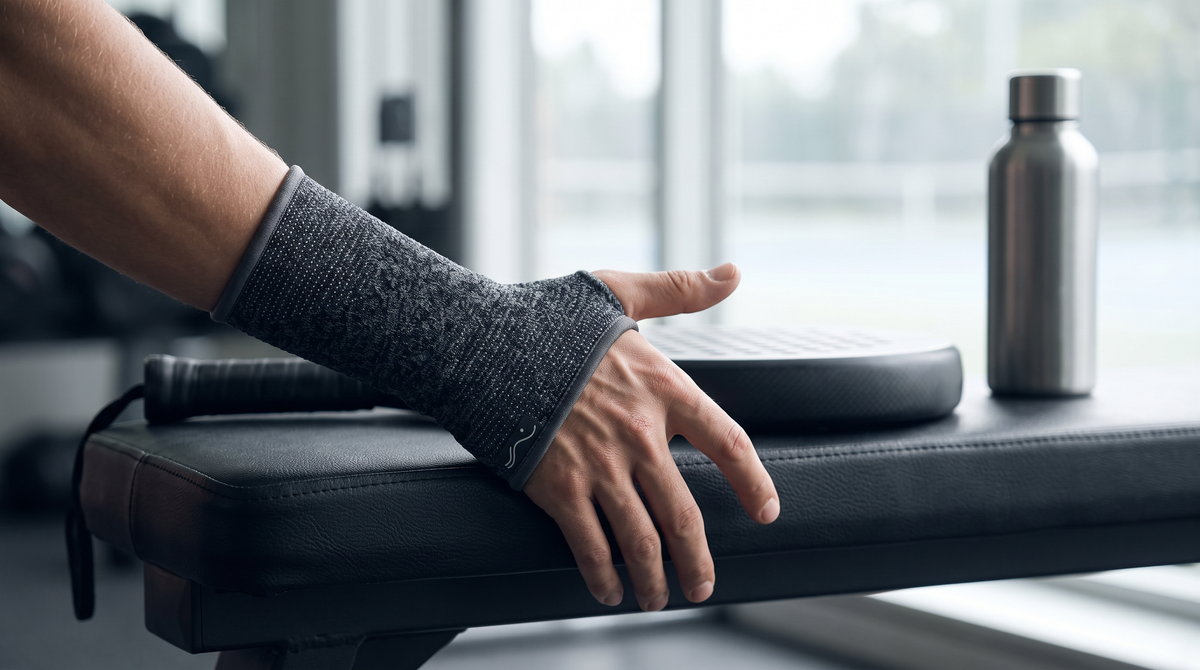
Our Wrist Support Sleeve is a gray knit compression sleeve with a thumb opening that keeps it in place, so it needs no silicone bands. It gives light, even compression for training, padel, tennis, golf and long keyboard days. Sizes are measured around the wrist at its narrowest point: S 13-15 cm, M 15-20 cm, L 20-25 cm. Between sizes, choose the larger. It is sold singly. Hand-wash it; the fabric is naturally odor-resistant, with no added chemicals.

It is not a splint, wrap or brace: it does not immobilize the wrist, add strength or prevent injuries. Pick your size with the size calculator or our size guides, and see how to measure for a support.
Frequently asked questions
Do wrist sleeves actually work?
For feel and comfort, perhaps. Small lab studies suggest elastic supports may sharpen wrist position sense while worn [6], and lifters feel more stable in wraps [4]. No study shows that a soft sleeve prevents injuries or adds strength.
Wrist sleeve or wrist wraps for lifting?
Wraps made the bench press feel more stable but did not change strength, and they felt less comfortable [4]. A sleeve is lighter for general training. Neither replaces technique and sensible loading.
Is a wrist support good for padel?
It can be comfortable and it helps with sweat. Padel injuries are mostly at the elbow; the wrist accounts for about 3-12% [1]. If your wrist hurts when you play, get it assessed [13].
How tight should a wrist sleeve be?
Snug but comfortable, with one finger fitting under the fabric. Take it off if you feel tingling or numbness or your fingers change color, and raise your hand for 10 minutes [14].
What is the right wrist position for typing?
Straight and in line with your forearms, with the keyboard in front of you and your elbows close to your sides [10]. In a lab study, bending the wrist up or toward the thumb raised pressure inside the wrist [8]. Move every hour [11].
Sources
- Dahmen J, Emanuel KS, Fontanellas-Fes A, Verhagen E, Kerkhoffs GMMJ, Pluim BM. Incidence, prevalence and nature of injuries in padel: a systematic review. BMJ Open Sport & Exercise Medicine. 2023;9(2):e001607. doi:10.1136/bmjsem-2023-001607
- Fu MC, Ellenbecker TS, Renstrom PA, Windler GS, Dines DM. Epidemiology of injuries in tennis players. Current Reviews in Musculoskeletal Medicine. 2018;11(1):1-5. doi:10.1007/s12178-018-9452-9
- Aasa U, Svartholm I, Andersson F, Berglund L. Injuries among weightlifters and powerlifters: a systematic review. British Journal of Sports Medicine. 2017;51(4):211-219. doi:10.1136/bjsports-2016-096037
- Harris DR, Harris DR, Cardaci TD, Cintineo HP, Funderburk LK, Machek SB. Wrist wraps do not affect barbell bench press muscular strength, power, or endurance in resistance-trained men and women. Journal of Strength and Conditioning Research. 2024;38(12):e708-e715. doi:10.1519/JSC.0000000000004930
- Harris D, Cardaci T, Cintineo H, Pham R, Dunsmore K, Funderburk L, Machek S. A cross-sectional examination of wrist wrap use prevalence and characterization for ergogenic purposes in actively competing powerlifters. International Journal of Strength and Conditioning. 2023;3(1). doi:10.47206/ijsc.v3i1.185
- Ucuzoglu ME, Unver B, Sarac DC, Cilga G. Similar effects of two different external supports on wrist joint position sense in healthy subjects: a randomized clinical trial. Hand Surgery and Rehabilitation. 2020;39(2):96-101. doi:10.1016/j.hansur.2019.11.006
- Hume PA, Lorimer AV, Griffiths PC, Carlson I, Lamont M. Recreational snow-sports injury risk factors and countermeasures: a meta-analysis review and Haddon matrix evaluation. Sports Medicine. 2015;45(8):1175-1190. doi:10.1007/s40279-015-0334-7
- Rempel DM, Keir PJ, Bach JM. Effect of wrist posture on carpal tunnel pressure while typing. Journal of Orthopaedic Research. 2008;26(9):1269-1273. doi:10.1002/jor.20599
- Hoe VCW, Urquhart DM, Kelsall HL, Zamri EN, Sim MR. Ergonomic interventions for preventing work-related musculoskeletal disorders of the upper limb and neck among office workers. Cochrane Database of Systematic Reviews. 2018;(10):CD008570. doi:10.1002/14651858.CD008570.pub3
- Occupational Safety and Health Administration (US Department of Labor). Computer Workstations eTool: Keyboards. osha.gov
- Health and Safety Executive (UK). Working safely with display screen equipment: work routine and breaks. hse.gov.uk
- NHS. Carpal tunnel syndrome. nhs.uk
- NHS. Wrist pain. nhs.uk
- Kingston and Richmond NHS Foundation Trust, Physiotherapy. Futura splint: patient leaflet. kingstonandrichmond.nhs.uk
About this guide. Prepared by the Step Balance Research Team, the in-house product and research group behind our insoles, compression supports and recovery tools, designed in Spain. Product details come from our own specifications; statements about wrist support, training and desk work come from the sources listed above. This guide is for information only and does not replace advice from a healthcare professional.
 Ankle Support Sleeve
 Elbow Support Sleeve
 Gel Knee Support Sleeve
 Knee Support Sleeve