
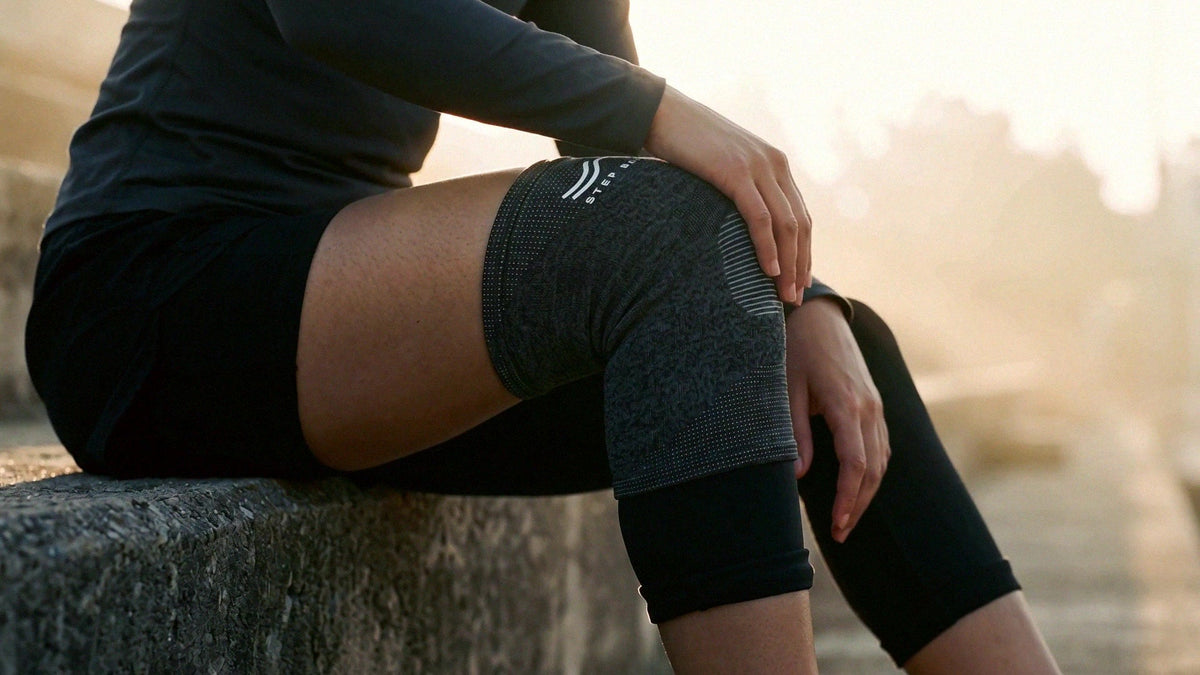
8-minute read · By the Step Balance Research Team
Knee sleeves are everywhere: in the gym, on the padel court, on long hikes. People wear them because the knee feels warmer, more secure or simply better. But what does a compression sleeve actually do, and what can it not do? This guide sets out what the research shows, where the evidence is thin, and how to choose and wear a sleeve well.
In 30 seconds
- A sleeve is not a brace. Knit sleeves give compression, warmth and a feeling of support. With no hinges or stays, they do not mechanically stabilize the knee.
- Small effect on position sense. In lab studies of healthy people, sleeves slightly improved how accurately people sense the position of their knee, by a fraction of a degree on average [1][2][3].
- Feeling stable is not the same as being stable. Most people report feeling more stable in a sleeve, while measured knee mechanics barely change [5].
- Recovery evidence is about compression garments in general, mostly leg garments rather than knee sleeves, and shows small to moderate benefits for soreness and strength recovery [6][7].
- See a professional if a knee locks, gives way, is badly swollen or cannot take your weight [9].
What a knee sleeve is, and what it is not
A compression sleeve is a stretchy tube that you pull on over the knee. It presses evenly around the joint, keeps the skin warm and gives you a constant sense of contact. That is different from a hinged brace or a support with rigid side stays, which are built to limit movement. A sleeve lets the knee bend freely; it adds feedback and comfort, not mechanical restraint.
What the research shows
Position sense: small but measurable
Proprioception is your sense of where a joint is without looking at it. A meta-analysis of 50 studies with 1,443 people looked at braces, sleeves and tape together. Six in ten studies found a significant improvement in joint position sense, and the pooled improvement at the knee was around half a degree; the effect on balance was negligible [1]. In individual studies, a sleeve improved knee repositioning accuracy by 23% to 28% in 20 healthy adults [2], and in a group of 64 people it kept position sense from worsening after a fatigue protocol [3]. These are small, short-term effects measured in labs, mostly with neoprene sleeves.
Strength training: a feeling of security
In 15 trained men, neoprene sleeves added about 5 kg to a maximum barbell squat (166 kg against 161 kg in a minimal control sleeve), but did not improve jumps, leg extension strength or endurance, and a tighter sleeve gave no extra benefit [4]. In 17 CrossFit athletes, sleeves had little effect on how the knee moved during squats and box jumps, yet 94% said they felt more stable [5]. A sleeve changes how the knee feels more than how it moves.

Recovery: compression in general
Meta-analyses of compression garments worn after hard exercise found small to moderate benefits for muscle soreness and for the recovery of strength and power [6][7]. Those studies mostly used leg tights and full-length garments, not knee sleeves, so the results cannot simply be transferred to a sleeve around one joint.
An honest note on far-infrared yarn
Our knee sleeves are knitted with a polyester yarn that contains bioceramic particles, often called FIR (far-infrared) polyester. A 2021 systematic review of far-infrared garments in sport found 11 studies, few of which measured the same outcomes, and concluded that the results were inconclusive [8]. So we describe FIR polyester as one of the materials in the knit, and we do not make health claims for it.
How a sleeve should fit
- Measure first. Measure around the center of the knee and use the size chart; between two sizes, choose the larger. Our guide on how to measure for a support shows how.
- Snug and even. The sleeve should press evenly without rolling down or bunching behind the knee.
- Never numb. Take it off if your foot or lower leg goes numb, tingles, changes color or feels cold [10].
- Not at night. General advice for compression bandages is to take them off in bed [10], and the same common sense applies to sleeves.
- Tighter is not better. In the squat study, a tighter sleeve added nothing [4].
When to see a professional
A sleeve is for comfort during activity, not a way to manage an injury. The NHS advises seeing a doctor if knee pain has not improved within a few weeks, and getting urgent advice if the knee is very painful, you cannot move it or put weight on it, it is badly swollen or has changed shape, it locks or gives way, or it is hot and red with a fever [9].
Our knee sleeves
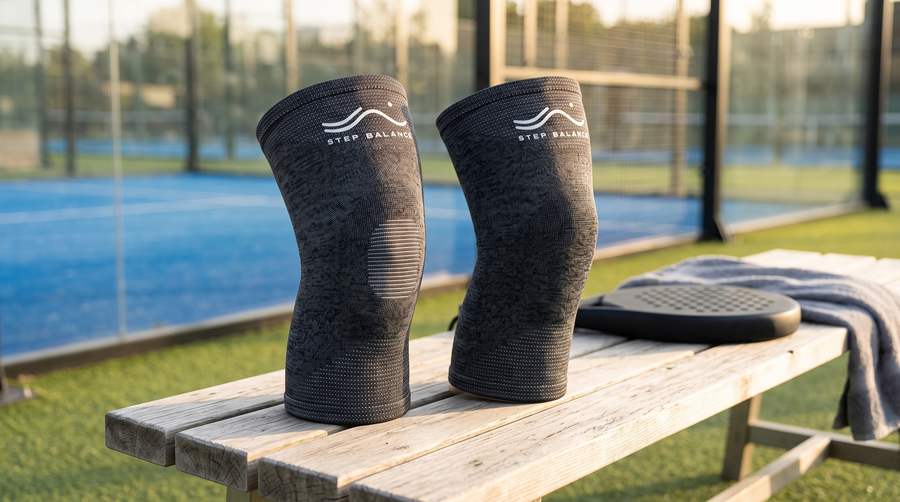
The Knee Support Sleeve is a seamless circular knit with four-way stretch and latex-free TPU bands on the inside to stop it sliding down. Sizes by circumference around the center of the knee: S 30 to 38 cm, M 38 to 47 cm, L 47 to 55 cm. The Gel Knee Support Sleeve adds a soft TPR gel ring around the kneecap for cushioning; it is made for active sport and is not designed for kneeling work. Sizes: S 30 to 40 cm, M 40 to 50 cm, L 50 to 55 cm. Both are sold as single sleeves and are hand wash only.

Frequently asked questions
Can I wear a knee sleeve all day?
Sleeves are designed for activity. If you wear one for longer, check that it stays comfortable, never causes numbness or tingling, and take it off at night [10].
Standard or gel sleeve?
Choose the standard sleeve for running, cycling, gym work and everyday activity. The gel version suits sports where you want extra cushioning around the kneecap. Neither is designed for kneeling work.
Will a sleeve prevent knee injuries?
There is no good evidence that a knit sleeve prevents injuries. What studies show is a small effect on position sense and a greater feeling of security [1][5].
Should I wear it during recovery from an injury?
Follow the advice of the professional treating you. A sleeve is not a substitute for assessment or rehabilitation.
Sources
- Ghai S, Driller M, Ghai I. Effects of joint stabilizers on proprioception and stability: a systematic review and meta-analysis. Physical Therapy in Sport. 2017;25:65-75. doi:10.1016/j.ptsp.2016.05.006
- Herrington L, Simmonds C, Hatcher J. The effect of a neoprene sleeve on knee joint position sense. Research in Sports Medicine. 2005;13(1):37-46. doi:10.1080/15438620590922077
- Van Tiggelen D, Coorevits P, Witvrouw E. The use of a neoprene knee sleeve to compensate the deficit in knee joint position sense caused by muscle fatigue. Scandinavian Journal of Medicine & Science in Sports. 2008;18(1):62-66. doi:10.1111/j.1600-0838.2007.00649.x
- Machek SB, Cardaci TD, Wilburn DT, et al. Neoprene knee sleeves of varying tightness augment barbell squat one repetition maximum performance without improving other indices of muscular strength, power, or endurance. Journal of Strength and Conditioning Research. 2021;35(Suppl 1):S6-S15. doi:10.1519/JSC.0000000000003869
- Maynart FR, Mazuquin B, Costa HS, et al. Are 7 mm neoprene knee sleeves capable of modifying the knee kinematics and kinetics during box jump and front squat exercises in healthy CrossFit practitioners? An exploratory cross-sectional study. Journal of Bodywork and Movement Therapies. 2024;40:1027-1033. doi:10.1016/j.jbmt.2024.07.032
- Hill J, Howatson G, van Someren K, Leeder J, Pedlar C. Compression garments and recovery from exercise-induced muscle damage: a meta-analysis. British Journal of Sports Medicine. 2014;48(18):1340-1346. doi:10.1136/bjsports-2013-092456
- Brown F, Gissane C, Howatson G, van Someren K, Pedlar C, Hill J. Compression garments and recovery from exercise: a meta-analysis. Sports Medicine. 2017;47(11):2245-2267. doi:10.1007/s40279-017-0728-9
- Bontemps B, Gruet M, Vercruyssen F, Louis J. Utilisation of far infrared-emitting garments for optimising performance and recovery in sport: real potential or new fad? A systematic review. PLoS One. 2021;16(5):e0251282. doi:10.1371/journal.pone.0251282
- NHS. Knee pain. nhs.uk
- Northern Care Alliance NHS Foundation Trust. Emergency and urgent care: Tubigrip. Patient leaflet. northerncarealliance.nhs.uk
About this guide. Prepared by the Step Balance Research Team, the in-house product and research group behind our insoles, compression supports and recovery tools, designed in Spain. Product details come from our own specifications; statements about knee sleeves, compression and position sense come from the studies and health-service sources listed above. This guide is for information only and does not replace advice from a healthcare professional.
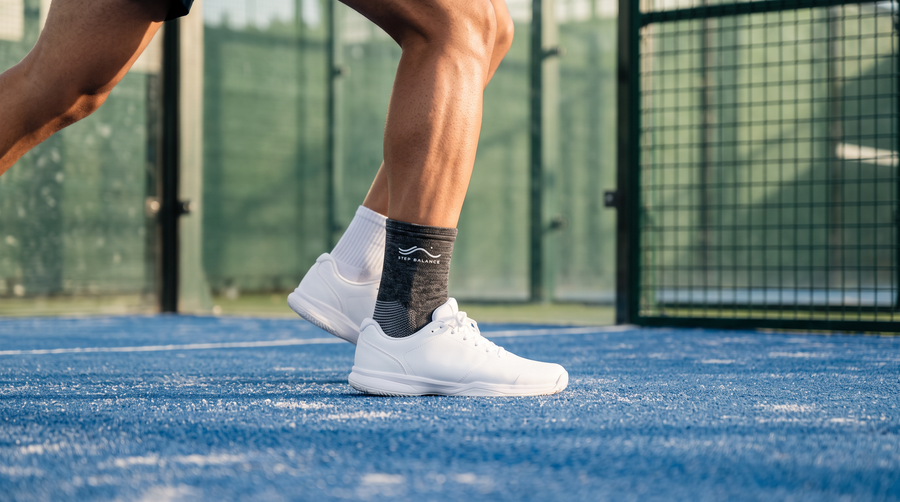
 Ankle Support Sleeve
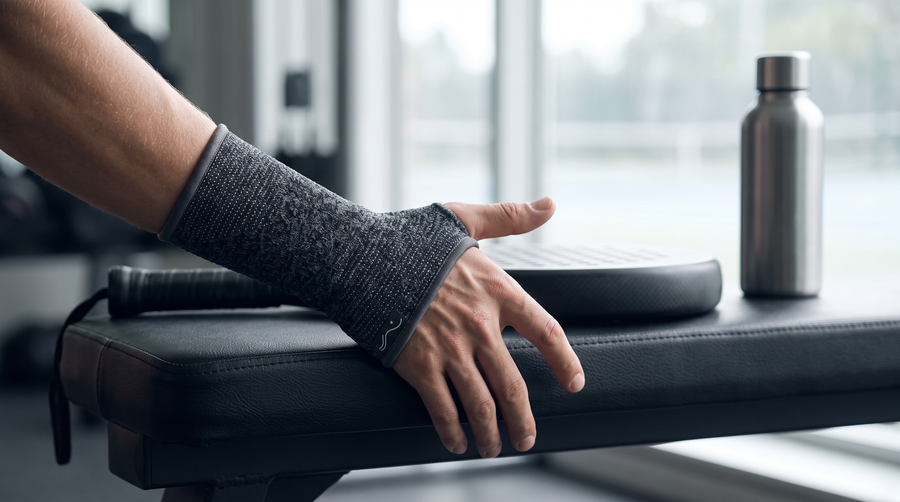
 Elbow Support Sleeve
 Gel Knee Support Sleeve
 Knee Support Sleeve