
7-minute read · By the Step Balance Research Team
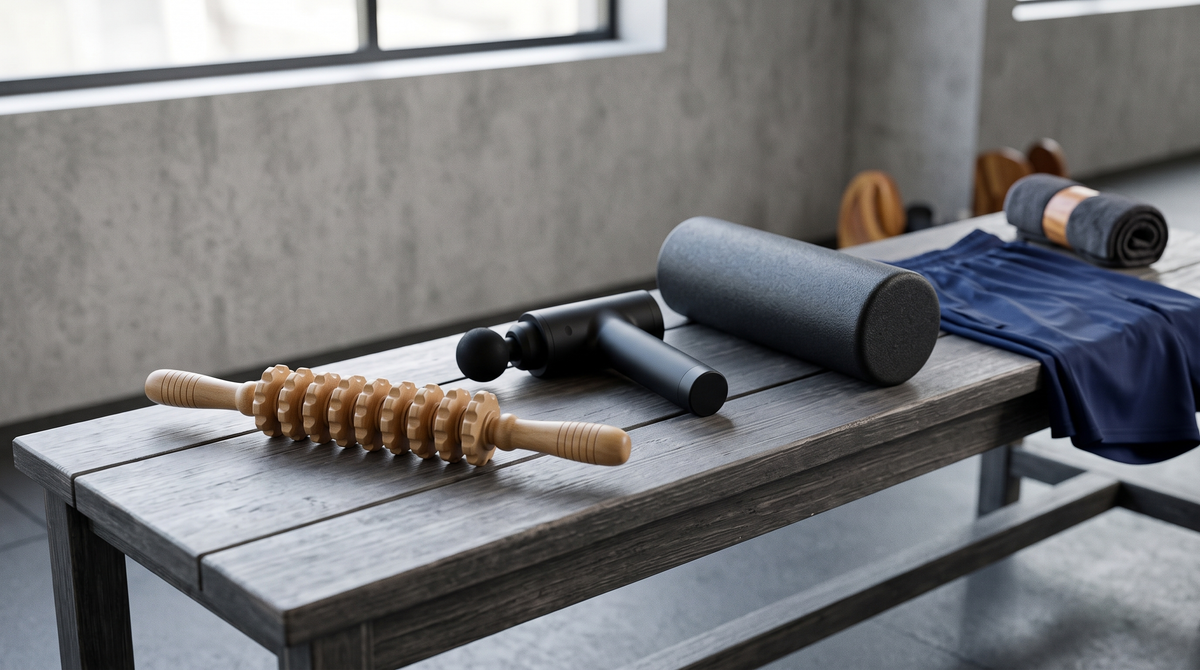
Walk into any gym and you will see all three: foam rollers by the mats, massage guns in sports bags, and massage sticks at the side of the track. They all do the same basic thing, apply pressure to a muscle, but they do it in different ways and at very different prices. This guide looks at what the research shows for each and how to choose.
In 30 seconds
- Rolling (foam roller or massage stick) has the most research. It reliably improves range of motion for a short time and can ease the feeling of soreness slightly [1][2].
- Foam roller or stick? Before exercise, the difference between them was too small to matter in practice [2].
- Massage guns have fewer, smaller studies. They can improve flexibility and some recovery measures in the short term, but did not improve, and sometimes reduced, strength, balance and explosive performance [3].
- Choose by use: a foam roller for the back and large muscles at home, a stick for quick work on the legs anywhere, a gun if you want powered, targeted work and do not mind the price, the charging or the noise.
Three tools, one idea
A foam roller uses your body weight: you lie on it and roll. A massage stick (or roller massager) uses your arms: you hold the handles and press the rollers into the muscle. A massage gun uses a motor: a head moves rapidly in and out, delivering short, repeated strikes, usually called percussion. The first two are rolling; the third is vibration and percussion.
What the research shows
Rolling: the best-studied option
A 2020 meta-analysis found that rolling produces a clear, immediate improvement in range of motion, about as much as stretching [1]. A 2019 meta-analysis of 21 studies found that rolling before exercise slightly improved sprint performance and flexibility without reducing strength, and that rolling after exercise reduced the perception of muscle pain [2]. The same analysis compared foam rollers with handheld roller massagers: before exercise, the difference was not of practical relevance [2]. Even very short bouts work: rolling the hamstrings with a handheld roller for 5 to 10 seconds increased sit-and-reach range by about 4% [4].
Massage guns: promising, but less evidence
A 2023 systematic review found only 11 studies that met its criteria, most with a moderate risk of bias [3]. Massage guns improved the flexibility of the hamstrings, calves and hip flexors in the short term, and after a fatiguing protocol they helped with stiffness, range of motion and strength. They did not improve, and in some studies reduced, strength, balance, acceleration, agility and explosive performance, so the authors did not recommend them right before those activities [3].
What none of them do
None of these tools has been shown to repair muscle faster. A 2023 meta-analysis that measured markers of muscle damage found no clear difference between rolling and doing nothing [5]. And the idea that rollers "break up" fascia or knots is not supported: the short-term effects are more likely explained by how the nervous system responds to pressure [6].

Side by side
| Foam roller | Massage stick | Massage gun | |
|---|---|---|---|
| How it works | Rolling, body weight | Rolling, arm pressure | Motorised percussion |
| Research | Most studied | Studied with foam rolling; similar effects | Fewer, smaller studies |
| Before training | Good, if there is floor space | Good, anywhere, in 1 to 3 minutes | Not recommended right before explosive sport [3] |
| Best for | Back, glutes, large leg muscles | Calves, thighs, forearms | Small, targeted areas |
| Control over pressure | By shifting your weight | Fine control with your hands | Speed settings and heads |
| Power and noise | None | None | Battery to charge; audible motor |
| Portability | Bulky | Fits in a sports bag | Compact but heavy |
| Typical cost | Low | Low | Highest of the three |
How to choose
- You want one tool for the whole body at home: a foam roller.
- You want a quick warm-up for the legs before a run or a match, anywhere: a massage stick. It is the most practical of the three at the side of a track or a court.
- You want powered, targeted work on small areas and are happy to charge it: a massage gun, used after training rather than right before explosive sport.
- Many people use two: a foam roller at home for the back and hips, and a stick in the bag for the legs.
How to use a massage stick
Before training: roll each muscle you are about to use for 30 to 60 seconds, at a steady pace and with moderate pressure, then do your usual dynamic warm-up. After training: roll each tired muscle for around 90 seconds, more slowly [7]. Pressure should be firm but comfortable, never sharp.
Avoid rolling or using a gun directly over bones, joints, the front of the neck, bruises, varicose veins, open wounds or a recent injury. If you have a circulation or clotting disorder, are pregnant, or are recovering from an injury or surgery, ask a healthcare professional first.
Our MuscleGlide
Our MuscleGlide is a massage stick with nine gear-cut rings in solid Schima hardwood that turn independently on a steel axle, so each ring follows the shape of the muscle. It is 38.4 cm long and weighs 240 g, with no batteries, no charging and no noise. For a deeper look at rolling, read Wooden roller or foam roller? What the research says.
Frequently asked questions
Is a massage gun better than a foam roller?
Not on current evidence. Rolling has more and better research behind it. Guns are convenient for small areas, but the studies are fewer and smaller [3].
Can I use a massage gun before a match?
The 2023 review did not recommend it right before strength, balance, agility or explosive activities [3]. A short rolling warm-up does not reduce strength [2][4].
Why wood?
The research compares tools by how they apply pressure, not by material, so wood is not proven to work better. It gives a firmer, more direct feel than foam, and separate rings follow the curve of the muscle.
Sources
- Wilke J, Müller AL, Giesche F, Power G, Ahmedi H, Behm DG. Acute effects of foam rolling on range of motion in healthy adults: a systematic review with multilevel meta-analysis. Sports Medicine. 2020;50(2):387-402. doi:10.1007/s40279-019-01205-7
- Wiewelhove T, Döweling A, Schneider C, et al. A meta-analysis of the effects of foam rolling on performance and recovery. Frontiers in Physiology. 2019;10:376. doi:10.3389/fphys.2019.00376
- Ferreira RM, Silva R, Vigário P, Martins PN, Casanova F, Fernandes RJ, Sampaio AR. The effects of massage guns on performance and recovery: a systematic review. Journal of Functional Morphology and Kinesiology. 2023;8(3):138. doi:10.3390/jfmk8030138
- Sullivan KM, Silvey DB, Button DC, Behm DG. Roller-massager application to the hamstrings increases sit-and-reach range of motion within five to ten seconds without performance impairments. International Journal of Sports Physical Therapy. 2013;8(3):228-236. PubMed 23772339
- Medeiros F, Martins W, Behm D, et al. Acute effects of foam roller or stick massage on indirect markers from exercise-induced muscle damage in healthy individuals: a systematic review and meta-analysis. Journal of Bodywork and Movement Therapies. 2023;35:273-283. doi:10.1016/j.jbmt.2023.04.016
- Behm DG, Wilke J. Do self-myofascial release devices release myofascia? Rolling mechanisms: a narrative review. Sports Medicine. 2019;49(8):1173-1181. doi:10.1007/s40279-019-01149-y
- Hughes GA, Ramer LM. Duration of myofascial rolling for optimal recovery, range of motion, and performance: a systematic review of the literature. International Journal of Sports Physical Therapy. 2019;14(6):845-859. PubMed 31803517
About this guide. Prepared by the Step Balance Research Team, the in-house product and research group behind our insoles, compression supports and recovery tools, designed in Spain. Product details come from our own specifications; statements about rolling, massage guns and recovery come from the peer-reviewed studies listed above. This guide is for information only and does not replace advice from a healthcare professional.
 MuscleGlide™ Wooden Recovery Stick
 ReflexRoll™ Wooden Foot Massager
 AcuNomad™ Foldable Acupressure Mat
 AcuEarth™ Acupressure Set