
6-minute read · By the Step Balance Research Team
Most padel matches start the same way: a few volleys at the net, a couple of lobs, and straight into the first game. Padel looks easy-going from the outside, but it is a sport of short sprints, sudden changes of direction, low volleys and overheads, often played by people who have spent the day at a desk. This guide looks at what padel asks of the body, what the research says about warming up and rolling, and gives you an eight-minute court-side routine with a massage stick.
In 30 seconds
- Padel loads the elbow, knees, shoulders and lower back most. A 2023 systematic review found the elbow was the most commonly injured area, followed by the knee, shoulder and lower back, mostly tendon and muscle problems [1].
- A structured warm-up beats a few casual volleys. Padel-specific trials are still missing, but in football a 20-minute warm-up programme (FIFA 11+) reduced injuries by about 39% in randomised trials [2], and programmes with strength and balance work reduce sports injuries in general [3].
- Rolling fits at the start. Rolling before exercise slightly improved sprint performance and flexibility without reducing strength [4], and as little as 5 to 10 seconds per muscle can increase range of motion [5].
- Keep static stretches short. Holding a stretch for 60 seconds or more right before play can slightly reduce performance; short holds followed by dynamic movement do not [6].
What padel asks of your body
Padel rallies are short and explosive: quick steps, split-steps, lunges for low balls, and overheads such as the bandeja, the víbora and the smash close to the glass. Reviews of the sport describe high action speed and sudden changes of direction as likely risk factors, especially for less trained players [7]. Surveys of recreational players point the same way: the elbow is consistently among the most affected areas, with the ankle, knee and shoulder close behind, and most problems come from tendon or muscle overload rather than impacts [1][8].
These studies are surveys, so they cannot prove what causes injuries. One Belgian survey even found that players who warmed up reported more injuries; one possible explanation is that players with past injuries are the ones who warm up most, and the authors call for more research before drawing conclusions [9]. A Portuguese survey found that players supervised by an instructor warmed up more consistently and had lower odds of elbow injury [8]. The honest summary: padel-specific evidence is still thin, and the clearest guidance comes from well-controlled trials in other sports.
What the research says about warming up
Structured warm-ups work, in other sports
FIFA 11+ is a 20-minute warm-up of running, strength, balance and jumping exercises. In a meta-analysis of randomised trials in recreational and sub-elite football, it reduced injuries by about 39% [2]. A broader meta-analysis of 25 trials found that strength training, balance training and combined programmes lowered sports injuries, while stretching on its own did not [3]. Padel is not football, but the principle carries over: raise your body temperature, move through the ranges you will use, and prepare your muscles for fast, loaded movements.
Where rolling fits
A 2019 meta-analysis found that rolling before exercise produced small improvements in sprint performance (about 0.7%) and flexibility (about 4%), with no meaningful effect on jump or strength performance [4]. Handheld roller massagers like a massage stick were part of those studies. In one trial, rolling the back of the thigh for just 5 to 10 seconds increased sit-and-reach range by about 4% with no loss of muscle performance [5]. Rolling is not a warm-up on its own; it is a quick way to start one.
Short holds, then movement
A systematic review of stretching found that long static stretches (60 seconds or more per muscle) right before activity can reduce performance by a few percent, while shorter holds have little effect, and dynamic stretching tends to help when it is done shortly before play [6]. That is why the routine below uses rolling and dynamic movement rather than long holds.
| Phase | What | Time |
|---|---|---|
| Raise | Easy jog around the court, side shuffles, skipping | 2 min |
| Roll | Calves, front and back of the thighs, forearms with the massage stick | 2.5 min |
| Mobilise | Leg swings, lunges with rotation, arm and wrist circles | 1.5 min |
| Prime | Split-steps, lateral lunges, shadow strokes, then easy volleys and lobs | 2 min |
The 8-minute court-side routine
Start about ten minutes before your booking so you go straight from the warm-up into the first game.
- Raise (2 minutes). Jog easily around the outside of the court, side-shuffle along the back glass, then skip with high knees. Your breathing should rise but you should still be able to talk.
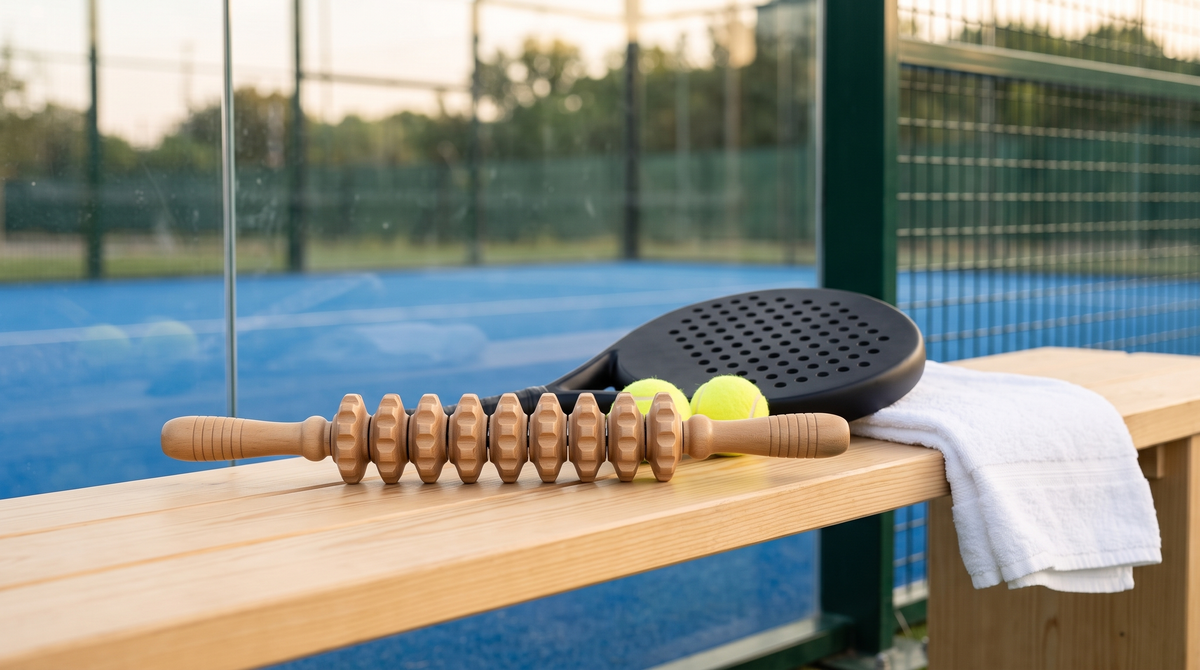
- Calves (30 seconds per leg). Sit on the bench with one heel on the ground and the leg relaxed. Hold the stick by both handles and roll from just above the ankle to just below the back of the knee.
- Thighs (15 seconds front and 15 seconds back, per leg). Roll the front of the thigh from above the kneecap to the hip, then rest the heel on the bench and roll the back of the thigh. Keep off the kneecap.
- Forearms (15 seconds per arm). Rest the forearm on your thigh, hold one handle and let the rings roll gently from the wrist to just below the elbow. Light pressure only, and keep off the elbow joint itself.
- Mobilise (90 seconds). Ten leg swings forward and back and ten side to side per leg, five walking lunges with a turn of the trunk towards the front leg on each side, ten arm circles each way and ten wrist circles each way.
- Prime (2 minutes). Ten split-steps, five lateral lunges to each side, ten shadow forehands and backhands and five shadow bandejas, then volleys and lobs with your partner, starting easy and building up.

After the match: 3 minutes
Once your breathing has settled, roll the calves (45 seconds per leg) and the front of the thighs (30 seconds per leg) more slowly, and give each forearm a few gentle passes. In the meta-analysis, rolling after exercise reduced how sore people felt and slightly lessened the drop in sprint and strength performance [4]. It does not repair anything: if something hurts, rest it and get it checked.
What to avoid
Do not roll over bones, joints, the kneecap, the elbow joint, bruises, varicose veins or a recent injury. Sharp or increasing pain is a signal to stop. If your elbow, knee or calf already hurts, rolling is not a treatment: see a physiotherapist or doctor. Protective eyewear is also worth considering: in Sweden, padel has become a leading cause of sport-related eye injuries, almost all caused by the ball [10].
Our MuscleGlide
Our MuscleGlide has nine gear-cut rings in solid Schima hardwood that turn independently on a steel axle, between two turned handles in the same wood. At 38.4 cm and 240 g it fits in a padel bag next to your racket. No batteries, no charging, no noise on court. If you play with a compression sleeve, read our guide to elbow supports for padel; for the full rolling routine before and after training, see our massage-stick routine for runners.

Frequently asked questions
How long before the match should I start?
About ten minutes. The aim is to finish the routine and go straight into the first game, while you are still warm.
Can rolling replace the warm-up?
No. Rolling is the first step; you still need movement and a few progressive strokes before playing points.
Is it OK to roll my elbow?
Roll the forearm muscles gently, never the elbow joint itself. If the elbow is already painful, get it checked before you play.
Indoor or outdoor courts?
The same routine works for both. In cold weather, add an extra minute to the raise phase.
Sources
- Dahmen J, Emanuel KS, Fontanellas-Fes A, Verhagen E, Kerkhoffs GMMJ, Pluim BM. Incidence, prevalence and nature of injuries in padel: a systematic review. BMJ Open Sport & Exercise Medicine. 2023;9(2):e001607. doi:10.1136/bmjsem-2023-001607
- Thorborg K, Krommes KK, Esteve E, Clausen MB, Bartels EM, Rathleff MS. Effect of specific exercise-based football injury prevention programmes on the overall injury rate in football: a systematic review and meta-analysis of the FIFA 11 and 11+ programmes. British Journal of Sports Medicine. 2017;51(7):562-571. doi:10.1136/bjsports-2016-097066
- Lauersen JB, Bertelsen DM, Andersen LB. The effectiveness of exercise interventions to prevent sports injuries: a systematic review and meta-analysis of randomised controlled trials. British Journal of Sports Medicine. 2014;48(11):871-877. doi:10.1136/bjsports-2013-092538
- Wiewelhove T, Döweling A, Schneider C, et al. A meta-analysis of the effects of foam rolling on performance and recovery. Frontiers in Physiology. 2019;10:376. doi:10.3389/fphys.2019.00376
- Sullivan KM, Silvey DB, Button DC, Behm DG. Roller-massager application to the hamstrings increases sit-and-reach range of motion within five to ten seconds without performance impairments. International Journal of Sports Physical Therapy. 2013;8(3):228-236. PubMed 23772339
- Behm DG, Blazevich AJ, Kay AD, McHugh M. Acute effects of muscle stretching on physical performance, range of motion, and injury incidence in healthy active individuals: a systematic review. Applied Physiology, Nutrition, and Metabolism. 2016;41(1):1-11. doi:10.1139/apnm-2015-0235
- Demeco A, de Sire A, Marotta N, et al. Match analysis, physical training, risk of injury and rehabilitation in padel: overview of the literature. International Journal of Environmental Research and Public Health. 2022;19(7):4153. doi:10.3390/ijerph19074153
- Ferreira RM, Fernandes LG, Campos LD, Gonçalves RS. Sport-related injuries in Portuguese padel practitioners and their characteristics. Medicina (Kaunas). 2025;61(9):1707. doi:10.3390/medicina61091707
- Declève P, Nourissat G, Neyens D, Cools A, Borms D. Prevalence and injury profiles for recreational padel players: a cross-sectional survey-based study. Physical Therapy in Sport. 2025;75:8-14. doi:10.1016/j.ptsp.2025.07.002
- Kasiga T, Bro T. Padel an increasing cause of sport-related eye injuries in Sweden. Acta Ophthalmologica. 2024;102(1):74-79. doi:10.1111/aos.15685
About this guide. Prepared by the Step Balance Research Team, the in-house product and research group behind our insoles, compression supports and recovery tools, designed in Spain. Product details come from our own specifications; statements about padel, warming up and rolling come from the sources listed above. This guide is for information only and does not replace advice from a healthcare professional.
 MuscleGlide™ Wooden Recovery Stick
 ReflexRoll™ Wooden Foot Massager
 AcuNomad™ Foldable Acupressure Mat
 AcuEarth™ Acupressure Set