
7-minute read · By the Step Balance Research Team
Padel, tennis and golf all ask a lot of the forearm. Every grip, every backhand and every swing passes through the muscles and tendons around the elbow. Many players reach for an elbow support, but there are two quite different kinds, and the research behind them is not the same. This guide explains what studies show about the elbow in these sports, the difference between a sleeve and a strap, and the things that matter at least as much as what you wear.
In 30 seconds
- The elbow is the most commonly reported injury site in padel studies, mostly tendon and muscle problems [1].
- Golf is not far behind. More than half of amateur golfers report an injury at some point, and the elbow is among the most affected areas [4][5].
- Sleeve and strap are different tools. Most research tests forearm straps, with low-quality evidence of short-term benefit while gripping [6][7][8]. There are no trials of knit elbow sleeves.
- Equipment and strength matter. Grip size and string tension change the load on the forearm in lab studies [9][10], and strength training reduces sports injuries overall [12].
- Seek advice if elbow pain lasts more than a few weeks, or straight away if you have numbness, tingling or a change of shape after a fall [14].
Why the elbow takes the strain
The muscles that grip a racket or club and lift the wrist attach by tendons near the elbow. In racket sports they work on every shot, often hundreds of times in a session, which is why overuse problems at the elbow are common.
In padel, a systematic review of eight studies with 2,022 players found about 3 injuries per 1,000 hours of play, with the elbow the most frequently reported site, followed by the knee, shoulder and lower back; most problems involved tendons or muscles [1]. A German study found that padel players who did not also play another racket sport had more elbow problems [2]. In tennis, overuse problems in the arm are more common in recreational players, and racket properties and grip are among the factors studied [3].
Golf is often thought of as gentle, but a meta-analysis of 20 studies with more than 9,000 golfers found a lifetime injury prevalence of 57% in amateurs and 74% in professionals [4]. In a survey of 303 UK golfers, the lower back and the elbow had the highest injury rates [5].

Sleeve or strap: two different tools
| Compression sleeve | Forearm strap | |
|---|---|---|
| What it is | A knit tube that covers the elbow | A band worn just below the elbow, over the forearm muscles |
| What it does | Even compression and warmth around the joint | Concentrated pressure on the forearm muscles |
| Research | No published trials of knit elbow sleeves | Several small trials, mostly in people with pain on the outside of the elbow |
| Best for | Comfort and warmth during play and training | Short-term use while gripping, often on professional advice |
What do the strap studies show? A Cochrane review found too few good trials to draw firm conclusions [6]. A later review of seven small crossover trials found low-quality evidence that forearm straps can reduce pain while gripping and improve pain-free grip strength straight away, but not maximum grip strength [7]. In a placebo-controlled trial with 31 people, both the real and the placebo strap groups improved, with the real strap better only for some measures [8]. The NHS lists a forearm strap or elbow brace among self-care options, alongside rest and exercise [15].
We sell a sleeve, not a strap, and we want to be clear: there is no clinical evidence that a knit elbow sleeve treats or prevents any elbow condition. What a sleeve offers is even compression, warmth and comfort during activity.
What matters as much as what you wear
Equipment
In a lab study of tennis players, a well-chosen handle size reduced grip force during strokes, and modeling suggested lower load on the wrist-extending muscles [9]. In another, 20 players simulating backhands experienced less acceleration at the elbow with lower string tension (5.6 m/s² at 200 N against 7.5 m/s² at 245 N) [10]. AAOS notes that poor stroke technique and unsuitable equipment may contribute to elbow problems, and suggests having your equipment checked [13].
Strength and technique
Exercise is the backbone of physical therapy for elbow pain: a meta-analysis of 30 trials found that exercise did better than passive treatments, although the effects were small [11]. More broadly, a meta-analysis of 25 trials with over 26,000 people found that strength training cut sports injuries to less than a third, while stretching alone had no effect [12]. A warm-up and regular forearm, wrist and shoulder strengthening are sensible habits for any racket or club sport. A lesson with a coach to check your technique can also help.

When to see a professional
The NHS advises seeing a doctor if elbow pain has not gone after a few weeks, and going to urgent care if you have severe pain and difficulty moving the arm, a snapping sound or a change of shape after an injury, or tingling or numbness [14]. If pain persists despite rest, physical therapy that includes strengthening exercises is often recommended [15].
Our elbow sleeve
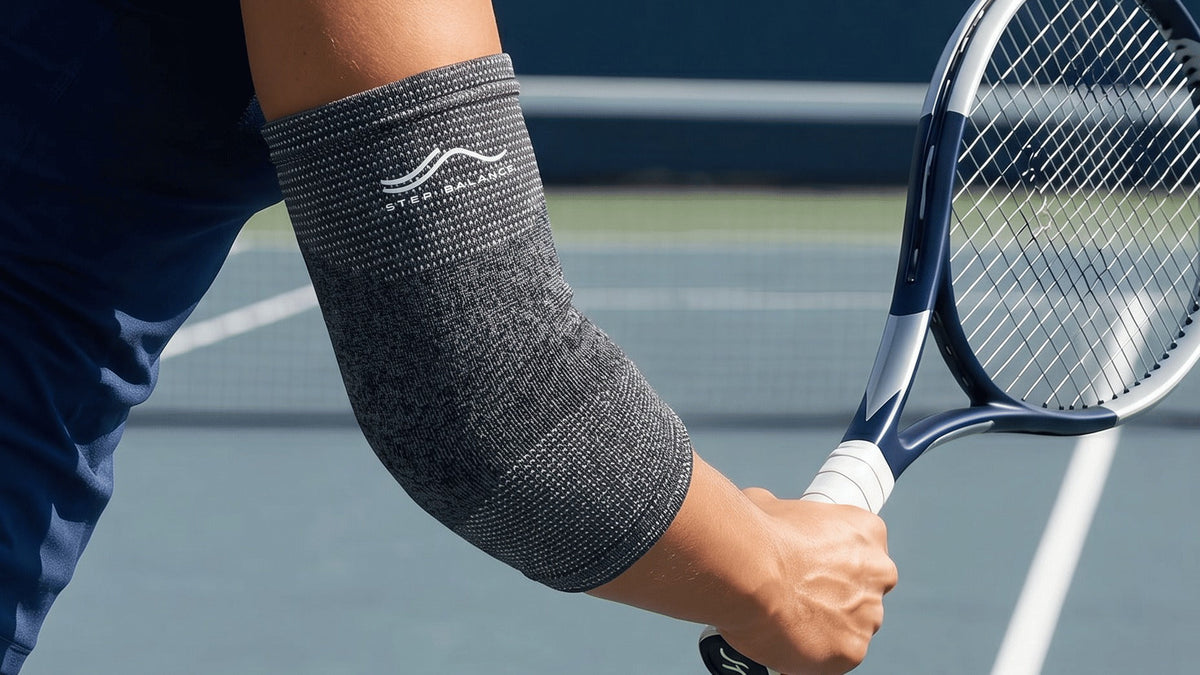
The Elbow Support Sleeve is a seamless circular knit with four-way stretch, so it gives even compression without limiting movement, and it fits either arm. Sizes by elbow circumference: S 18 to 23 cm, M 23 to 27 cm, L 27 to 34 cm; between two sizes, choose the larger. It is sold as a single sleeve and is hand wash only. Our guide on how to measure for a support shows exactly where to measure. Playing padel? See our guide to looking after your feet, knees and elbows in padel.
Frequently asked questions
Should I wear a sleeve or a strap?
They do different jobs. A sleeve is for comfort and warmth during play. If you already have pain on the outside of the elbow, get it assessed: a professional may suggest a strap as part of a wider plan [15].
Can I wear the sleeve on either arm?
Yes. It is symmetrical and fits the left or right arm.
Will a sleeve stop my elbow problems coming back?
There is no evidence that a sleeve prevents elbow problems. Strength training, a good warm-up and the right equipment are where the evidence points [9][10][12].
How tight should it be?
Snug and even, without pinching. Take it off if your hand or forearm tingles, goes numb or changes color.
Sources
- Dahmen J, Emanuel KS, Fontanellas-Fes A, Verhagen E, Kerkhoffs GMMJ, Pluim BM. Incidence, prevalence and nature of injuries in padel: a systematic review. BMJ Open Sport & Exercise Medicine. 2023;9(2):e001607. doi:10.1136/bmjsem-2023-001607
- Meyer HL, Birkner L, Polan C, et al. Injuries and overuse injuries in padel tennis: a retrospective epidemiological cross-sectional study of a level 1 trauma center in Germany. Journal of Sports Medicine and Physical Fitness. 2025;65(10):1363-1370. doi:10.23736/S0022-4707.25.16884-9
- Abrams GD, Renstrom PA, Safran MR. Epidemiology of musculoskeletal injury in the tennis player. British Journal of Sports Medicine. 2012;46(7):492-498. doi:10.1136/bjsports-2012-091164
- Williamson TR, Kay RS, Robinson PG, Murray AD, Clement ND. Epidemiology of musculoskeletal injury in professional and amateur golfers: a systematic review and meta-analysis. British Journal of Sports Medicine. 2024;58(11):606-614. doi:10.1136/bjsports-2023-107324
- Williams A, Murray A, Sorbie GG. Epidemiology of injuries in UK based golfers: a retrospective study. The Physician and Sportsmedicine. 2025;53(2):152-158. doi:10.1080/00913847.2024.2432859
- Struijs PA, Smidt N, Arola H, van Dijk CN, Buchbinder R, Assendelft WJ. Orthotic devices for the treatment of tennis elbow. Cochrane Database of Systematic Reviews. 2002;(1):CD001821. doi:10.1002/14651858.CD001821
- Heales LJ, McClintock SR, Maynard S, et al. Evaluating the immediate effect of forearm and wrist orthoses on pain and function in individuals with lateral elbow tendinopathy: a systematic review. Musculoskeletal Science and Practice. 2020;47:102147. doi:10.1016/j.msksp.2020.102147
- Kroslak M, Pirapakaran K, Murrell GAC. Counterforce bracing of lateral epicondylitis: a prospective, randomized, double-blinded, placebo-controlled clinical trial. Journal of Shoulder and Elbow Surgery. 2019;28(2):288-295. doi:10.1016/j.jse.2018.10.002
- Rossi J, Vigouroux L, Barla C, Berton E. Potential effects of racket grip size on lateral epicondilalgy risks. Scandinavian Journal of Medicine & Science in Sports. 2014;24(6):e462-e470. doi:10.1111/sms.12204
- Mohandhas BR, Makaram N, Drew TS, Wang W, Arnold GP, Abboud RJ. Racquet string tension directly affects force experienced at the elbow: implications for the development of lateral epicondylitis in tennis players. Shoulder & Elbow. 2016;8(3):184-191. doi:10.1177/1758573216640201
- Karanasios S, Korakakis V, Whiteley R, Vasilogeorgis I, Woodbridge S, Gioftsos G. Exercise interventions in lateral elbow tendinopathy have better outcomes than passive interventions, but the effects are small: a systematic review and meta-analysis of 2123 subjects in 30 trials. British Journal of Sports Medicine. 2021;55(9):477-485. doi:10.1136/bjsports-2020-102525
- Lauersen JB, Bertelsen DM, Andersen LB. The effectiveness of exercise interventions to prevent sports injuries: a systematic review and meta-analysis of randomised controlled trials. British Journal of Sports Medicine. 2014;48(11):871-877. doi:10.1136/bjsports-2013-092538
- American Academy of Orthopaedic Surgeons. Tennis elbow (lateral epicondylitis). OrthoInfo. orthoinfo.aaos.org
- NHS. Elbow and arm pain. nhs.uk
- NHS. Tennis elbow. nhs.uk
About this guide. Prepared by the Step Balance Research Team, the in-house product and research group behind our insoles, compression supports and recovery tools, designed in Spain. Product details come from our own specifications; statements about elbow injuries in racket and club sports, supports and exercise come from the studies and health-service sources listed above. This guide is for information only and does not replace advice from a healthcare professional.
 Ankle Support Sleeve
 Elbow Support Sleeve
 Gel Knee Support Sleeve
 Knee Support Sleeve