
6-minute read · By the Step Balance Research Team
After a long day on your feet, or a long day sitting with them tucked under a desk, feet often feel tight and heavy. A few minutes of simple movement can make them feel better. This guide gives you a five-minute routine you can do seated, explains what the research says about each part of it, and is honest about what a routine like this can and cannot do.
In 30 seconds
- Rolling the sole is a simple self-care step included in NHS exercise leaflets: 1 to 2 minutes per foot [8].
- Short-term effects are real but small. In one small trial, two minutes of rolling each sole slightly improved a forward-reach flexibility test straight afterwards [1].
- Calves matter too. Rolling the calf improved ankle range of motion about as much as stretching, without reducing strength [2][3].
- Strong feet need training, not only support. Foot exercises done most days for 8 weeks increased foot muscle size and strength [6].
- Diabetes or numb feet? Check your feet daily [10] and ask a professional before using pressure tools.
The 5-minute routine
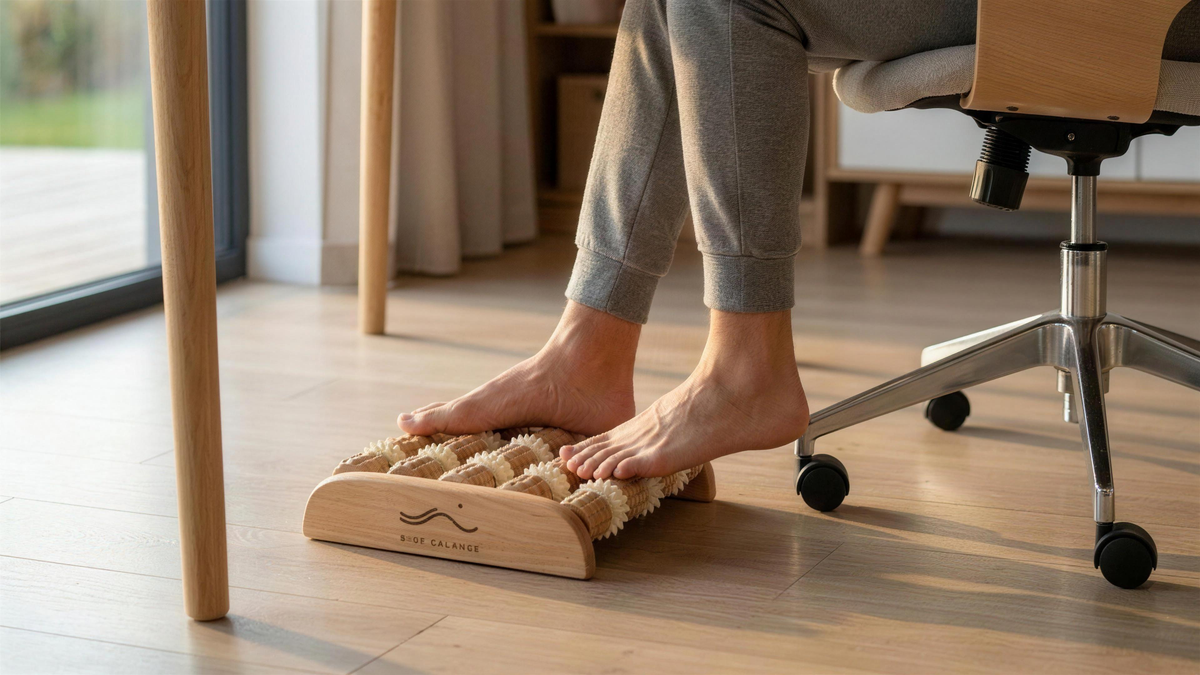
Sit on a chair with your feet flat on the floor. Use moderate pressure throughout: firm enough to feel, never painful.
| Time | What to do | How |
|---|---|---|
| 0:00 to 2:00 | Roll the soles | Roll each foot slowly from heel to toes over a foot roller or a ball. With a two-channel roller you can do both feet at once [1][8]. |
| 2:00 to 3:00 | Ankle circles and toe spreads | Lift one foot and draw 10 slow circles each way, then spread and relax the toes. Repeat on the other side [8]. |
| 3:00 to 4:00 | Towel scrunches | Place a small towel under one foot and scrunch it toward you with your toes: 10 times per foot [8]. |
| 4:00 to 5:00 | Calves | Roll each calf for 30 seconds with a handheld roller, or hold a wall calf stretch for 30 seconds per leg [2][8]. |
Do it at the end of the working day, after a long walk, or whenever your feet feel tired. Start gently, and stop any step that causes pain.

What the research says
Rolling the sole
In a small randomized trial with 24 healthy adults, rolling a ball under each foot for two minutes increased the reach in a sit-and-reach test by 2.4 cm, against 0.8 cm in people who sat still [1]. It was one session, measured immediately, without a placebo, so it shows a small, short-term change rather than a lasting effect. NHS physical therapy leaflets include rolling the sole over a ball or bottle for 1 to 2 minutes as part of daily foot exercises [8].
Calves and ankles
Tight calves limit how far the ankle bends. In 14 trained adults, three 30-second bouts with a handheld roller on the calf increased ankle range of motion by about 4%, similar to static stretching, and did not reduce strength [2]. Across 26 trials, rolling improved range of motion in the short term compared with doing nothing, and was about as effective as stretching [3]. Calf stretching gives small gains of about 2 to 3 degrees in ankle bend [4]. Small, but enough to feel looser.
Strength, not only support
The small muscles inside the foot help shape and stabilize the arch, and researchers have argued that they deserve training rather than only external support [5]. In a trial with 57 runners, progressive foot exercises done at least five days a week for eight weeks increased foot muscle size and strength [6]. In another trial with 118 recreational runners, those who did an eight-week foot strengthening program were less likely to report a running injury over the following year [7]. Those were structured programs, not a five-minute routine, but towel scrunches and toe exercises are a good place to start.
An honest note: no study has tested this exact routine, and none has tested our products. Rolling does not "release" fascia, detox the body or act on other organs through the feet. What a short routine offers is movement, a change of position and a few minutes of attention to feet that work hard all day.
Who should be careful
- Diabetes, numbness or poor circulation in the feet: check your feet every day for damage [10] and ask your healthcare team before using pressure tools.
- Pain that lasts: if foot pain lasts more than three weeks, or comes with tingling or numbness, see a podiatrist [9].
- Do not roll over cuts, blisters, bruises, swelling or a recent injury.
Our tools for the routine
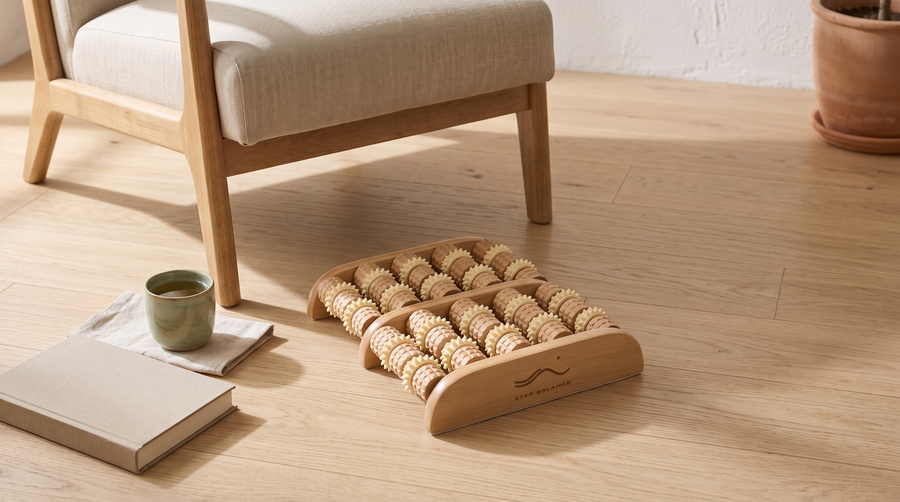
The ReflexRoll is a wooden foot roller with 50 rollers in two textures: 25 in smooth Schima hardwood and 25 with TPR nubs for firmer pressure. Two roller channels let you use one foot or both, and a rubber base keeps it steady on the floor; it is 29 cm long and made for seated use. For the calves, the MuscleGlide handheld roller has nine wooden rings that turn independently, so you set the pressure with your hands. How does a handheld roller compare with a foam roller? Read our guide.

Frequently asked questions
How often can I do the routine?
Once or twice a day is fine for most people. Keep the pressure moderate and skip any step that hurts.
Smooth or nubbed rollers?
Start with the smooth rollers. Move to the nubbed side once you are used to the pressure, or use one foot on each.
Can I roll my feet standing up?
You can, but seated is easier to control, because your body weight is not pressing down on the roller.
Will this fix my foot problem?
A routine like this is about comfort and movement. If you have pain that lasts, see a podiatrist or doctor [9].
Sources
- Grieve R, Goodwin F, Alfaki M, Bourton AJ, Jeffries C, Scott H. The immediate effect of bilateral self myofascial release on the plantar surface of the feet on hamstring and lumbar spine flexibility: a pilot randomised controlled trial. Journal of Bodywork and Movement Therapies. 2015;19(3):544-552. doi:10.1016/j.jbmt.2014.12.004
- Halperin I, Aboodarda SJ, Button DC, Andersen LL, Behm DG. Roller massager improves range of motion of plantar flexor muscles without subsequent decreases in force parameters. International Journal of Sports Physical Therapy. 2014;9(1):92-102. PubMed 24567860
- Wilke J, Müller AL, Giesche F, Power G, Ahmedi H, Behm DG. Acute effects of foam rolling on range of motion in healthy adults: a systematic review with multilevel meta-analysis. Sports Medicine. 2020;50(2):387-402. doi:10.1007/s40279-019-01205-7
- Radford JA, Burns J, Buchbinder R, Landorf KB, Cook C. Does stretching increase ankle dorsiflexion range of motion? A systematic review. British Journal of Sports Medicine. 2006;40(10):870-875. doi:10.1136/bjsm.2006.029348
- McKeon PO, Hertel J, Bramble D, Davis I. The foot core system: a new paradigm for understanding intrinsic foot muscle function. British Journal of Sports Medicine. 2015;49(5):290. doi:10.1136/bjsports-2013-092690
- Ridge ST, Olsen MT, Bruening DA, et al. Walking in minimalist shoes is effective for strengthening foot muscles. Medicine and Science in Sports and Exercise. 2019;51(1):104-113. doi:10.1249/MSS.0000000000001751
- Taddei UT, Matias AB, Duarte M, Sacco ICN. Foot core training to prevent running-related injuries: a survival analysis of a single-blind, randomized controlled trial. American Journal of Sports Medicine. 2020;48(14):3610-3619. doi:10.1177/0363546520969205
- United Lincolnshire Hospitals NHS Trust. Plantar fasciitis exercises. Patient information. ulh.nhs.uk
- Royal College of Podiatry. Sore feet. rcpod.org.uk
- Mersey Care NHS Foundation Trust. Footcare advice for people with diabetes. merseycare.nhs.uk
About this guide. Prepared by the Step Balance Research Team, the in-house product and research group behind our insoles, compression supports and recovery tools, designed in Spain. Product details come from our own specifications; statements about foot rolling, stretching and foot strengthening come from the studies and health-service sources listed above. This guide is for information only and does not replace advice from a healthcare professional.
 MuscleGlide™ Wooden Recovery Stick
 ReflexRoll™ Wooden Foot Massager
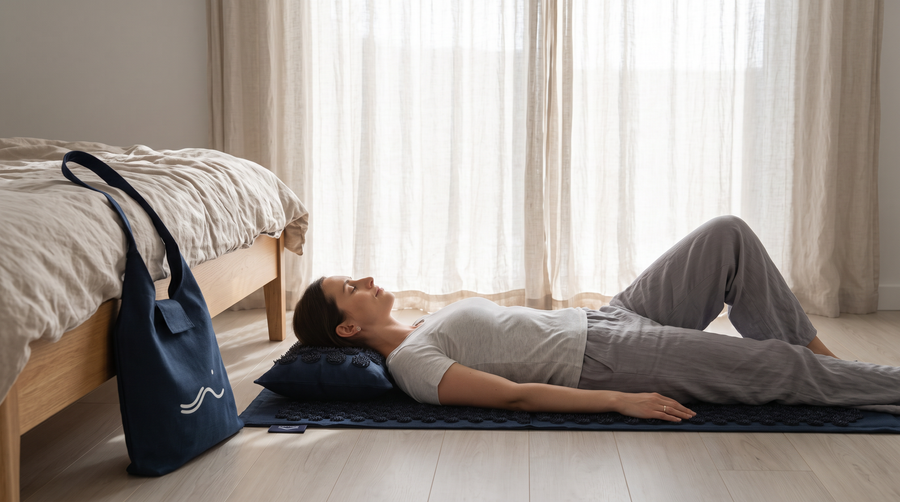
 AcuNomad™ Foldable Acupressure Mat
 AcuEarth™ Acupressure Set