
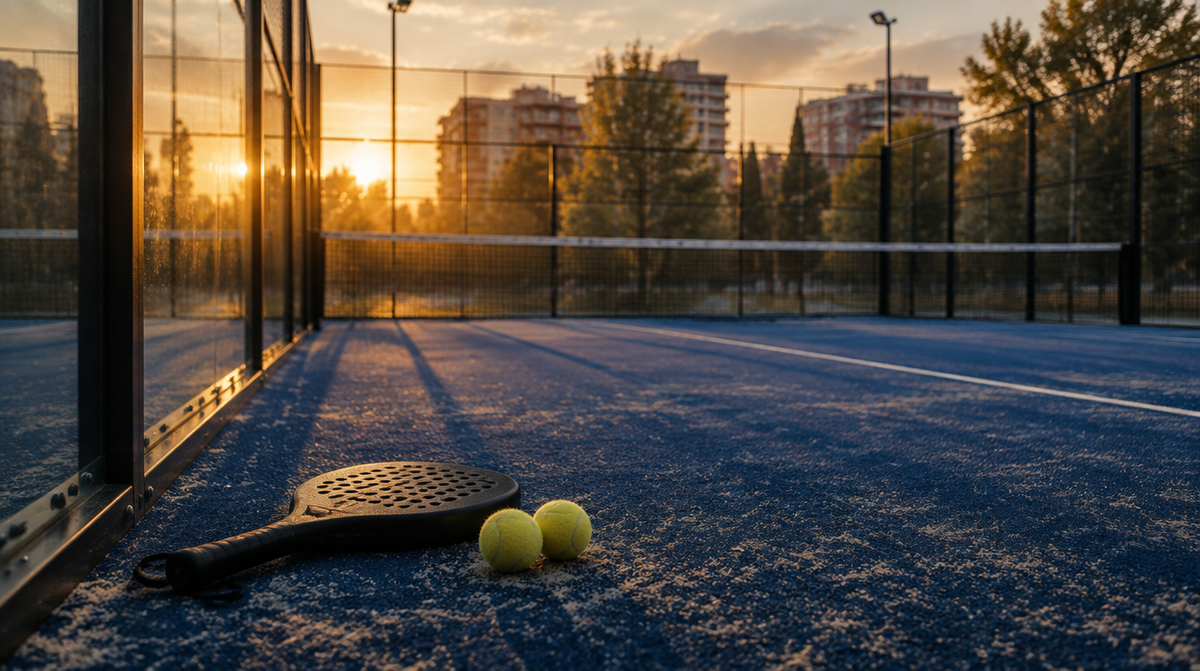
8-minute read · By the Step Balance Research Team
Padel has become one of Spain's favorite sports. In 2022, about 9% of people aged 15 and over had played it in the previous year, and among people who did any sport the figure was almost 16% [1]. Federation licenses passed 109,000 in 2024 [2]. It is sociable and easy to start, but it asks a lot of three areas in particular: the feet and lower legs, the knees and the elbow. This guide brings together what the research says about padel injuries and the habits most likely to keep you on court.
In 30 seconds
- Injuries are common. Studies report about 3 to 4 injuries per 1,000 hours of play, mostly tendon and muscle problems [3][4][5][6].
- The elbow tops the list in reviews, while the lower limbs, from the knee down, make up the largest share in several recent surveys [3][4][5].
- Volume and equipment are linked to injuries, including playing hours, racket weight and shape, sole pattern and court type, although surveys cannot prove cause and effect [7][8].
- Strength and balance training work. In sport in general, strength training cut injuries to less than a third, while stretching alone did not help [10].
- Warm up with purpose. A structured warm-up reduced injuries by 39% in soccer [11]; no padel-specific trial exists yet.
What the studies show
A systematic review of eight studies with 2,022 padel players found about 3 injuries per 1,000 hours of training and 8 per 1,000 matches. The elbow was the most frequently reported site, followed by the knee, shoulder and lower back, and most problems involved tendons or muscles [3]. Recent surveys add detail. In 457 Belgian recreational players, 36.5% had been injured in the past year, at 2.8 injuries per 1,000 hours, and lower-limb injuries were the largest group at 53.5% [4]. In 234 German players, the rate was 4.0 per 1,000 hours, with the lower leg, ankle and foot most affected overall, and the knee the most common site in recreational players [5]. In Portugal, the elbow (18%), ankle (17%) and knee (13%) led the list, and players often attributed their injuries to fatigue or overload [6].
Most of this evidence comes from questionnaires, which rely on memory and cannot show what causes what. Still, the pattern is consistent: padel loads the elbow through the racket and the legs through constant accelerations, braking and lunges. Professional players make around 400 accelerations per hour of play [9].
What is linked to injuries
Surveys have found associations between injuries and playing hours and experience, racket characteristics such as weight and shape, sole pattern, and playing on sand-filled courts [7][8]. In Portugal, higher body mass index was linked to more injuries, while playing under an instructor's supervision was linked to doing a warm-up and to fewer elbow injuries [6]. One Belgian study even found that players who warmed up reported more injuries, most likely because people who have been injured before are the ones who warm up [4]. These are associations, not proof, but they point to the same practical levers: how much you play, what you play with and how you prepare.
Feet and lower legs
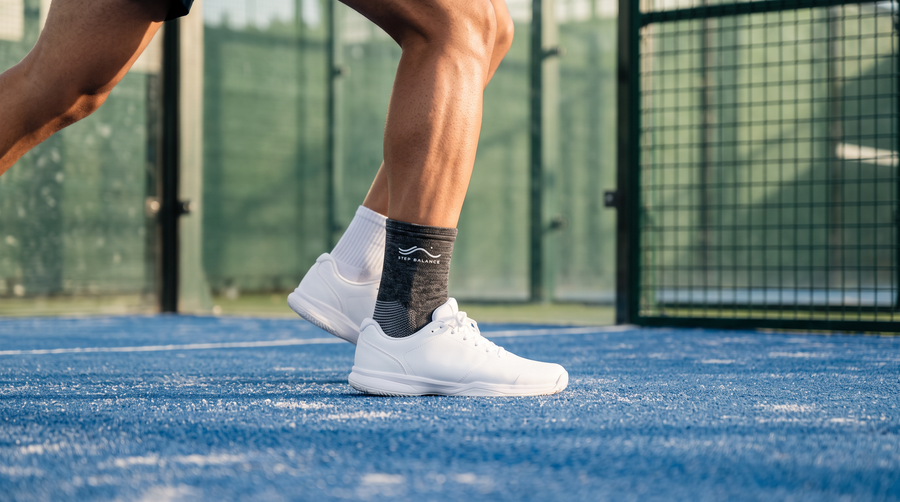
- Wear a court shoe. AAOS recommends a sport-specific shoe if you play more than twice a week, and notes that court shoes are designed for stability in all directions [12]. Choose a sole made for artificial grass with sand, and replace shoes when the tread wears smooth.
- Fit the insole properly. If you use a sports insole, replace the factory one rather than stacking them, and check that your heel stays put when you stop sharply. Our guide to insoles for running and padel explains what to look for.
- Prepare the calves and ankles. Include calf raises and quick footwork in your warm-up, before the first hard sprint to the net.

Knees
- Build strength and balance. Across 25 trials with more than 26,000 people, strength training reduced sports injuries to less than a third and balance training also helped, while stretching alone had no effect [10]. Two short sessions a week of squats, lunges, step-ups and single-leg balance work are a sensible base.
- Warm up with movement, not just a few gentle rallies. The FIFA 11+ warm-up, which combines running, strength, jumping and balance exercises, reduced soccer injuries by 39% [11]. No equivalent trial exists for padel, but the same principles apply.
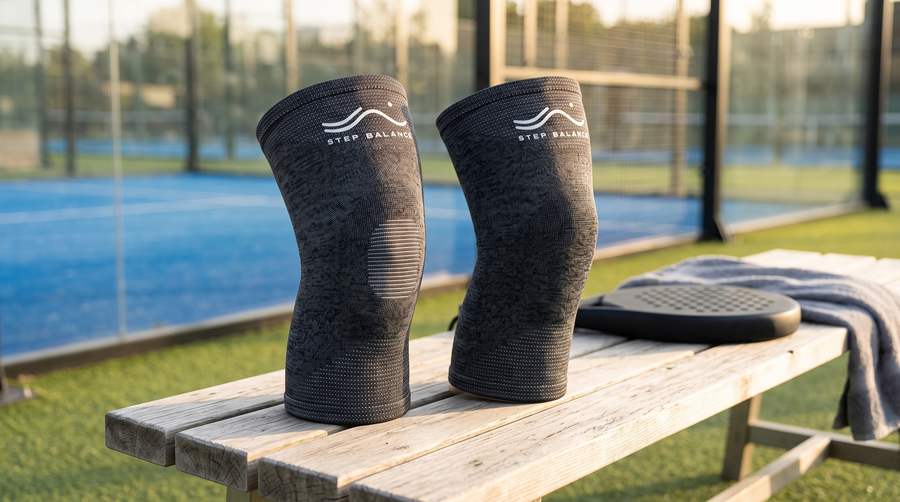
- A knee sleeve is for comfort. It gives compression, warmth and a feeling of security, but it is not a brace. Our guide on what knee sleeves do and don't do explains the evidence.

Elbows
- Check your racket. Surveys have linked racket weight and shape with injuries [7][8]. If your elbow complains, ask your coach or store about a lighter or more forgiving racket and the right grip size.
- Train the forearm, wrist and shoulder as part of your strength work.
- Work on technique. A few lessons with a coach can help you hit more cleanly and with less effort from the arm.
- Understand supports. A compression sleeve and a forearm strap are different tools. Our guide to elbow support for padel, tennis and golf explains the research.
A 10-minute padel warm-up
| Minutes | What to do |
|---|---|
| 0 to 3 | Easy jogging around the court, side steps and backwards steps |
| 3 to 5 | Leg swings, hip circles, arm circles and trunk rotations |
| 5 to 8 | 10 squats, 5 lunges per leg, 15 calf raises, wrist and forearm circles, a few short accelerations |
| 8 to 10 | Progressive rallies: volleys, then groundstrokes, then a few overheads |
This routine follows the principles of tested warm-ups in other sports [11]; it has not been tested in padel. After playing, a few minutes of easy movement and, if you like, rolling the calves and thighs, help you finish the session in a calm way. Our guide on wooden and foam rollers covers what rolling can and cannot do.
When to stop and get advice
Stop playing if you feel a sudden sharp pain, a pop or a snap, or if you cannot put weight on a leg. See a doctor or physical therapist if pain lasts more than a couple of weeks, keeps coming back when you play, or comes with swelling, numbness or tingling.
Our products for padel players
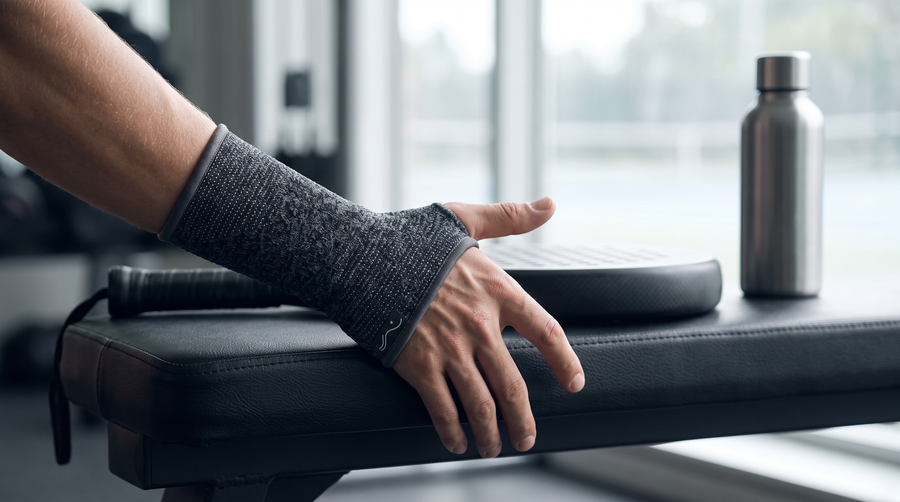
For the feet, Sports Performance insoles fit in court shoes, with heel and forefoot pads and a base that resists twisting. For comfort and warmth during play, the Knee Support Sleeve, Elbow Support Sleeve and Wrist Support Sleeve are seamless knits sized by circumference. After the match, the MuscleGlide roller fits in your padel bag. None of them prevents injuries; good preparation does most of the work.
Frequently asked questions
I am over 40. Am I more at risk?
Not necessarily. One Belgian survey linked age over 30 with injuries [4], but age has not been a consistent risk factor across studies. Strength training, a proper warm-up and gradual increases in playing time matter at any age.
How much padel is too much?
Several surveys link more playing hours with more injuries [7][8]. Increase your playing time gradually, and leave time for recovery between hard sessions.
Do padel shoes prevent injuries?
There is no proof that any shoe prevents injuries. A court shoe that fits well and suits the surface gives you stability for side-to-side movement [12].
Is stretching enough as a warm-up?
On its own, stretching did not reduce sports injuries in trials [10]. A warm-up with movement, strength and balance exercises is a better choice.
Sources
- Ministerio de Cultura y Deporte, Consejo Superior de Deportes. Encuesta de Hábitos Deportivos en España 2022: síntesis de resultados. educacionfpydeportes.gob.es
- Ministerio de Educación, Formación Profesional y Deportes, Consejo Superior de Deportes. Estadística de Deporte Federado 2024. educacionfpydeportes.gob.es
- Dahmen J, Emanuel KS, Fontanellas-Fes A, Verhagen E, Kerkhoffs GMMJ, Pluim BM. Incidence, prevalence and nature of injuries in padel: a systematic review. BMJ Open Sport & Exercise Medicine. 2023;9(2):e001607. doi:10.1136/bmjsem-2023-001607
- Declève P, Nourissat G, Neyens D, Cools A, Borms D. Prevalence and injury profiles for recreational padel players: a cross-sectional survey-based study. Physical Therapy in Sport. 2025;75:8-14. doi:10.1016/j.ptsp.2025.07.002
- Meyer HL, Birkner L, Polan C, et al. Injuries and overuse injuries in padel tennis: a retrospective epidemiological cross-sectional study of a level 1 trauma center in Germany. Journal of Sports Medicine and Physical Fitness. 2025;65(10):1363-1370. doi:10.23736/S0022-4707.25.16884-9
- Ferreira RM, Fernandes LG, Campos LD, Gonçalves RS. Sport-related injuries in Portuguese padel practitioners and their characteristics. Medicina. 2025;61(9):1707. doi:10.3390/medicina61091707
- Muñoz D, Coronado M, Robles-Gil MC, Martín M, Escudero-Tena A. Incidence of upper body injuries in amateur padel players. International Journal of Environmental Research and Public Health. 2022;19(24):16858. doi:10.3390/ijerph192416858
- Rocamora-López G, Mateo-Orcajada A. Analysis of differences in injuries in padel players according to sport-specific factors, level of physical activity, adherence to the Mediterranean diet, and psychological status. Sports. 2025;13(7):228. doi:10.3390/sports13070228
- Miralles R, Martínez-Gallego R, Guzmán J, Ramón-Llin J. Movement patterns and player load: insights from professional padel. Biology of Sport. 2025;42(1):163-169. doi:10.5114/biolsport.2025.139856
- Lauersen JB, Bertelsen DM, Andersen LB. The effectiveness of exercise interventions to prevent sports injuries: a systematic review and meta-analysis of randomised controlled trials. British Journal of Sports Medicine. 2014;48(11):871-877. doi:10.1136/bjsports-2013-092538
- Thorborg K, Krommes KK, Esteve E, Clausen MB, Bartels EM, Rathleff MS. Effect of specific exercise-based football injury prevention programmes on the overall injury rate in football: a systematic review and meta-analysis of the FIFA 11 and 11+ programmes. British Journal of Sports Medicine. 2017;51(7):562-571. doi:10.1136/bjsports-2016-097066
- American Academy of Orthopaedic Surgeons. Athletic shoes. OrthoInfo. orthoinfo.aaos.org
About this guide. Prepared by the Step Balance Research Team, the in-house product and research group behind our insoles, compression supports and recovery tools, designed in Spain. Product details come from our own specifications; statements about padel participation, injuries and injury prevention come from the studies and health-service sources listed above. This guide is for information only and does not replace advice from a healthcare professional.
 Ankle Support Sleeve
 Elbow Support Sleeve
 Gel Knee Support Sleeve
 Knee Support Sleeve